ABOUT CHINESE EMBROIDERY INSTITUTE

A Living Art of Silk, Thread, and Cultural Memory

Chinese Embroidery Institute is an independently operated professional institution focused on Chinese embroidery, related woven-textile traditions, and kesi. In China, it uses the name 北京邵晓琤织绣研究院. Its work combines long-term hand practice with research, publishing, teaching, conservation and restoration, public education, and cross-cultural exchange.

CEI-Chinese Embroidery Institute

Our Mission

Chinese embroidery is not only a set of stitches or a decorative surface. It is a system of knowledge shaped by materials, techniques, imagery, historical contexts, aesthetic judgment, hand practice, and cultural memory.

Our mission is to document how Chinese embroidery, related woven-textile traditions, and kesi are made, understood, taught, conserved, and restored, and to make this knowledge accessible through publication, education, and carefully defined project work.

• Source-led research into Chinese embroidery history, materials, stitches, structures, imagery, and regional traditions
• Teaching grounded in hand practice, materials, stitches, and image interpretation
• Documentation, preservation awareness, and cross-cultural exchange for public and institutional audiences

What We Do

Our work connects research, long-term practice, publication, teaching, conservation and restoration, and public interpretation. Each activity is defined according to the evidence, object, and expertise required.

Research & Documentation

We study Chinese embroidery, related woven-textile traditions, and kesi through historical objects, regional traditions, stitch and textile structures, materials, imagery, documents, and cultural contexts. The research connects textual and visual evidence with close observation and sustained hand practice.

Teaching & Courses

Our courses guide learners through published sources, materials, thread handling, stitch techniques, image interpretation, and disciplined hand practice. Teaching focuses on traditional Chinese hand embroidery rather than machine embroidery or general garment construction.

Conservation, Restoration, Reconstruction, and Reproduction

Chinese Embroidery Institute independently undertakes the assessment, treatment planning, emergency stabilization, conservation and restoration, research-based reconstruction and reproduction, and documentation of Chinese embroidery and related textiles. Each project begins with an assessment of the object’s condition, materials, stitch and textile structures, cultural context, available records, and intended purpose.

Observation, treatment, reconstruction, and reproduction are documented as distinct forms of work.

For especially difficult conservation and reproduction problems, institutions including the Palace Museum, the National Museum of China, and Beijing Institute of Fashion Technology have turned to the Institute for specialist solutions.

Selected Restoration Experience

Chinese Embroidery Institute independently carried out emergency stabilization and conservation treatment for a privately held Japanese raised-embroidery screen traditionally associated with the Edo period.

Chinese embroidery artwork depicting a landscape with mountains and trees

Why Chinese Embroidery Matters Today

Chinese embroidery carries a long conversation between silk, thread, imagery, hand discipline, regional memory, and cultural meaning. Studying it today shows how traditional knowledge can continue through teaching, conservation and restoration, artistic practice, publication, public education, and cultural exchange.

• A living tradition shaped by material, image, and hand practice
• A cultural language connected with regional memory and historical continuity
• A field for teaching, preservation awareness, and contemporary cultural work

Long-Term Practice and Intergenerational Work

Chinese Embroidery Institute grows from Shao Xiaocheng’s long-term research, hand practice, teaching, publication, and artistic work in traditional Chinese embroidery.

Shao Xiaocheng wrote the 2014 English-language book Chinese Embroidery: An Illustrated Stitch Guide, which covers embroidery history, tools and materials, stitches, practical and artistic projects, and approaches to selection and care.

Yao Xiao (Martin Xiao) served as responsible editor for Shao Xiaocheng’s The Illustrated Art of Embroidery (《图说刺绣艺术》). He also contributes research, writing, editorial development, visual documentation, digital publishing, and English-language presentation. A public bibliographic record lists him as the sole author of 中国历代刺绣缂丝鉴赏与投资 (2012), and Shanghai Scientific & Technical Publishers lists Shao Xiaocheng and Xiao Yao as authors of 中国刺绣经典针法图典:跟着大师学刺绣 (2022).

Together, their work connects traditional hand knowledge with research, publication, documentation, teaching, and international communication.

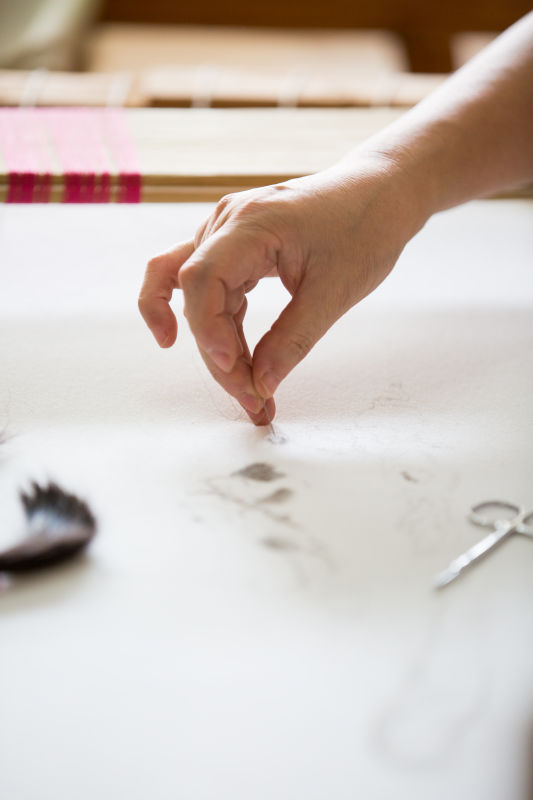
Shao Xiaocheng working on traditional Chinese embroidery in the studio

Start a Conversation with the Institute

Whether you would like to study Chinese embroidery, discuss a conservation, restoration, reconstruction, or object-focused research project, request bilingual documentation, review publications, or develop a public education or cross-cultural exchange program, you are welcome to contact the institute.