The Digital Museum of Chinese Embroidery is the Chinese Embroidery Institute’s visual archive of embroidery works, materials, studio practice, exhibitions and cultural records. Each entry below gives the facts recorded by the Institute: date, technique, exhibition and present collection where known.
Selected works by Shao Xiaocheng
| Year | Work | Technique | Record |
|---|---|---|---|
| 1996 | 簪花仕女图 (Ladies Wearing Flowers) | Beijing art embroidery | Private collection, Germany |
| 2000 | 娄师白画牵牛花 (Morning Glories after Lou Shibai) | Embroidery | Shown at the 6th China Art Festival; catalogued in 中国当代工艺美术精品集 (Jiangsu Fine Arts Publishing House) |
| 2002 | 花篮 (Flower Basket) | Gold couching (盘金绣) | Private collection, Beijing; illustrated in Chinese Embroidery: An Illustrated Stitch Guide |
| 2003 | 米芾书法研山铭 (Mi Fu’s Yanshan Inscription) | Beijing embroidery | Bronze Crafts Cup award, 1st Beijing Arts and Crafts Biennale; catalogued in 中国刺绣鉴赏宝典 |
| 2006 | 清明上河图·虹桥段 (Along the River during Qingming, Rainbow Bridge section) | Embroidery | Private collection, Taiwan |
| 2009 | 梧桐绶带图 (Chinese Parasol and Paradise Flycatcher) | Embroidery | Shown at the National Art Museum of China, arts and crafts exhibition for the 60th anniversary of the PRC |
| 2016 | 大千画·绿度母 (Green Tara after Zhang Daqian) | Beijing art embroidery | 3rd China Contemporary Arts and Crafts Biennale, National Museum of China |
| 2018 | 锦绣年华 (Splendid Years) | Jingji embroidery | 4th China Contemporary Arts and Crafts Biennale, National Museum of China; reserved for acquisition by the China Arts and Crafts Museum |
| — | 白度母 (White Tara) | Jingji embroidery | — |
| — | 蓝鹊枇杷图 (Blue Magpie and Loquat) | Embroidery | — |
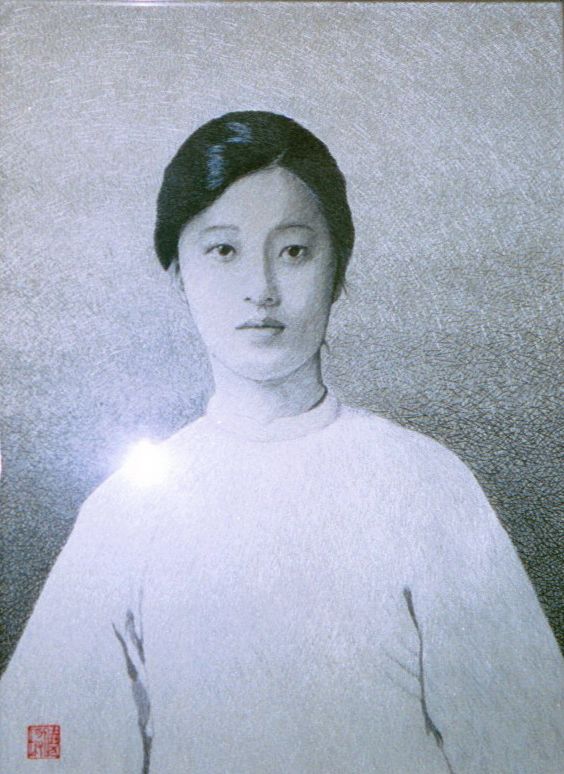
| — | Female Figure | Simulation embroidery | — |
Historical and study objects
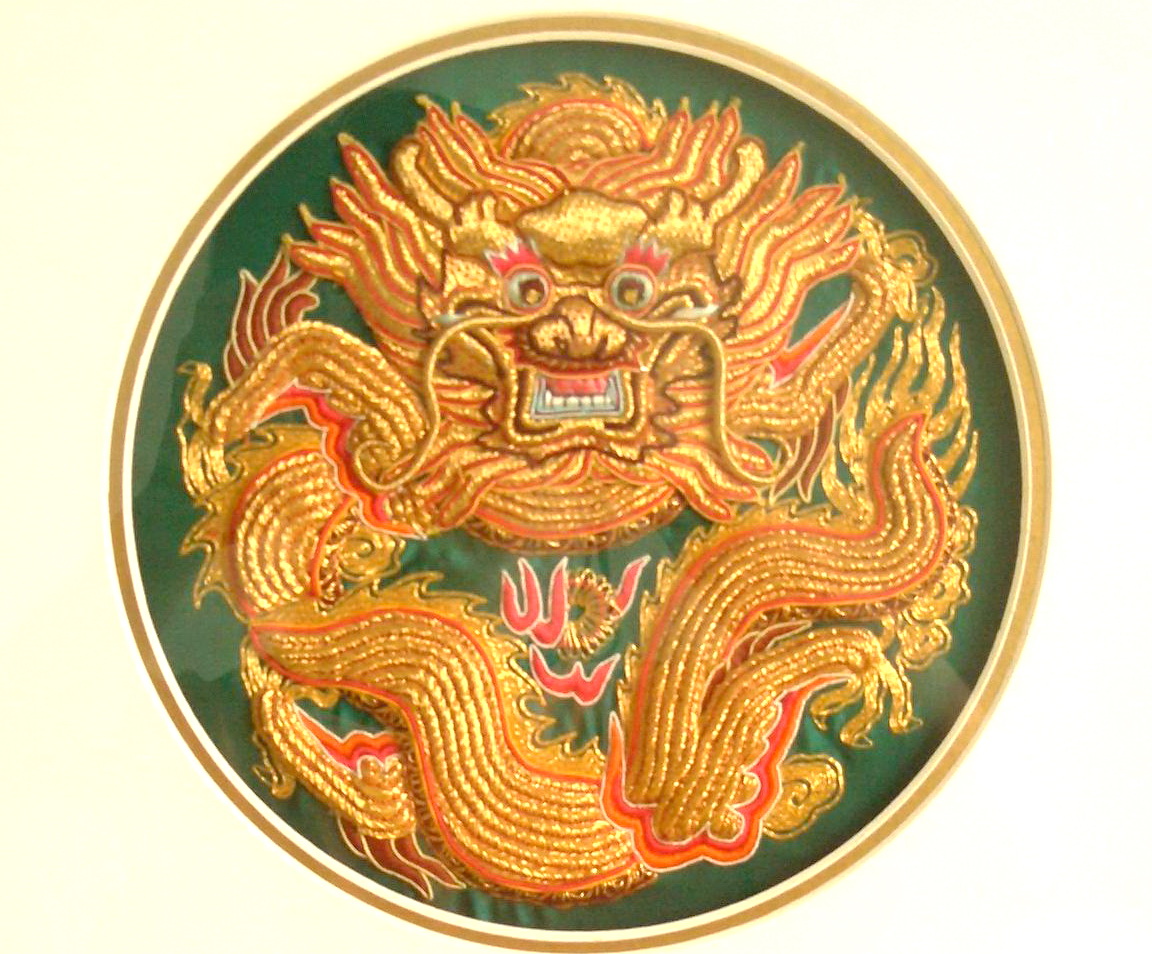
- Dragon, Chaozhou embroidery — preserved in the Beijing Shao Xiaocheng Embroidery Research Institute.
- Western Zhou embroidery imprint — chain-stitch traces in silt from the tomb of Yu Bo, Baoji, Shaanxi (excavated 1974), now in the Baoji Museum. See history of Chinese embroidery.
- Twisted silk thread — a material record; see choosing silk thread.
How to look at these works
- Source: is the image a painting, calligraphy or an original design?
- Stitch direction: silk reflects light differently as direction changes.
- Silk division: finer filaments give softer transitions.
- Technique: gold couching, simulation embroidery and art embroidery each read differently.
More: how to recognise fine Chinese embroidery; research and reproduction: restoration and reproduction.
For image use, documentation or cultural cooperation, contact the Institute.