
How to Choose Silk Thread for Chinese Embroidery
Silk thread is not chosen by colour or shine alone. In Chinese embroidery, a thread, its ground fabric, the intended image, and the way light moves across the surface work together. A thread that looks beautiful on a card may be unsuitable for a particular fabric or visual task. The useful question is not “Which silk thread is best?” but “What must this thread do in this work?”
Quick answer
Choose silk embroidery thread by matching its stated material and construction to the ground fabric, the scale of the image, and the surface effect you want to observe. Ask whether the thread can be divided, how the maker describes its twist or construction, how much is supplied, and what the supplier can verify about fibre content, shade, care, and intended use. A small representative sample is more informative than buying a large, unrelated assortment.
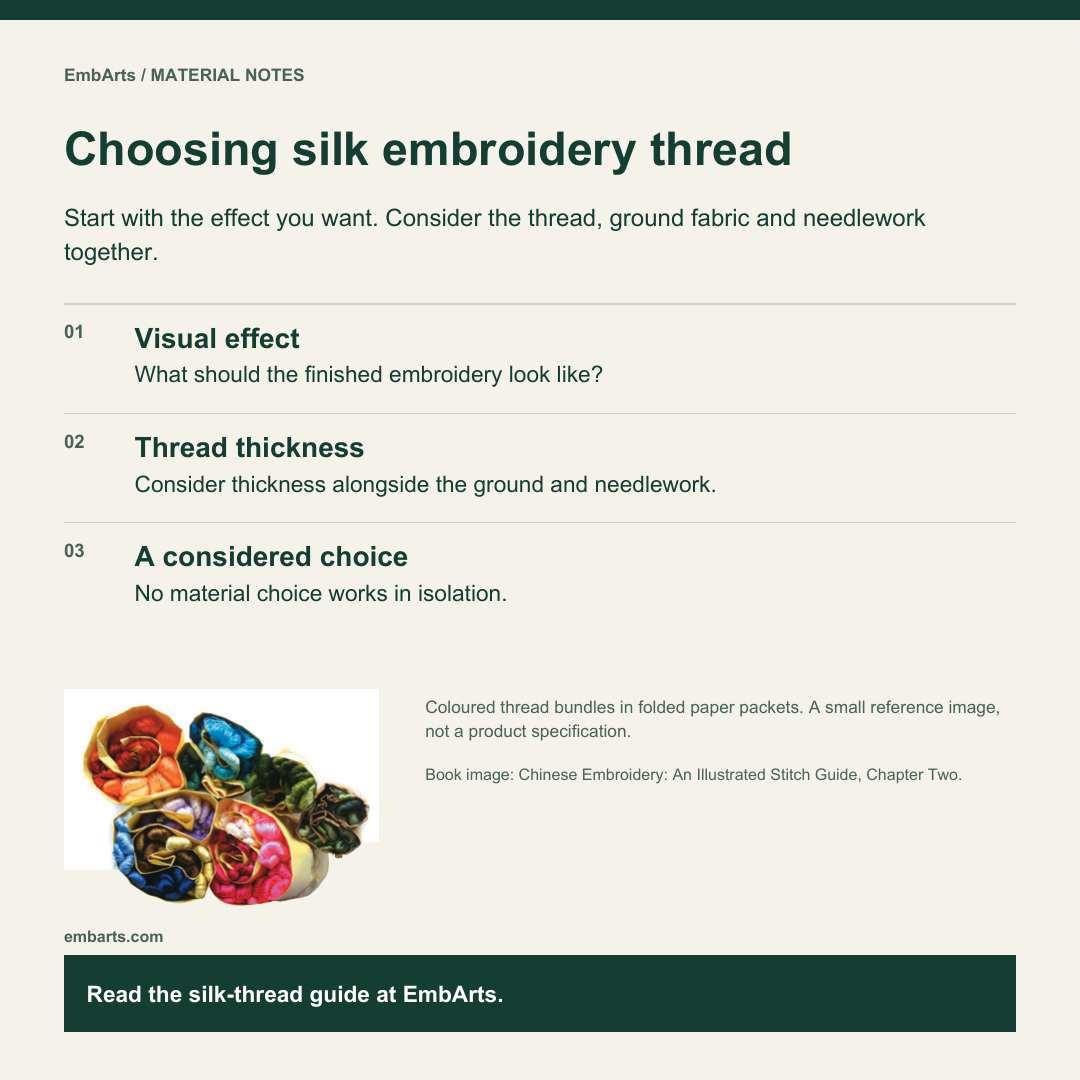
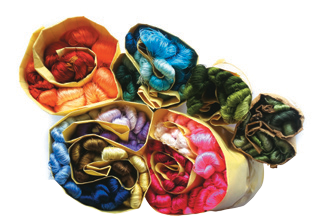
A materials study from Chinese Embroidery: An Illustrated Stitch Guide, Chapter Two, showing colour-organised thread bundles rather than a product specification.
Start with the work, not the shopping list
Chapter Two of Chinese Embroidery: An Illustrated Stitch Guide treats tools and materials as a system rather than a compulsory complete set. Its practical principle is that selection should be convenient, simple, workable, and appropriate to the circumstances. That remains a useful starting point for a reader buying thread today.
First define the job. Is the work a practice sample, a display piece, a small object that will be handled, or a study of a particular visual effect? Next look at the ground: is it fine or firm, smooth or open, opaque or transparent? Finally consider the image. A broad area, a fine contour, a gradual colour transition, and an animal-fur effect do not ask the same thing of a thread.
The source book describes silk threads as bright and decorative, capable of a distinctive effect and of being divided into finer strands. It also warns that silk is vulnerable to washing and strong sunlight. These statements explain why a silk choice belongs to the purpose and care conditions of a work.
Check whether your thread is intended to be divided
The source book uses dividing silk to mean separating an embroidery thread into finer strands for use. This changes the amount of material carried in a stitch and can support finer line, quieter coverage, or more gradual colour movement. It is a material and visual decision, not a universal proof of quality.
Before buying, ask whether the maker states that this exact thread is intended to be divided, and whether that statement applies to the particular colour and batch being supplied. The answer helps a reader decide how much material may be carried in a pass; it does not settle the rest of the fabric, needle, or image decisions.
The same chapter gives core-wrapped and feather-and-silk constructions as special thread examples. They should not be confused with a stated divisible silk thread. A general word such as “twisted” is not a substitute for the maker’s description of whether a particular thread is intended to be divided.
Thickness, direction, and sheen work together
Thread thickness is not only a number on a packet. What the eye sees depends on the amount of thread in a pass, the ground beneath it, the stitch direction, the density of neighbouring passes, and the viewing light. A fuller thread can give a clear line or cover a ground quickly. A finer divided thread can make smaller changes possible. Neither result is automatically more refined outside the image and material context.
Silk’s lustre also needs to be read in context. A highlight that follows a petal, feather, fold, or other form may be part of the intended modelling. A sudden isolated flash may call for a closer look at light, thread direction, density, ground condition, or photography before anyone names it a fault. Shine alone cannot identify a stitch, prove historical date, or settle workmanship.
This is why a thread should be considered with its intended surface effect. Before committing valuable fabric, compare a small representative area under even light. Look at line weight, coverage, whether the ground stays visually coherent, and whether the sheen supports rather than interrupts the form.
Match the thread to the ground fabric
The source book lists silk grounds with different surfaces, structures, thicknesses and degrees of transparency, alongside cotton and linen-based grounds. It presents them for different functions and embroidery contexts. The lesson is not that one named fabric is superior. Fibre and weave or other fabric structure are separate questions, and the same surface name does not by itself reveal weight, finish, transparency, stability, or suitability for a particular project.
When choosing a thread, ask what the ground needs to support. A delicate or open ground may make needle openings, pulling, or uneven coverage easier to see. A firmer ground may suit a different scale or use. The book relates needle choice to fabric, needlework, and thread thickness; its exact needle numbers are reference material, not a universal shopping prescription. A compatible relationship matters more than assembling a prestigious collection of materials.
Questions worth asking before you buy
Use product names as starting points, not as proof. A responsible seller, retailer, or studio should be able to clarify as much of the following as applies to the item:
- What fibre content is actually stated, and is “silk” a fibre description, a trade name, or an unverified label?
- Is the exact thread stated to be intended for division, or is it described as a different construction?
- Is any stated thickness, twist, strand count, length, or weight tied to this exact item rather than a generic category?
- Which shade, dye lot, pack quantity, and supplier identifier will be supplied?
- What ground fabrics and intended uses does the seller state, and what care limits are documented?
- Can a small sample or a clear close photograph be provided before a larger purchase?
Keep the answers with the sample or label. Do not use a home burning test to identify a thread: it damages the sample and is poorer evidence than traceable product information or textile assessment.
Keep a Comparison Record with the Sample
A useful sample does more than show whether a colour or surface effect appeals to you at one moment. It gives you a small, repeatable piece of evidence about one material combination. That evidence is easy to lose if the thread packet, fabric offcut, and notes are separated after the test.
Keep one short record with the sample itself. It does not need to look like a laboratory report, and it does not prove the identity or quality of a material on its own. Its purpose is simpler: it lets you return to the information that was actually available when you made a choice.
| Keep with the sample | Why it matters later |
|---|---|
| The item as it was described | Retain the supplier’s stated fibre content, thread construction or intended use. A silky appearance or a familiar product name is not a substitute for the information supplied for that exact item. |
| The purchase reference | Note the seller, purchase date, shade or batch identifier when one is provided, and any product-specific care information. These details help distinguish one purchase from another without claiming that all threads of a similar name behave alike. |
| The working combination | Record the ground used, the thread as used, and the support or needle choice in ordinary descriptive terms. The point is to remember the combination, not to turn one successful sample into a universal specification. |
| What you observed and what remains open | Write what was visible under the light in which you looked: for example, whether the line, coverage, ground, or surface effect suited the intended image. Keep unanswered questions as questions. A sample may narrow a choice without explaining every cause. |
| The comparison line | For a pair of samples, note what stayed the same, what changed, and what was actually observed. Do not treat this as a controlled test or a single-cause diagnosis. |
When two samples are compared, add one comparison line: what you kept the same, what you intentionally changed, and what you could actually see. This turns “change one variable at a time” into a usable note rather than a vague instruction. It still does not prove that the changed item alone caused the result; it only makes the next comparison more intelligible.
This record is not a storage method and not conservation treatment. It does not tell you how every silk thread should be kept, washed, or used. For those questions, retain the supplier’s own instructions for the exact item and seek appropriate guidance when the object is old, valuable, or already damaged.
The next time you compare a thread or ground, place the new sample beside the earlier labelled one rather than relying on memory alone. You can then see what changed in the intended effect and identify which material relationship you want to test next.
A practical next step
Begin with one intended use, one known ground, and one thread whose stated information you can retain. Compare one variable at a time rather than mixing unrelated fibres, tools, and surfaces. For the wider relationship among hoop or frame, needle, scissors, thread, and fabric, see Essential Tools and Materials for Chinese Embroidery. For Chinese-first stitch terms and related visual questions, see Chinese Embroidery Stitches. Readers comparing the book’s visual and material framework can also visit Chinese Embroidery: An Illustrated Stitch Guide. To examine the ground more closely, read How to Choose Silk Fabric for Chinese Embroidery. For guided study, see Classes & Courses.