Shui Horsetail Embroidery: Wrapped Core Threads and Couched Outlines
Quick answer
Shui horsetail embroidery (水族马尾绣) uses horsetail hair as a firm core, wraps it with silk or other thread, and couches the prepared line along a planned outline. Colorful motifs are then organized within those raised boundaries. The English guide calls the structural method “horse-tail-hair twining thread couching stitch.” That phrase explains the construction, but the named Shui tradition includes its own objects, visual language, and cultural setting.
The cultural name comes first
The public name should be Shui horsetail embroidery (水族马尾绣). The Illustrated Art of Embroidery presents it as a distinctive practice of Shui women in Guizhou. Shao describes white thread wrapped around horsetail hair, the prepared horsetail line couched along the edge of a planned pattern, and other motifs embroidered within the resulting boundaries.
The English guide uses the more structural phrase horse-tail-hair twining thread couching stitch. It separates three material actions in the finished surface:
- a firm core provides body;
- a finer thread wraps the core to make a twining thread;
- small tacking stitches couch the prepared line to the ground fabric.
This English name is useful for technical explanation and search, but it is not a universal replacement for Shui horsetail embroidery. Similar wrapped-core and couched-thread principles appear in more than one Chinese embroidery context. The Shui name identifies a specific tradition, community, object use, and visual system.
A line is prepared before it becomes an outline
Ordinary embroidery thread is soft and follows the ground closely. A horsetail core changes the behavior of the line. Once wrapped, it becomes firmer, more stable, and more capable of holding a curve or boundary above the cloth.
Chinese Embroidery: An Illustrated Stitch Guide describes horse-tail-hair threads as hard because silk is wrapped around the horsetail core. It associates that firmness with outlines that retain their form and with durable embroidered objects. The same guide places horsetail and peacock-feather threads within a broader category of special twining threads made by wrapping a fine outer thread around a different core.
The public principle is material transformation: the visible embroidery line is not simply a strand taken directly from a spool. It is a prepared composite thread whose core, wrapping, and surface attachment work together.
Couching fixes the raised line to the ground
After the wrapped line has been prepared, it is laid along the intended contour and secured by tacking stitches. In ordinary couching, a laid thread is held down by another thread. Here, the laid element already has a firm, wrapped core, so the outline gains greater relief and definition.
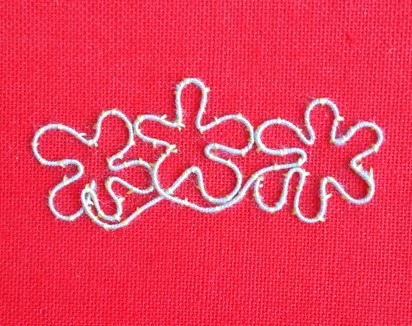
The English guide recommends using a tacking thread close in color to the twining thread when a unified line is desired. In its teaching illustration, contrasting colors are used only to make the roles easier to distinguish. This difference between demonstration color and finished-object color is important: a diagram may reveal construction more clearly than the final work, but it should not be mistaken for a fixed aesthetic rule.
Raised boundaries organize colored motifs
The Illustrated Art of Embroidery says that various motifs are embroidered inside the couched outlines. The outline therefore does more than draw a border. It divides the surface into fields, holds the composition together, and gives the colored filling a clear boundary.
This relationship produces the relief noted in both books. The wrapped horsetail line sits above the ground, while the interior embroidery adds color and texture within its limits. Against dark ground cloth, pale outlines can be especially legible; against bright cloth, the same structure can organize dense ornament without allowing the motifs to merge visually.
The raised structure also affects touch and wear. Shao Xiaocheng’s books describe Shui horsetail work as durable. That is a statement about the material logic recorded by the authors, not a reason to handle historic embroidery casually. Age, abrasion, broken tacking stitches, weakened ground fabric, and earlier repairs can still make a surviving piece fragile.
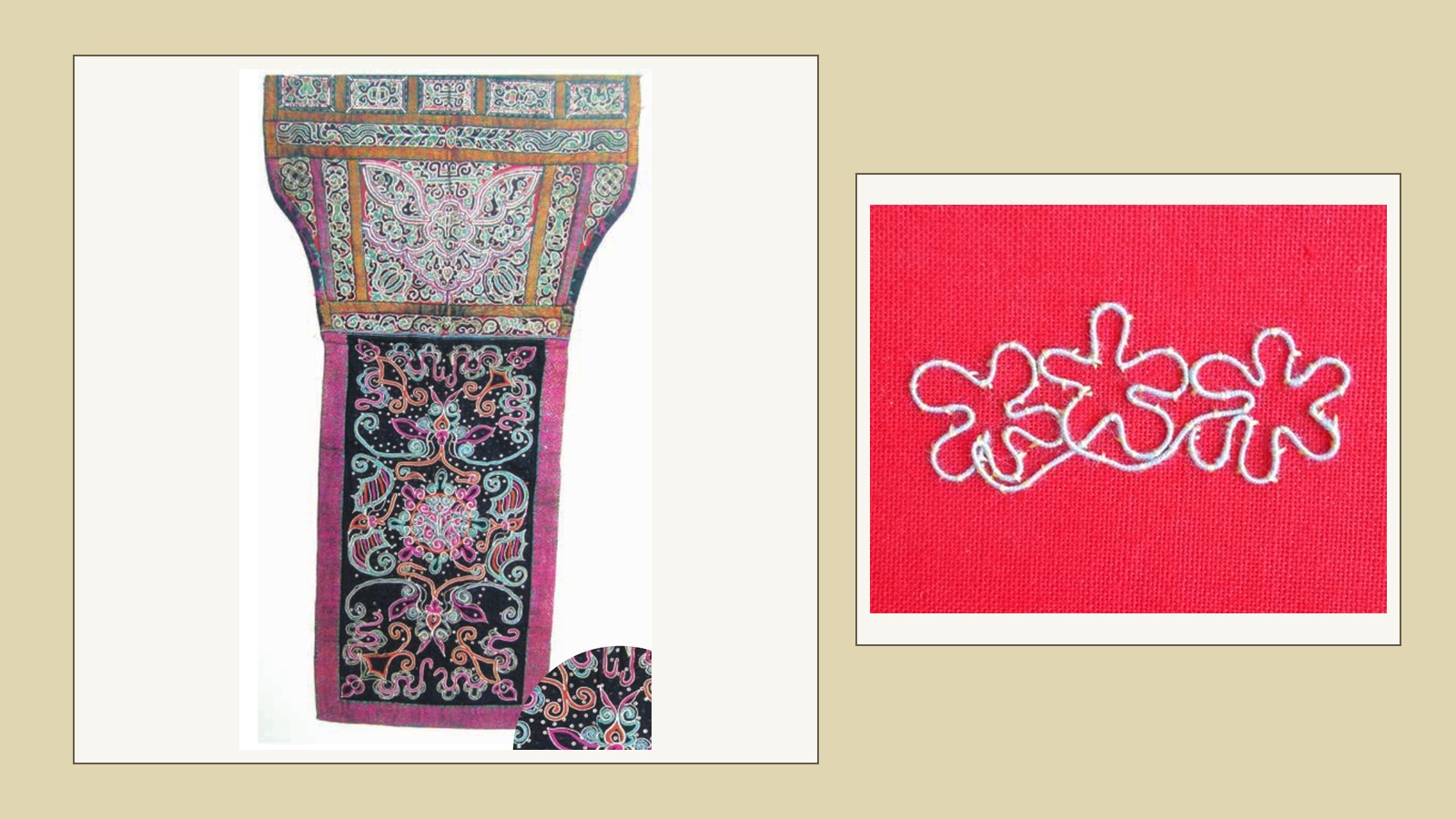
A Shui embroidered back fan
The Illustrated Art of Embroidery reproduces a Shui embroidered back fan (水族刺绣背扇), fig. 5-18. The object shows pale and colored raised outlines forming dense, symmetrical fields on dark cloth, with additional bands and patterned areas above them.
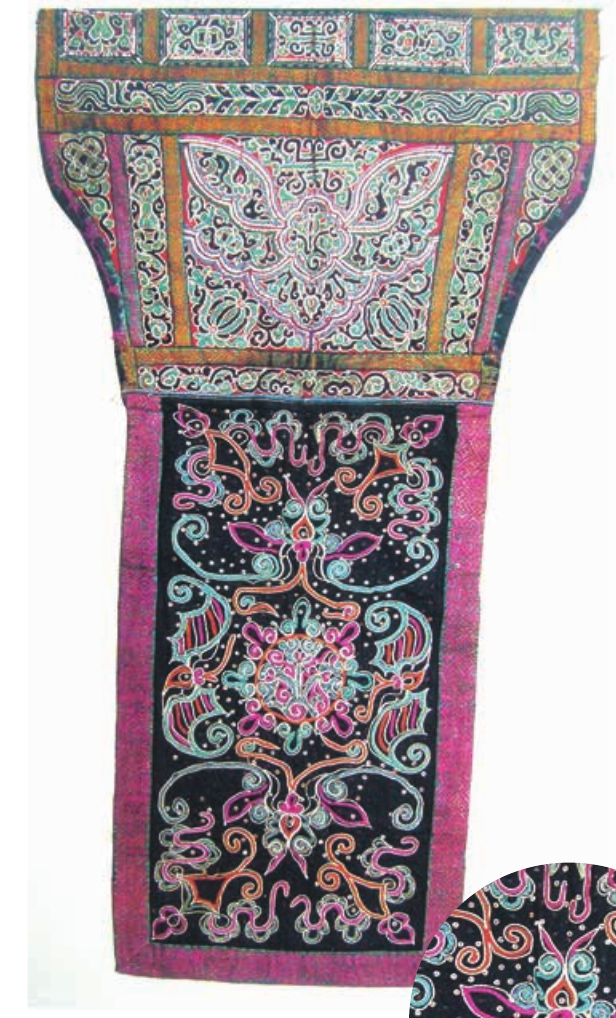
The image is useful because it connects technique to an object rather than isolating a stitch sample. The outlined forms are not scattered exercises. They participate in the proportions, borders, symmetry, and use of the textile as a whole.
Related structures in other Chinese embroidery traditions
The English guide says twining thread couching is frequently seen in the Bijie area of Guizhou and is also used occasionally in Chaozhou embroidery and other schools. The Illustrated Art of Embroidery separately records silk-wrapped horsetail used to outline motifs in Guangdong embroidery.
These references show that the material principle is not confined to one place. They do not prove that every wrapped-core outline belongs to the Shui tradition. A responsible description should distinguish:
- Shui horsetail embroidery, the specific ethnic tradition discussed here;
- horse-tail-hair twining thread couching, the structural English name used by the guide;
- other regional uses of wrapped horsetail, peacock feather, palm fiber, or hardened cores.
Shared construction can create technical relationships without erasing regional identity.
How to examine a horsetail-embroidered surface
Five visual questions help readers describe a work without claiming more than the evidence supports:
- Is the principal outline visibly raised above the ground fabric?
- Can a wrapped surface be seen around a firmer central core?
- Are small tacking stitches visible at intervals along the line?
- Do the outlines divide the design into fields filled with other colored embroidery?
- Are broken tacking stitches, exposed core material, abrasion, or distortion present?
These observations help identify construction and condition. Ethnic attribution, date, place, and object history still require documented context.
Why the distinction matters
Calling the technique only “couching” loses the prepared horsetail line; calling every wrapped-core outline “Shui horsetail embroidery” loses regional boundaries. The most accurate approach is to name the Chinese tradition first, then use the English structural term to explain how its raised outlines are made.
Readers can place this technique within ethnic embroidery traditions in China, compare its surface attachment with gold and silver thread couching, and review the wider Chinese embroidery stitch families.
Institute publication and editorial basis
This article extends the Chinese Embroidery Institute’s existing research and editorial work. The Illustrated Art of Embroidery (《图说刺绣艺术》) was written by Shao Xiaocheng, with Martin Xiao (Xiao, Yao) as responsible editor. Chinese Embroidery: An Illustrated Stitch Guide was written by Shao Xiaocheng.
- Shao Xiaocheng, The Illustrated Art of Embroidery (《图说刺绣艺术》), book p. 165, fig. 5-18; related Guangdong embroidery discussion on book pp. 119 and 123.
- Shao Xiaocheng, Chinese Embroidery: An Illustrated Stitch Guide, Chapter Two, “Making Special Threads”; Chapter Three, “Twining Thread Couching Stitch,” listed at p. 89 in the contents; Chapter Four, “Embroidered Pouch of Shui Ethnicity,” book pp. 118-119.
Leave your comment
Related posts