Ethnic Embroidery Traditions in China: A Guide to Regional Diversity
Quick answer
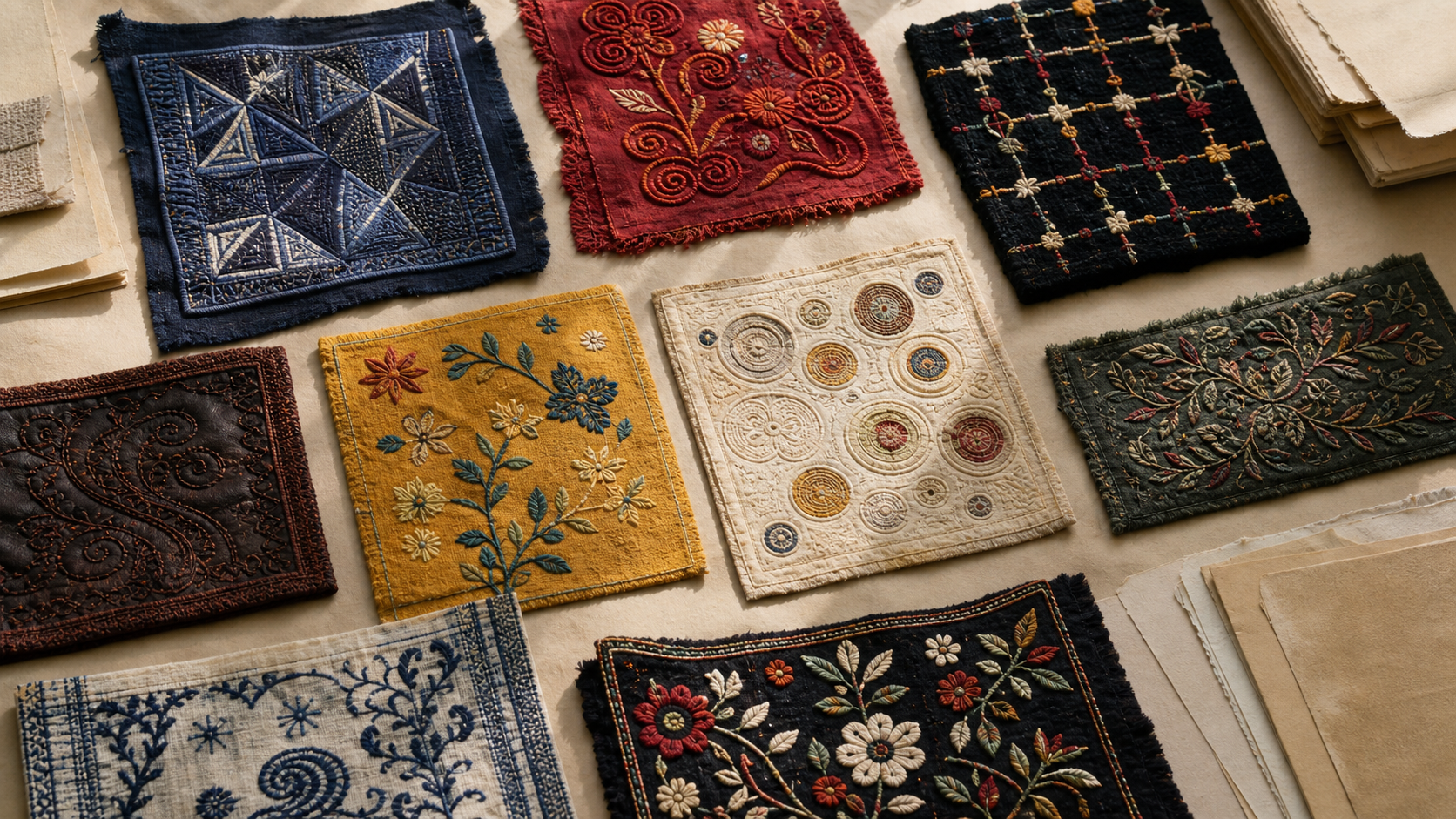
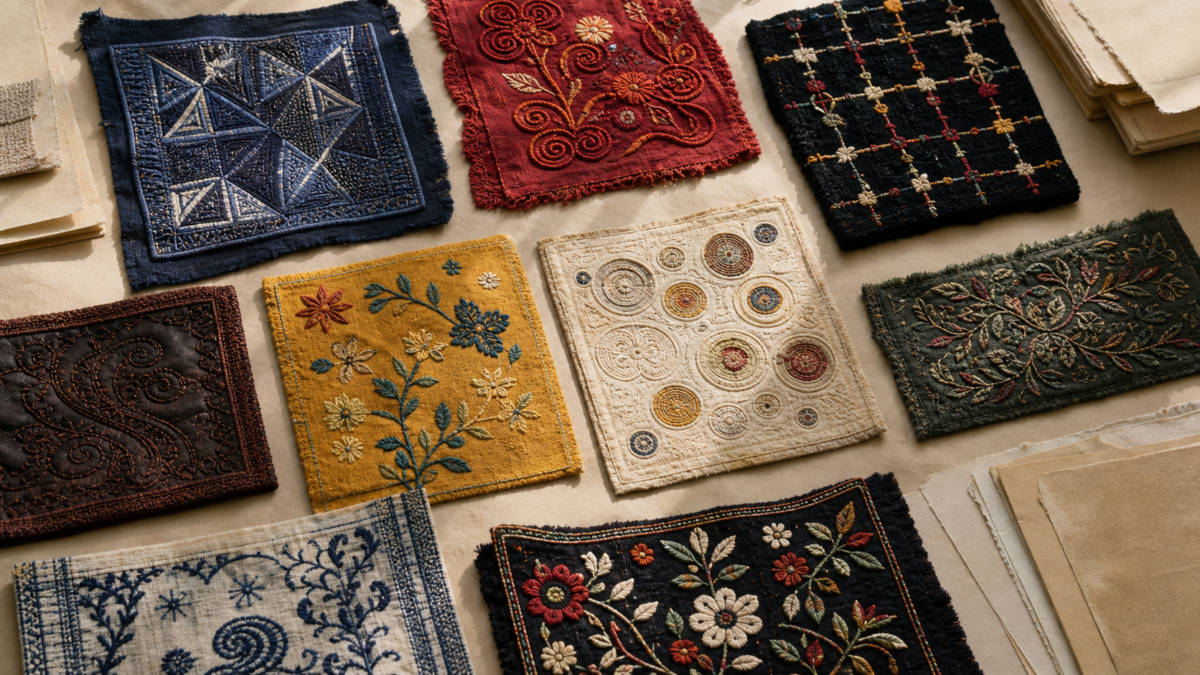
Ethnic embroidery in China is not a single style. It includes many community-based traditions shaped by local dress, household objects, available materials, inherited techniques, migration, ceremony, and daily life. Cotton, silk, wool, felt, leather, horsehair, metal, and appliquéd cloth may all appear. A good way to explore this diversity is to begin with a documented object and ask where, when, by whom, and for what purpose it was made.
Why “ethnic embroidery” is a broad category
China is home to many communities with distinct textile histories. The phrase “ethnic embroidery” is therefore only a starting point. It does not mean that all non-Han embroidery shares one visual language, or that the same motif carries the same meaning everywhere.
Shao Xiaocheng’s Illustrated Art of Embroidery introduces selected traditions associated with Zhuang, Bai, Dong, Miao, Yao, Yi, Shui, Qiang, Tu, Uyghur, Kazakh, Ewenki, and Daur communities. The chapter is valuable because it brings together objects, materials, techniques, and regional examples. It also states that the selection is not exhaustive. Any website introduction should preserve that limitation.
Even within one named tradition, embroidery can vary by county, village, generation, object type, and occasion. A baby carrier, sleeve panel, embroidered shoe, cap, pouch, horse blanket, ritual textile, and contemporary souvenir all answer different needs. Treating them as interchangeable examples removes the context that gives each work meaning.
Begin with objects, not stereotypes
Embroidery is often discussed as surface decoration, but many of the examples in The Illustrated Art of Embroidery belong to practical objects. Zhuang embroidery appears on shoes, caps, breast coverings, curtains, cushions, pouches, and theatrical dress. Bai embroidery is connected with clothing, headdresses, shoes, pillow covers, and household textiles. Dong and Miao examples include children’s caps, baby carriers, sleeves, belts, aprons, and bags.
Farther north and west, embroidered caps, garments, felt, leather, boots, gloves, and riding equipment show other relationships between textile practice and local life. A Kazakh felt saddle cloth, an Ewenki leather boot, and a Daur deerskin glove are not simply three surfaces for the same decorative idea. Their materials, movement, climate, use, and construction all shape the embroidery.
Before asking what a pattern “means,” ask what the object is, who used it, how it was worn or handled, and what part carries the embroidery.
Materials expand the meaning of embroidery
Silk is central to many forms of Chinese embroidery, but ethnic textile traditions cannot be understood through silk alone.
The Institute’s published research describes cotton, silk, wool, felt, leather, appliquéd cloth, metal, and horsehair-supported structures. Each material changes the result: counted work follows a woven grid, couching creates relief, and felt or leather supports objects made for harder use.
Shui horsetail embroidery is a particularly clear example of structure affecting appearance. Thread is wrapped around horsehair to form a firm element that can define a raised outline. The public value of this example lies in understanding the relationship between material and relief; a complete preparation and working sequence belongs in specialist demonstration.
The Miao tin-embroidery material described in the Chinese book offers another reminder that embroidery categories may extend beyond familiar thread. Narrow tin elements are combined with a dark textile ground and colored thread, producing a reflective surface. Because such work is specific in material and cultural context, it should not be used as a generic visual symbol for all Miao embroidery.
Four ways to compare traditions responsibly
Comparison is useful when it helps us see differences, not when it turns traditions into a ranking.
1. Ground and structure
Look first at the supporting material: tightly woven cotton, silk, felt, leather, or another ground. Then observe whether the design is counted from the weave, drawn or transferred, built through appliqué, or formed through attached elements.
2. Line, mass, and relief
Some works emphasize linear outlines; others build dense color fields, repeated geometric units, raised knots, coiled structures, or layered cloth. These choices affect durability, rhythm, and the way the textile is seen at a distance.
3. Object and social use
An embroidered baby carrier relates to care, family, and the movement of the body. A wedding garment, theatrical costume, everyday shoe, cap, pouch, or saddle textile belongs to a different social setting. Use should be documented rather than guessed from appearance.
4. Motif in context
Flowers, birds, butterflies, dragons, fish, geometric forms, tools, plants, and animals appear in many traditions, but their meanings are not universal. The Dong examples in the Chinese book discuss sun, moon, dragon, well, horse, and gourd motifs within particular stories. Miao examples include butterflies, birds, fish, plants, and geometric forms. Such meanings belong to a documented community or source; they should not be turned into a fixed dictionary for every object.
Selected regional examples
The following observations are starting points, not complete definitions.
Southern and southwestern traditions
Zhuang examples combine strong color contrast with daily and theatrical objects. Bai embroidery appears on clothing and household textiles. Dong work includes smooth, granular, counted, and wrapped structures. Miao examples range from geometric clothing panels and butterfly imagery to reflective tin embroidery.
Yao examples emphasize colored threads on dark grounds. Yi examples combine geometric, animal, plant, and human subjects. Shui embroidery is represented by horsehair-supported outlines; Qiang work includes counted and surface techniques; Tu embroidery spans religious, daily-life, and ceremonial objects.
Northwestern and northern traditions
Uyghur embroidery appears especially on caps and clothing. Kazakh examples connect garments, felt, leather, and equestrian life. Ewenki work is described on pouches and soft leather boots; Daur embroidery appears on clothing, small accessories, shoes, and leather gloves.
These short descriptions should lead readers toward documented examples, not replace deeper community-specific research.
How to read an unfamiliar embroidered object
When a label is missing or uncertain, visual resemblance alone is not enough to assign an ethnicity. A useful record should look for several kinds of evidence:
- Object type: garment part, baby carrier, shoe, cap, pouch, domestic textile, ritual object, or equipment.
- Materials: ground fabric, embroidery thread, applied cloth, felt, leather, metal, horsehair, beads, or other additions.
- Construction: how the object was assembled and where embroidery enters that structure.
- Place and community: where the object was made, collected, worn, or documented.
- Date and provenance: when it was made and how its ownership or collection history is known.
- Recorded interpretation: whether a motif meaning comes from a community member, field record, maker, catalogue, or later speculation.
This method reduces two common errors: identifying a community from a single decorative feature and assigning symbolic meaning without evidence.
Tradition, change, and contemporary life
Textile traditions are not frozen. Markets, migration, museums, performance, and new forms of teaching can influence what is made. A recent object is not automatically inauthentic, and an older one is not representative of every period.
A better question is whether the object is accurately described: who made it, why it was made, which materials were used, and which methods were inherited or adapted. Contemporary documentation can be as valuable as historical collection work when it records makers’ voices instead of treating communities as anonymous sources of patterns.
The institute’s Digital Museum can support this approach by connecting images with titles, materials, dates, makers, places, and collection notes. Readers interested in the wider history can also visit A Brief History of Chinese Embroidery.
Learning without flattening difference
A general introduction can teach observation and vocabulary, but it cannot replace community-specific study or practical guidance. Complete working sequences, material preparation, pattern transfer, tension, finishing, and correction have been intentionally left out of this article.
Learners who want to connect stitch practice with historical and cultural context can review the institute’s Classes and Courses. Courses should present any regional or ethnic technique with a clear source and avoid treating an isolated pattern as a universal tradition.
Frequently asked questions
Is ethnic embroidery in China one style?
No. The term covers many traditions, locations, materials, objects, and histories.
Is all Chinese ethnic embroidery made with silk?
No. The documented examples include cotton, wool, felt, leather, metal, horsehair-supported elements, silk, and combinations of materials.
Can a motif identify the community that made an object?
Not reliably by itself. Object type, materials, construction, location, date, provenance, and documented interpretation should be considered together.
Are modern pieces less authentic than old ones?
Age alone is not a sufficient test. Accurate documentation of maker, purpose, material, context, and change is more useful than a simple old-versus-new judgment.
Institute publication and editorial basis
This article extends the Chinese Embroidery Institute’s existing research and editorial work. The Illustrated Art of Embroidery (《图说刺绣艺术》) was written by Shao Xiaocheng, with Martin Xiao (Xiao, Yao) as responsible editor. Chinese Embroidery: An Illustrated Stitch Guide was written by Shao Xiaocheng.
- 邵晓琤,《图说刺绣艺术》,第五章“各民族刺绣”,书内页 152-171。
- Shao Xiaocheng, Chinese Embroidery: An Illustrated Stitch Guide, Introduction; Chapter Four, selected Miao and Shui projects; Chapter Six, “Embroidery of Chinese Ethnic Minorities.”
Leave your comment
Related posts