Shu Embroidery: History, Style, and the Chengdu Tradition
Quick answer: What is Shu embroidery?
Shu embroidery, or shuxiu(蜀绣), is a regional Chinese embroidery tradition centred on Chengdu and the surrounding area of Sichuan. It belongs to the grouping known as the Four Famous Embroideries of China. Its best work is recognised not by one subject alone, but by disciplined stitching, a smooth and luminous surface, balanced color, clear composition, and rounded modelling. Carp are especially associated with its modern public image, but Shu embroidery also includes household textiles, clothing accessories, flowers, birds, animals, figures, and pictorial works.
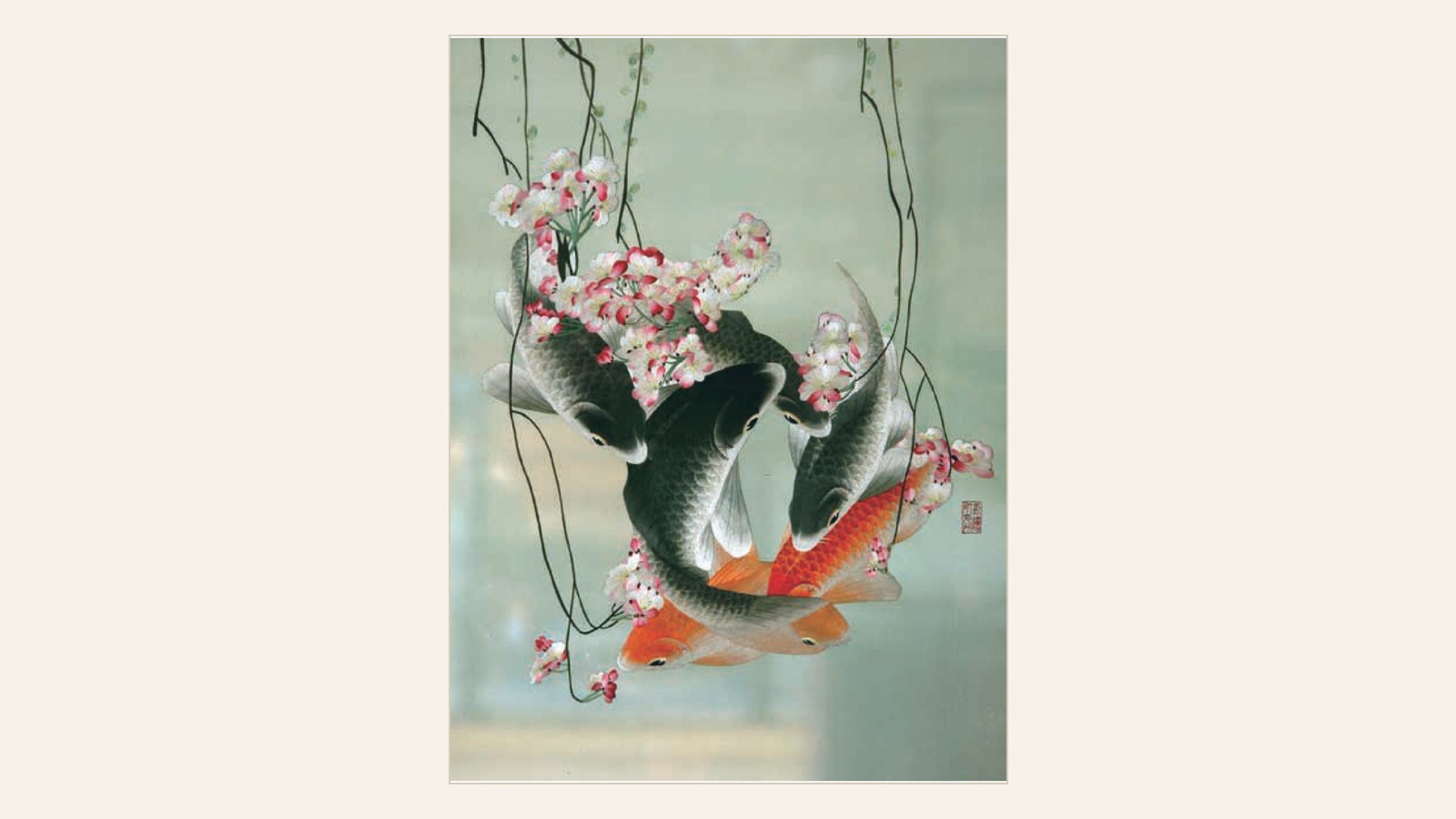
Shu embroidered carp, reproduced from Shao Xiaocheng’s The Illustrated Art of Embroidery, fig. 3-81, book p. 113. Shao uses this work to discuss orderly stitching, controlled thread thickness, layered color, and the balance of solid and open areas.
What the name shuxiu means
The English name Shu embroidery translates shuxiu(蜀绣). “Shu” is an old regional name associated with Sichuan. In current use, the term refers chiefly to embroidery centred on Chengdu rather than to every embroidered object made anywhere in the province.
Sichuan has a long history of sericulture, silk weaving, and embroidered textiles. That history created the conditions in which later regional embroidery developed; it does not place every early Sichuan textile inside the fully formed category now called Shu embroidery.
Shao Xiaocheng makes this separation in The Illustrated Art of Embroidery: the regional history is old, while the recognisable school emerged through later workshops, markets, and institutions. Shao wrote the book, with Xiao Yao (Martin Xiao / Xiao, Yao) as responsible editor; it belongs to the Chinese Embroidery Institute’s own published research.
A silk region before a named embroidery school
Sichuan’s association with silk reaches far beyond the modern embroidery trade. Historical writing and regional tradition connect the Chengdu plain with sericulture, woven silk, and skilled decorative work. These records explain why silk was readily available and why textile knowledge could be transmitted across generations.
Continuity is not the same as identity. The name, market reputation, and familiar stylistic profile took shape over time. Shao records that by the Daoguang period of the Qing dynasty, embroidery in Sichuan had reached an organised scale and was widely practised. Local work also absorbed experience associated with Su and Yue embroidery without becoming identical to either tradition.
What Shu embroidery looks like
Shao characterises Shu embroidery through a compact group of visual qualities: careful and fine workmanship, a level and bright surface, harmonious color, open composition, and substantial, rounded modelling. These are not separate decorations added at the end. They depend on how thread direction, thickness, density, color changes, and unstitched ground are coordinated across the whole image.
“Smooth” does not mean mechanically flat. A fish body, bird, flower, or animal may require visible changes in direction and thread weight so that light moves differently across the surface. “Balanced color” does not mean weak color. The palette can be clear and vivid while transitions remain controlled. “Open composition” means that empty ground participates in the design instead of every area being filled.
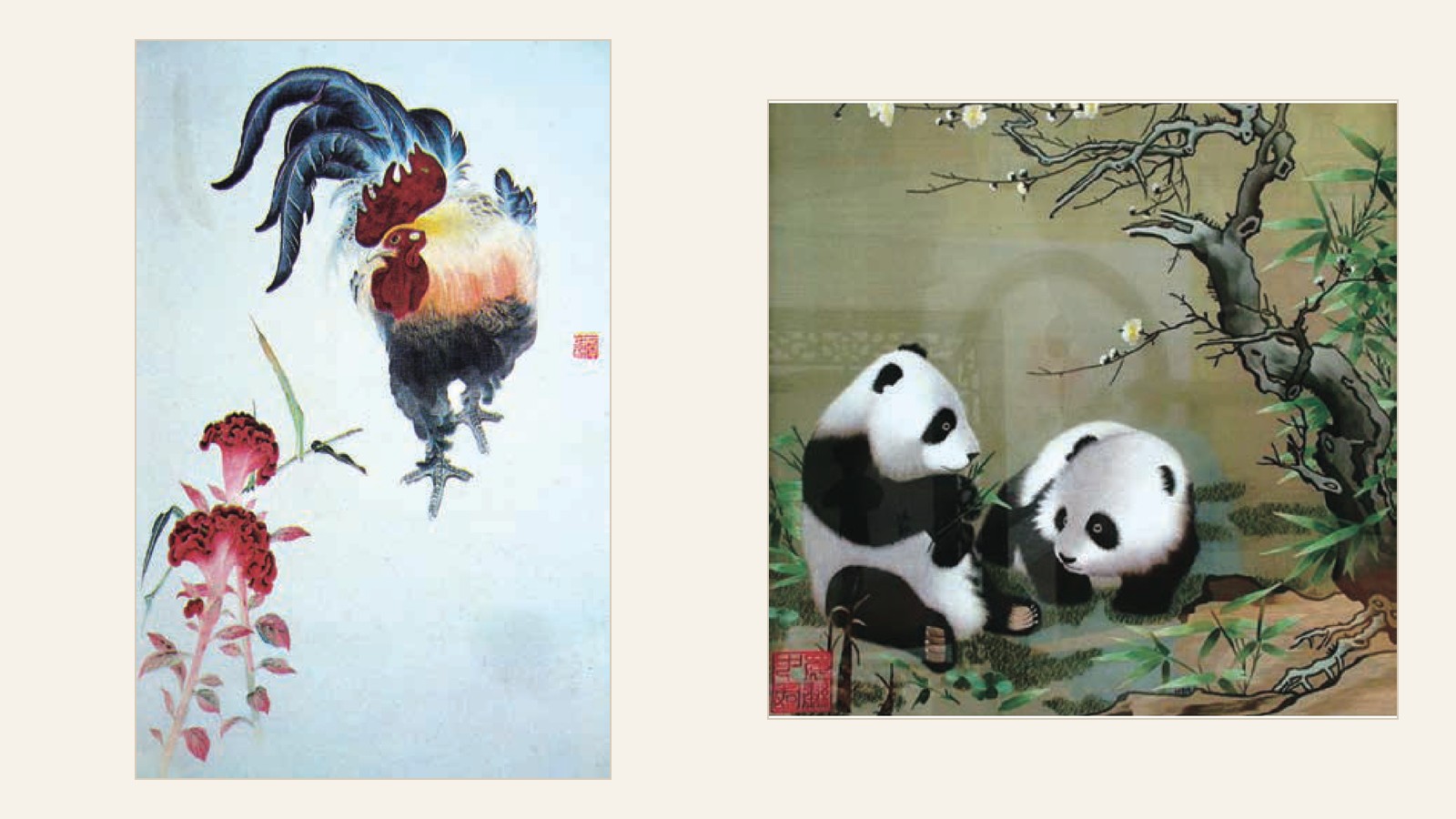
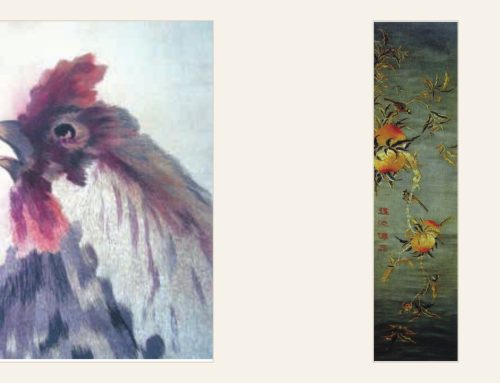
Two subjects in Shu embroidery: Crown upon Crown and Pandas, reproduced from Shao Xiaocheng’s The Illustrated Art of Embroidery, figs. 3-80 and 3-82, book pp. 112 and 114. The pairing shows that the regional language is broader than any single iconic animal.
Why carp became a signature subject
Carp are among the most recognisable subjects in Shu embroidery because they expose several technical and pictorial problems at once. Scales must read as an ordered surface without becoming rigid. The body needs weight and curvature. Fins require a different translucency and rhythm. Several fish must remain distinct while still belonging to one current of movement.
Shao presents the carp in figure 3-81 as a representative pictorial work. Her discussion emphasises proportionate use of thicker and finer silk, even stitches, distinct layers, and a controlled relation between dense and open passages. The finished image demonstrates judgement rather than a single special stitch.
The subject should not be reduced to a carp-scale recipe. Drawing, thread choice, stitch direction, color, spacing, and observation work together. Detailed sequences and correction methods belong in supervised technical study, not in a short public article.
Household textiles came before the gallery wall
Modern audiences often meet regional embroidery as framed art, but much historical work belonged to daily life. Bed valances, pillow tops, garments, sleeve bands, theatre costume, ceremonial clothing, pouches, mirror-centres, screens, and hangings all created different demands for scale, durability, viewing distance, and symbolism.
The objects on book page 115 make this range tangible. A long bed valance organises paired phoenixes and a central sun across an architectural textile. Two pouches compress floral and auspicious motifs into small, handled objects. Their shapes are not neutral containers: the embroidery is planned around seams, openings, proportions, and use.
Practical embroidery and display work share workshop knowledge, but not a fixed layout. A motif or stitch arrangement suited to a pouch had to be re-scaled and re-composed for a large hanging.
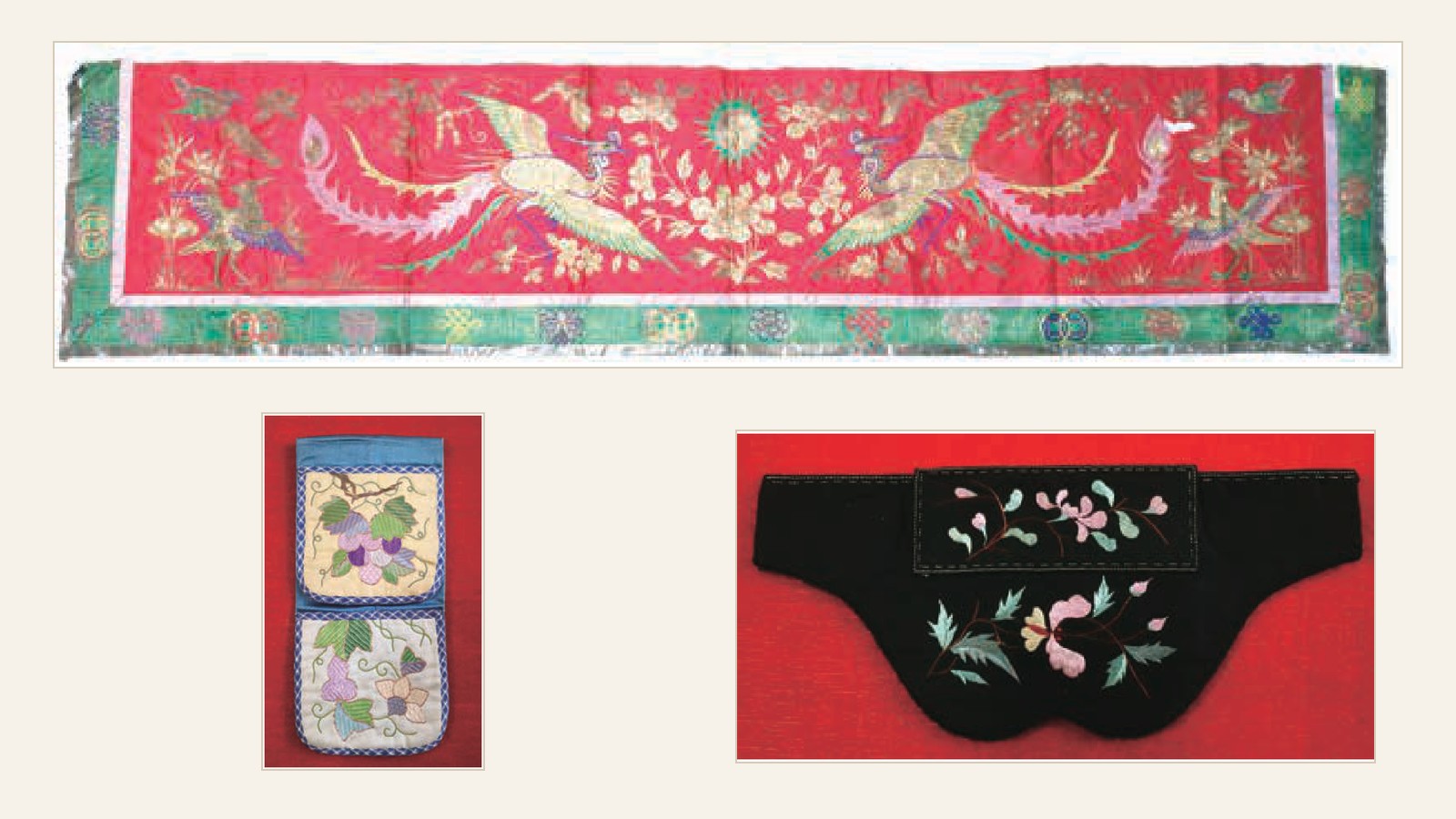
A Shu embroidered bed valance and two pouches, reproduced from Shao Xiaocheng’s The Illustrated Art of Embroidery, figs. 3-83 to 3-85, book p. 115. They show how composition changes with the shape and use of an object.
From household production to workshops and markets
During the Qing dynasty, specialised small workshops became more visible in Sichuan. Shao records that by around the Daoguang period, an embroidery guild known as the Sanhuang Society organised work into categories that included ceremonial shoulder pieces, sleeve bands, theatre costume, deity robes, screens, and decorated canopies. The list is useful because it describes an industry serving several kinds of object, not a studio producing only framed pictures.
In the early twentieth century, provincial efforts to promote industry added an embroidery section staffed by people who understood both drawing and stitchwork. Training, design, and product development helped household production enter a more structured market. Shao also records a period when professional male embroiderers, rural workers, and specialist shops all participated in production and distribution.
Domestic practice continued, but designs circulated differently and goods reached buyers farther afield. Pillow tops and mirror-centres preserve the meeting of daily use, auspicious imagery, workshop production, and trade.
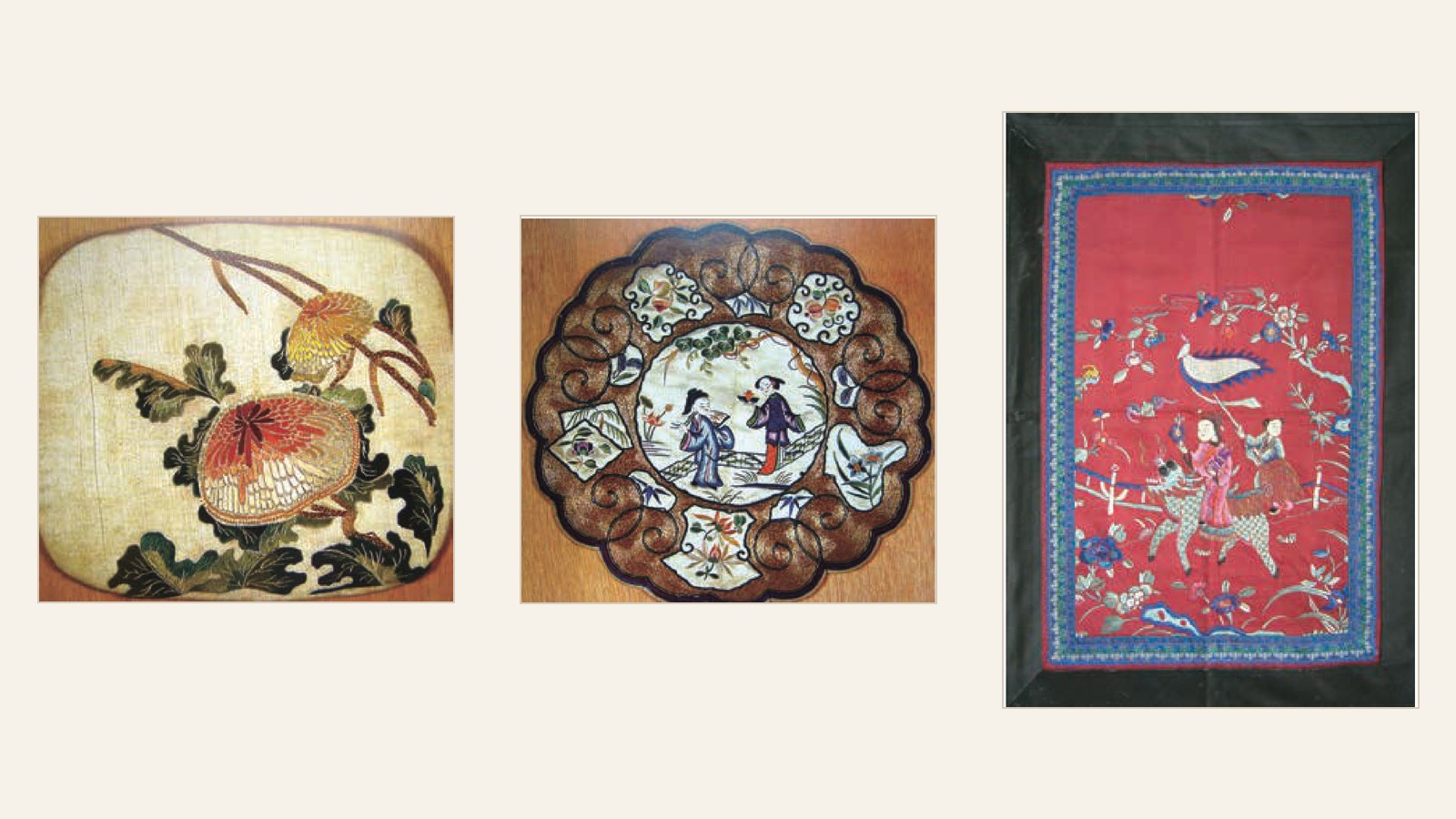
Qing-dynasty Shu embroidered pillow tops and a late-Qing Qilin Bringing a Son mirror-centre, reproduced from Shao Xiaocheng’s The Illustrated Art of Embroidery, figs. 3-86, 3-87, and 3-89, book pp. 116-117. The book records the pillow tops in the Sichuan Museum and the mirror-centre in the Beijing Shao Xiaocheng Institute of Textile Arts.
Painting expanded the pictorial repertoire
Shu embroidery’s relationship with painting became especially visible in pictorial work. Designs supplied by painters brought landscapes, flowers and birds, fish and insects, pandas, golden monkeys, and other subjects into the embroidery studio. Embroiderers then had to translate brush structure into the physical behaviour of silk.
Thread cannot reproduce ink or pigment literally. A painted wash may become a change in silk density; a contour may be strengthened or softened by stitch direction; paper left blank may become exposed ground fabric. Good work preserves the logic of the image without making silk behave like paint.
A panda does not automatically make a work Shu embroidery, just as a tiger does not automatically make a work Xiang embroidery. Attribution needs the object and its documentation, not an emblematic animal.
How to look at a Shu embroidery
Begin with the whole object before moving to individual stitches.
- Composition: Does the open ground give the image room, or does the arrangement feel crowded without purpose?
- Surface: Does silk reflect light coherently as forms change direction?
- Color: Are vivid colors balanced through controlled transitions and distribution?
- Modelling: Do fish, birds, animals, flowers, or figures have convincing volume rather than pasted-on outlines?
- Object type: Has the design been adapted to a pouch, pillow top, valance, screen, or pictorial hanging?
- Evidence: Do materials, condition, inscriptions, provenance, and comparable documented works support the claimed date and regional identity?
Historic textiles may have fading, losses, later repairs, remounting, or replacement parts that alter the visible surface. Readers can compare Shu embroidery with the pictorial traditions of Su embroidery and the stronger tonal modelling often associated with Xiang embroidery, without turning four regional names into rigid boxes.
Subjects beyond the panda
Pandas are effective public symbols of Sichuan, but they cannot stand in for the whole tradition. Carp, roosters, phoenixes, flowers, figures, auspicious children, religious subjects, landscapes, household textiles, costume parts, and pictorial hangings reveal a broader history. Fine thread and dense stitching are not enough; image, material, direction, color, scale, and purpose still have to agree.
Further study
The Chinese Embroidery Institute studies Chinese embroidery through publication, object examination, conservation and restoration, reproduction, and teaching. This article introduces how Shu embroidery can be viewed without publishing a complete working method. Structured hand practice is available through the Institute’s classes and courses; questions about historic objects should begin with condition and documentation rather than immediate cleaning or repair.
Frequently asked questions
Is Shu embroidery the same as Sichuan embroidery?
Shu embroidery is the established English name for shuxiu(蜀绣), the regional tradition centred on Chengdu in Sichuan. “Sichuan embroidery” can help English readers understand the geography, but it may also be used loosely for embroidery made elsewhere in the province. The terms therefore overlap without being perfectly interchangeable in every context.
Is every panda embroidery Shu embroidery?
No. Panda imagery is strongly associated with Sichuan and appears in modern Shu embroidery, but subject alone does not establish regional identity. Materials, stitch structure, maker, workshop record, date, and provenance are more reliable evidence.
Is Shu embroidery one stitch?
No. Shu embroidery is a regional practice, not the name of a single stitch. Its visual character comes from choosing and coordinating stitches, thread weights, directions, colors, densities, and ground fabric according to the subject and object type.
Publications and research basis
- Shao Xiaocheng, The Illustrated Art of Embroidery (《图说刺绣艺术》), responsible editor Xiao Yao (Martin Xiao / Xiao, Yao), book pp. 112-118, figs. 3-80 to 3-90.
- Shao Xiaocheng and Xiao Yao, Chinese Embroidery: An Illustrated Stitch Guide, introduction to regional embroidery, including the Sichuan embroidery discussion and fig. 28.
Leave your comment
Related posts