Wangzhen (Net Stitch) in Chinese Embroidery: Structure and Visual Guide
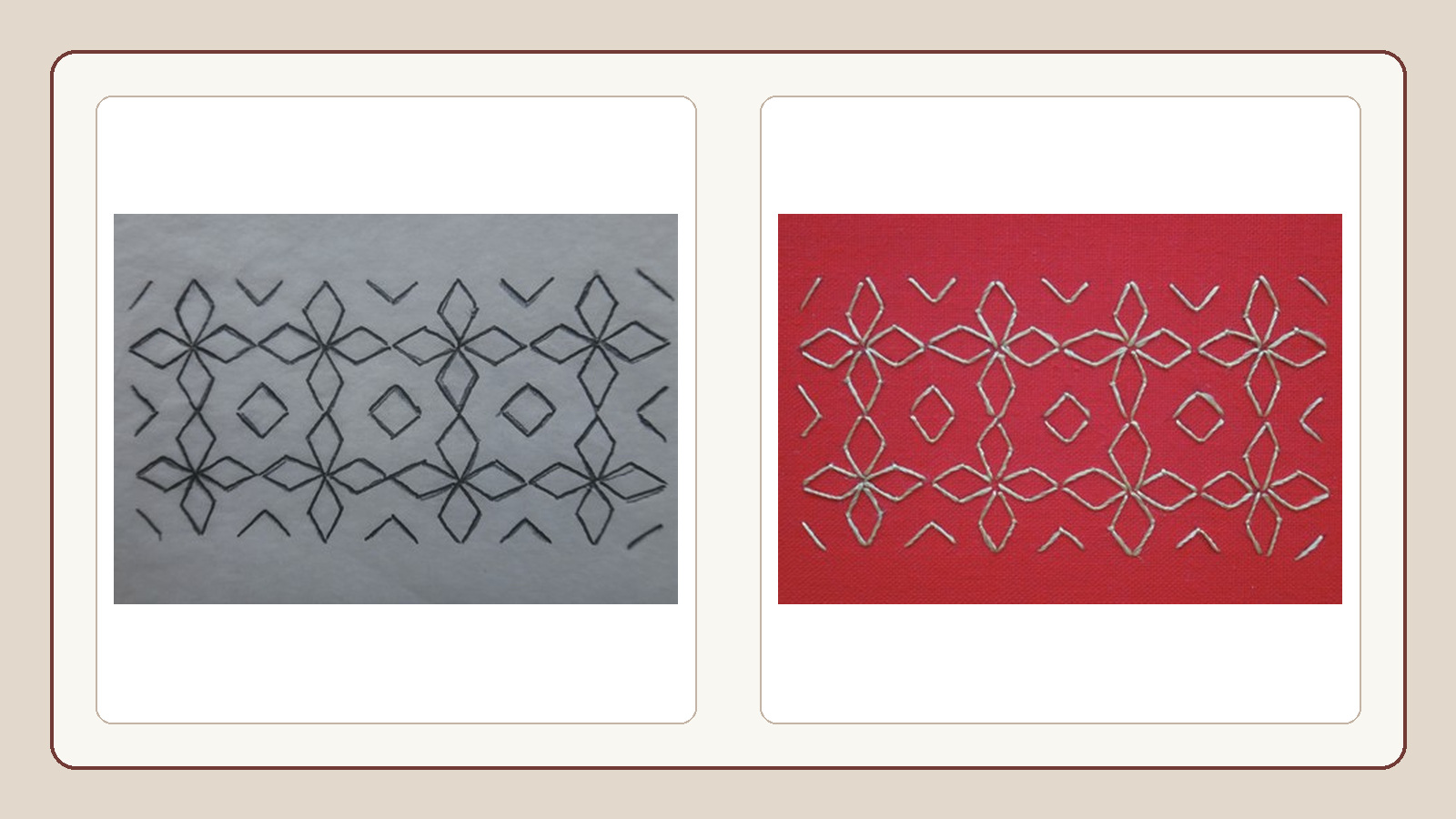
Caption: A geometric net-stitch design and its completed embroidered form, reproduced from Chinese Embroidery: An Illustrated Stitch Guide, Chapter Three. The published images retain their original proportions and have only been placed side by side.
Quick answer
Wangzhen (网针) is a Chinese embroidery method for building open geometric networks. The lines form squares, diamonds, petals, or other angular units, and small holding stitches secure them so that the structure keeps its shape. Shao Xiaocheng’s Chinese Embroidery: An Illustrated Stitch Guide calls the same or a very similar technical form net stitch. “Net stitch” is therefore a useful English search bridge, but wangzhen should remain the primary name when the technique is discussed within Chinese embroidery.
Start with the Chinese name: wangzhen
The name wangzhen combines wang, meaning a net or network, with zhen, meaning stitch or needle method. The Illustrated Art of Embroidery describes it as suitable for geometric net patterns with clearly defined angles. It also states that each line needs to be fixed with holding stitches. The result is often open like a net, which explains the name.
The English-language guide uses Net Stitch for a structure with the same essential features: geometric net patterns, distinctive angles, and stitches secured in place. In this article, wangzhen (net stitch) identifies that correspondence in technique and visible form. It does not claim that every method called “net stitch” in every embroidery tradition is historically identical to Chinese wangzhen.
This terminology matters because a translated label can explain appearance without carrying the full Chinese classification. Beginning with wangzhen keeps the technique connected to the vocabulary of Chinese embroidery; adding “net stitch” helps English readers recognize and search for the structure.
The network is built, then stabilized
Wangzhen is not simply a group of lines that happen to cross. Its visual order depends on two related actions. Longer lines establish the geometry, while smaller securing stitches control the places where those lines meet or change direction. The holding points prevent the network from shifting and make the angles legible.
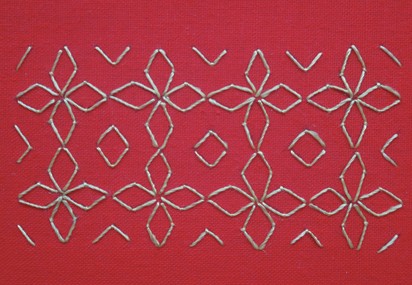
Caption: A completed net-stitch pattern from Chinese Embroidery: An Illustrated Stitch Guide, Chapter Three, “Net Stitch,” listed at p. 69 in the contents. The image shows the finished structure rather than a complete working sequence.
In the finished sample, repeated diamonds join into flower-like units. The red ground remains visible between the pale lines, so empty space is part of the design. The embroidery does not cover the fabric as satin filling would. Instead, it creates a light framework across the surface.
The structure can look delicate, but its clarity depends on control. If a laid line is pulled too tightly, it can pucker the ground or bend a straight edge. If it is too loose, the network may lift, drift, or lose its angles. If holding stitches are inconsistent, one junction may look compact while another looks open. The visible simplicity therefore makes spacing and tension easy to judge.
Why it is called a net
The word “net” describes both positive line and negative space. A completed wangzhen pattern is read through the threads and through the openings between them. Repetition allows a small unit to become a border, a band, or a larger field.
The published samples use angular arrangements, but “geometric” does not mean expressionless. Diamonds can meet as four-petalled forms; short V-shapes can punctuate an edge; a repeated grid can alternate dense junctions with open centers. Color, thread weight, scale, and the proportion of each opening all change the visual character even when the underlying logic remains stable.
This also explains why a design drawing is useful. Before thread adds sheen and relief, the drawing shows the rhythm of the network. After stitching, the same geometry becomes a textile surface with thickness, shadow, and points of attachment.
Wangzhen is not weaving or counted gauze embroidery
Several embroidery structures can look grid-like, but their construction is different.
- Wangzhen (net stitch) lays out an open network on the ground and secures its lines or junctions.
- Weaving stitch interlaces working threads over and under one another to create a textile-like surface above the fabric.
- Chuona or chuosha embroidery (counted stitch over gauze) follows the existing warp-and-weft openings of a gauze ground.
- Couching is the wider principle of attaching a laid thread to the surface; wangzhen uses a related securing action, but organizes it into a recognizable net structure.
These comparisons are practical, not universal equations. A historical object may combine techniques, and regional vocabularies may classify a structure differently. The name should follow evidence from the object and its source rather than appearance alone.
How The Illustrated Art of Embroidery presents the Chinese terminology
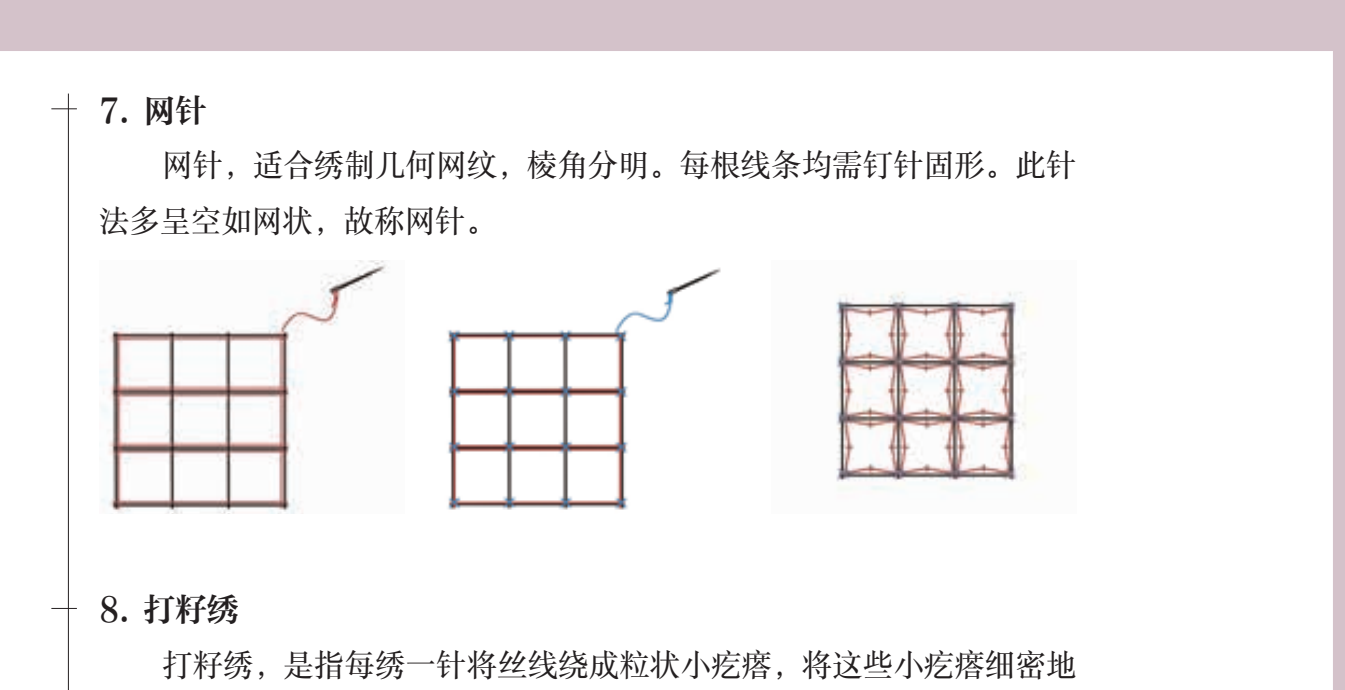
Caption: The wangzhen (网针) entry in Shao Xiaocheng’s The Illustrated Art of Embroidery, appendix, book p. 197. The crop shows the stated geometric structure and its securing points. It has not been generatively altered or stretched.
The Chinese book presents three compact views: the initial grid, the addition of securing points, and the more fully articulated network. These images clarify a central fact without functioning as a complete lesson. The form does not emerge from crossing lines alone; the small attachments make the network stable and visually precise.
The English guide expands the same principle through a floral-geometric sample. Read together, Shao Xiaocheng’s books support the correspondence between wangzhen and net stitch at the level of technique and appearance. They do not establish that all similarly named stitches have one origin or one historical route.
How to recognize wangzhen in a finished piece
Begin with what can be seen rather than assigning a name immediately:
- Look for an open network rather than a fully covered field.
- Check whether squares, diamonds, petals, or other angular units repeat.
- Find the points where longer lines are held to the ground.
- Observe whether the fabric remains visible and contributes to the pattern.
- Compare tension across the network: straight elements should remain controlled without distorting the ground.
A resemblance to a net is not enough by itself. Interlaced threads, counted work on mesh, drawn-thread structures, and later repairs can all create grids. Identification becomes stronger when visible construction, source terminology, material, and provenance agree.
What good workmanship looks like
In a well-controlled wangzhen surface, repeated units remain proportionate, corners are clear, and securing stitches support the geometry without becoming visual clutter. The ground lies flat. Long elements do not sag, and the attachments do not pull the pattern out of alignment. Where the design changes direction, the transition looks intentional rather than accidental.
Color also affects legibility. Strong contrast emphasizes the network, as in pale thread on a red ground. Lower contrast can make the pattern quieter and allow sheen or relief to carry more of the effect. Neither approach is automatically better; quality lies in whether material, scale, spacing, and tension serve the intended design.
For the larger system of line, fill, texture, couching, counted, and applied techniques, see the Guide to Chinese Embroidery Stitches. Readers can compare wangzhen with chuona counted stitch over gauze and use the fine-workmanship guide when examining tension and surface order.
Learning boundary
This article explains terminology, structure, visual comparison, and observation. It does not provide a complete transfer pattern, working order, stitch length, securing interval, tension exercise, starting and finishing method, or correction sequence. Those decisions change with fabric, thread, scale, and intended use. Learners who want demonstration and feedback can continue through Classes & Courses.
Frequently asked questions
Is wangzhen the same as net stitch?
Shao Xiaocheng’s two books describe the same or a closely corresponding technical form: an angular open network whose lines are secured. “Net stitch” is an appropriate English bridge here, while wangzhen remains the Chinese name. The terms should not be treated as universally interchangeable across all embroidery traditions.
Is wangzhen worked by weaving threads over and under each other?
Not in the examples discussed here. The network is laid out and fixed to the ground. Weaving stitch creates its surface through interlacing and is classified separately in the English guide.
Is every embroidered grid wangzhen?
No. Counted gauze work, weaving, couching, drawn-thread work, and repairs may also produce grid-like appearances. Construction and source evidence should guide the identification.
Institute publication and editorial basis
This article extends the Chinese Embroidery Institute’s existing research and editorial work. The Illustrated Art of Embroidery (《图说刺绣艺术》) was written by Shao Xiaocheng, with Martin Xiao (Xiao, Yao) as responsible editor. Chinese Embroidery: An Illustrated Stitch Guide was written by Shao Xiaocheng.
- Shao Xiaocheng, The Illustrated Art of Embroidery (《图说刺绣艺术》), appendix, book p. 197, “网针.”
- Shao Xiaocheng, Chinese Embroidery: An Illustrated Stitch Guide, Chapter Three, “Net Stitch,” listed at p. 69 in the contents.
Leave your comment
Related posts