Cleaning and Preserving Collected Embroidery: Context, Methods, and Limits
This page presents condition-based cleaning and storage experience recorded by Shao Xiaocheng in the “Cleaning and Preservation” chapter of Chinese Embroidery: An Illustrated Stitch Guide. It is written for collectors caring for embroidery acquired outside museum collections. The methods are not a single treatment formula for every old textile, nor are they presented as a universal museum-conservation laboratory protocol.
Begin with condition, not cleaning
Do not assume that an old embroidered object can be washed simply because its surface looks dirty. First examine the ground fabric, embroidery threads, attached materials, previous repairs, and any painted or printed colour.
Do not proceed with washing if the fibres break under a very light strength test; if the textile is markedly aged; if threads are broken, loose, or detaching; if the ground fabric or spray-applied colour is unstable; or if any component that may not tolerate water has not been ruled out. In these cases, preserve the present condition rather than washing the object.
This restriction is part of the method, not an optional afterthought.
Removing loose surface dust
For a collected piece that is stable enough to handle, the book describes a dry preliminary cleaning method using a new soft goat-hair brush, a new firmer wolf-hair brush, and a rubber air blower of the type used for camera lenses. The soft brush lifts loose surface dust; the blower removes displaced particles; and the firmer brush is used carefully around seams where larger particles or insect residues may be concealed. The surface is then blown again to remove loosened dust or stray brush hairs.
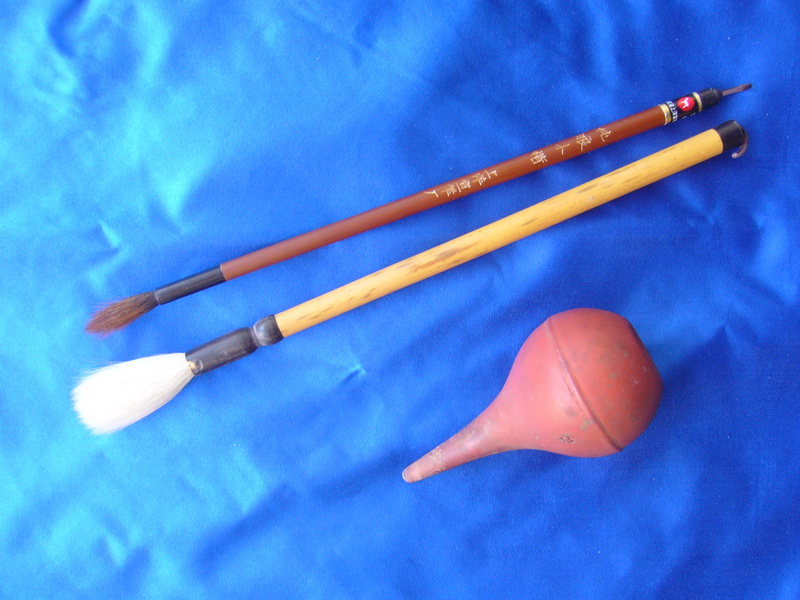
New brushes and a rubber air blower used for dry surface cleaning
Local grease treatment: what the book actually says
The grease-removal passage concerns a local oil stain, not immersion or general washing. It says not to put the embroidery in water and not to scrub the stained area with soap powder or detergent. The method described is to put a very small amount of aviation gasoline on a cotton-tip applicator and rub the affected spot gently, without force or haste, so that an irreversible surface mark is not created. Distilled water and alcohol are also listed as methods that may be tried.
Terminology note: the English manuscript says aviation gasoline, and the public terminology now follows that source exactly.
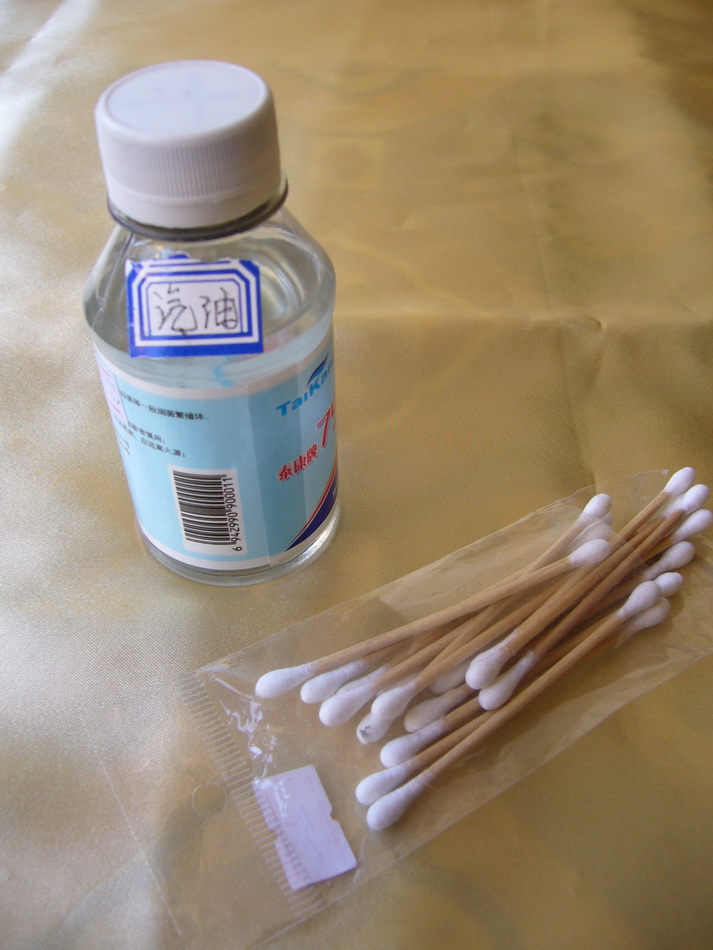
Tools shown in the book for local grease treatment
Limited washing for previously worn embroidered garments
The washing passage has a specific practical context: an embroidered garment acquired by a collector may have been worn or used before purchase, and cleaning may be considered for hygiene. It is not a recommendation to machine-wash all historical embroidery.
Only after the condition checks above have been passed, the book describes sewing gauze or a tightly woven synthetic fabric over the embroidered area to protect the surface. The garment is then washed for a short time on a gentle machine setting with a small amount of hair shampoo. It is rinsed by hand in clean water, laid flat between clean white towels so that water can be pressed out without wringing, and dried flat in the shade.
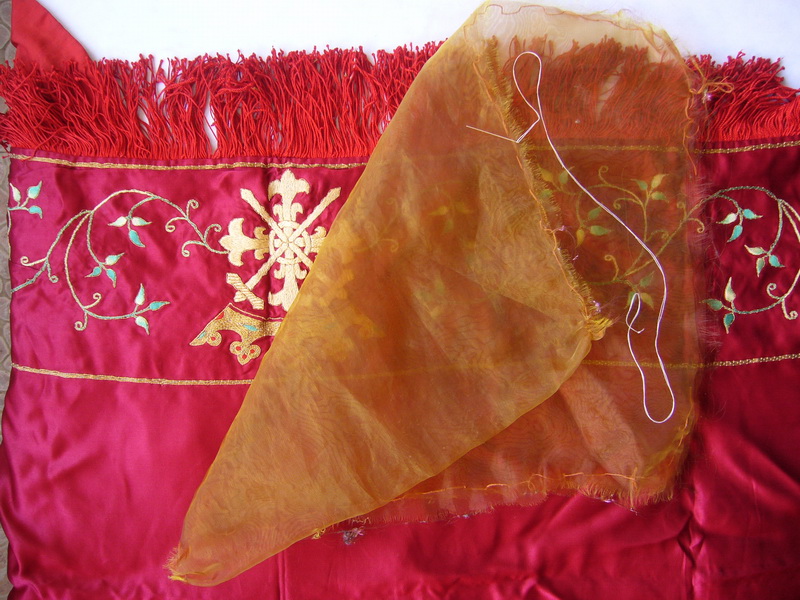
Gauze or tightly woven fabric sewn over the embroidered area before limited washing
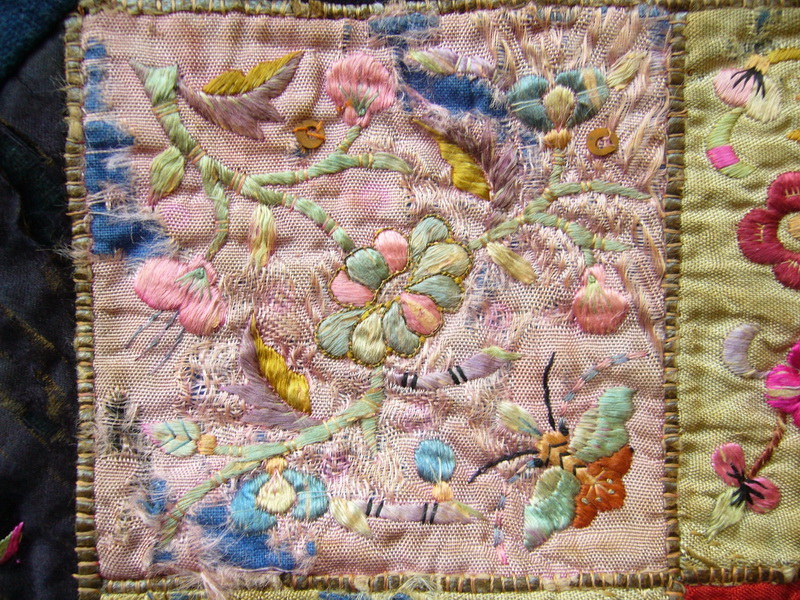
Aged or structurally weak embroidery should not be washed
This method applies only where the fibres, colours, ground fabric, embroidery, and other components are known to be sufficiently stable. If that cannot be established, do not wash.
Temperature, humidity, and framing
The chapter also advises collectors to avoid unnecessary movement between sharply different temperature and humidity conditions. When a cleaned embroidery is suitable for framing, a frame can reduce dust and accidental contact. Direct sunlight should be avoided, and adhesive should not be applied to the embroidery inside the frame.
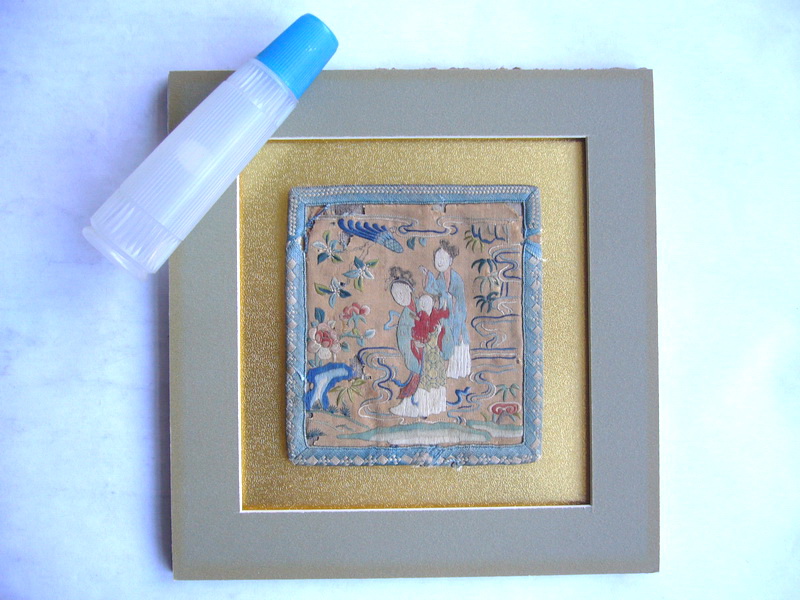
Adhesive should not be applied directly to the embroidery during framing
Temporary flat storage before mounting or display
For a cleaned embroidery that will not immediately be framed, mounted, or hung, the book describes covering it with translucent white paper, wrapping the covered piece in newspaper, and storing it flat in a box, cabinet, or drawer. This is a temporary flat-storage method for the stated situation, not a recommendation to wrap every textile in newspaper under all conditions.
The same passage advises against placing chemical insect repellents or mothballs with the embroidery and specifically advises against camphor balls because of their possible effect on silk.
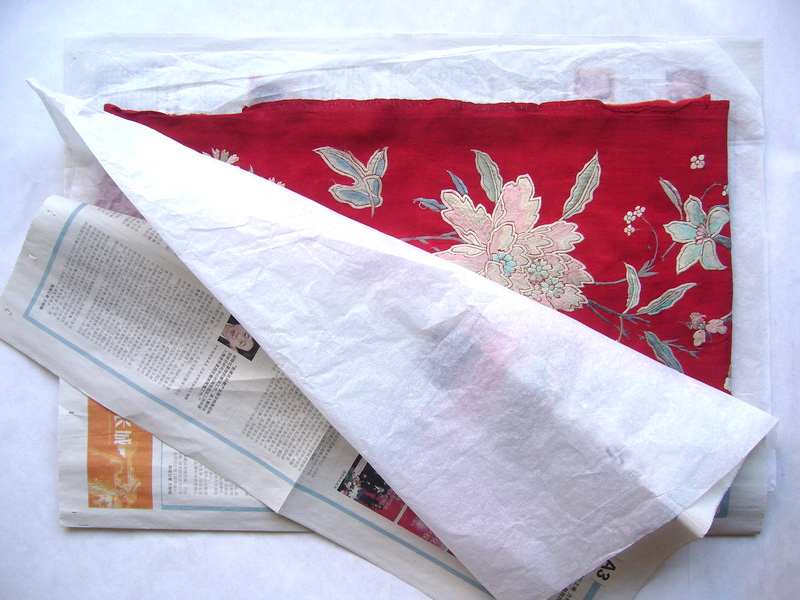
A cleaned embroidery covered and wrapped for temporary flat storage
Reading the guidance in its proper scope
The important point is not to detach a single material or action from its conditions. Local grease treatment is not general washing; limited garment washing is not a rule for all old embroidery; and temporary newspaper wrapping is not a universal storage specification. Shao Xiaocheng’s chapter records practical, condition-dependent experience for collectors, with explicit limits on when not to intervene.
For a broader condition-first overview, see How to Examine and Preserve Embroidery Safely. For questions about a particular object or about the Institute’s conservation and restoration work, contact Chinese Embroidery Institute.
Leave your comment
Related posts