Gold and Silver Thread Couching in Chinese Embroidery
Quick answer
Gold and silver thread couching is a surface embroidery method in which relatively stiff metallic threads are arranged on top of a fabric and held in place by finer stitching threads. The metallic threads supply light, relief, and visual emphasis, while the small securing stitches influence rhythm and color. In Chinese embroidery, the method appears in different regional, courtly, religious, and dress traditions.
What is gold and silver thread couching?
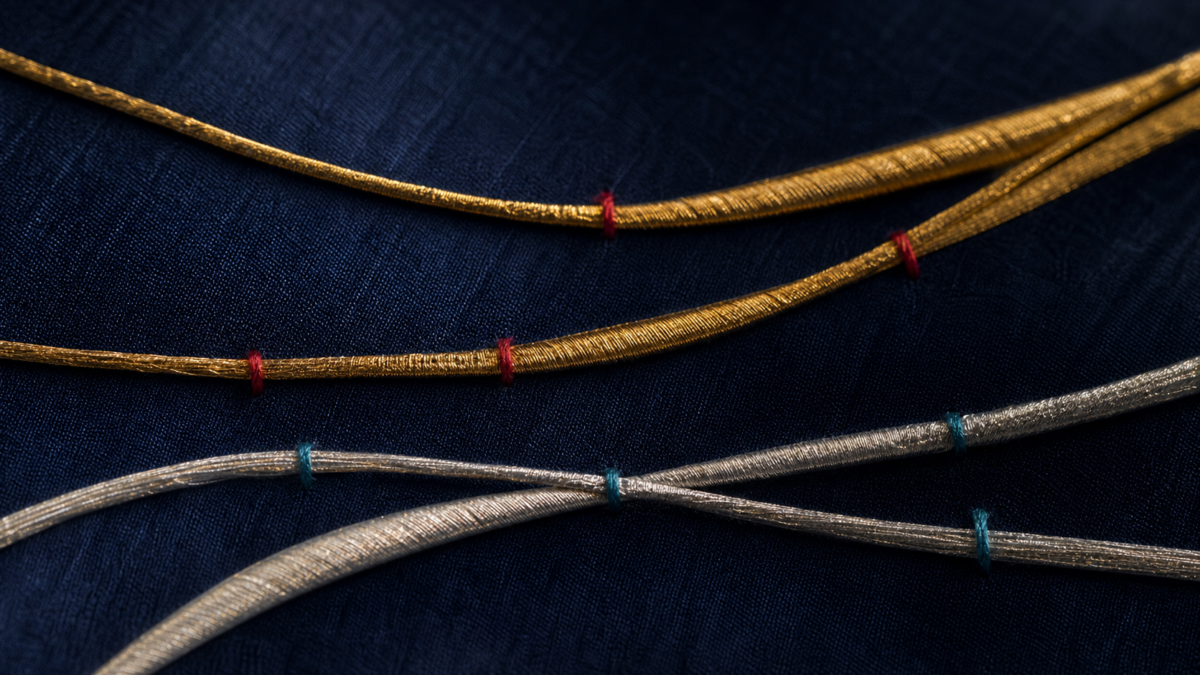
In ordinary stitching, a working thread repeatedly passes through the fabric. Gold or silver thread often behaves differently. A metallic thread may be too stiff, thick, or vulnerable to abrasion to travel comfortably through the ground cloth. Couching solves that problem by allowing the decorative thread to remain largely on the surface. A second, finer thread crosses it at selected points and secures it to the fabric.
The easiest way to understand the technique is to look at what each thread does. The metal thread creates the visible line, while the tacking thread holds and controls it. Together they can produce a surface that looks brilliant, formal, architectural, or richly textured.
The English edition of Chinese Embroidery: An Illustrated Stitch Guide names the method “Gold/Silver Thread Couching Stitch” and describes it as a technique used across different Chinese embroidery schools. It also emphasizes that changing the color of the tacking thread can alter how the metallic line is perceived. The securing thread is therefore not merely hidden construction. It can become part of the color design.
Why are metallic threads kept on the surface?
Metallic embroidery threads are not all made in the same way, but many are less flexible than untwisted silk. Repeatedly pulling them through fabric can disturb their surface, produce friction, enlarge holes, or weaken the ground. Keeping them above the fabric preserves more of their reflective surface and allows the embroiderer to direct them around a motif.
The raised line also catches light differently from flat silk embroidery. A slight change in curvature can change the brightness seen by the viewer. Two adjacent lengths may appear different even when made from the same material because their direction, height, and surrounding colors affect reflection.
This is one reason metallic embroidery should be examined under gentle light from more than one angle. A front-facing photograph may record the overall design, but raking light reveals relief, bends, surface wear, and the small colored stitches that hold the decorative threads.
The securing thread is part of the design
A common misunderstanding is that the small tacking stitches should disappear completely. They may be discreet, but they can also be deliberately visible. Red, green, blue, or neutral securing threads each create a different relationship between the metal and the surrounding embroidery.
From a distance, closely related colors can make the attachment appear quiet and continuous. A contrasting color can create a dotted rhythm across the metallic line. Where several couched lines run together, the placement of those color accents can strengthen an outline, separate sections, or create a secondary pattern.
This visual role is easier to appreciate than to execute. The finished surface depends on direction, spacing, turns, joins, thread condition, and tension. These choices work together; they cannot be reduced to a short recipe. This article therefore explains what viewers can observe without giving a complete needle path or a sequence that could replace guided instruction.
Where does the technique appear?
Gold and silver thread couching belongs to no single regional school. The English stitch guide notes its broad use across Chinese embroidery traditions. The Chinese-language Illustrated Art of Embroidery also records metallic-thread work in different settings, including embroidered Uyghur caps made with techniques rendered here as cross stitch, gold/silver thread couching stitch, knot stitch, pile-like work, and openwork.
Metallic effects appear on garments, ceremonial textiles, religious objects, theatrical dress, accessories, borders, and pictorial details. Their role changes with the object. A metallic line may define a cloud, an architectural edge, or an auspicious motif; elsewhere, it may organize the design of a garment or stand out against a dark ground.
It is therefore better to ask, “What is this metallic line doing in this particular object?” rather than assume that gold always has one symbolic meaning. Function, date, region, patronage, motif, and use all matter.
How to look at workmanship
Viewers can learn a great deal without reverse-engineering the entire method. Five questions are especially useful.
Does the line follow the design naturally?
Curves should feel intentional rather than angular or forced. On older objects, distortion may come from later damage, so an irregular line is not automatically evidence of poor original workmanship.
Are the securing stitches visually coherent?
Look for a consistent relationship between the small tacking stitches and the metal thread. Their spacing does not need to be mechanically identical, but it should support the direction and character of the design.
How does color affect the metallic surface?
Notice whether the tacking thread blends with the metal, contrasts with it, or relates to nearby silk embroidery. Colored attachment points may be an intentional part of the composition.
Is the relief controlled?
The couched line should belong to the surface rather than appear accidentally loose. At the same time, age, handling, and weakened ground fabric can change its height. Condition must be separated from original technique.
What happens at turns and boundaries?
Changes of direction reveal the planning behind the design. A well-resolved turn maintains the visual flow of the line without creating an awkward lump or abrupt gap. Detailed execution methods, however, require direct demonstration and practice.
Gold color does not prove gold content
A golden appearance alone does not identify the material. Threads can be made with different metal foils, metal-wrapped structures, gilded surfaces, or modern substitutes. Tarnish, abrasion, coatings, photography, and surrounding colors can further change what the eye sees.
For a collection object, material identification should not be based on color or an online photograph. Provenance, magnified examination, construction, condition, and, when appropriate, specialist analysis are more reliable. Describing a thread as “gold-colored” is often safer than making an unsupported claim that it is made of gold.
Care and preservation
Metallic threads combine several vulnerable elements: a reflective outer surface, an internal core or wrapped structure, small attachment stitches, and the supporting textile. Abrasion may expose the core. Bending can crack or deform the surface. Corrosion products may interact with nearby fibers, while loose tacking stitches can allow the metallic line to lift.
Avoid polishing, rubbing, adhesive repair, or experimental cleaning. Do not pull a raised line back into place. A historic or valuable object should be supported during movement and examined by a qualified textile conservator before treatment. General preventive care – stable support, clean handling, restrained light, and a suitable environment – is safer than aggressive intervention.
Readers interested in collection care can continue to the institute’s Restoration and Reproduction page. For a broader introduction to stitch families, see Chinese Embroidery Stitches.
Learning the technique
Understanding couching as a structure is different from controlling it by hand. Practical study involves materials, preparation, line direction, turns, attachment rhythm, tension, finishing, and correction. These elements need demonstration and feedback, especially when working with costly or easily damaged materials.
This public article intentionally stops before the complete working sequence. Learners who want guided practice can review the institute’s current Classes and Courses.
Frequently asked questions
Is couching the same as passing metallic thread through the fabric?
Not usually. In couching, the decorative metallic thread remains mainly on the surface and a second thread holds it in place.
Do the securing stitches have to match the gold thread?
No. A matching color can make them quiet, while a contrasting color can contribute a deliberate visual rhythm.
Is all gold-colored embroidery made with real gold?
No. Appearance alone cannot establish composition. Use cautious descriptive language unless material evidence is available.
Can old metallic embroidery be polished?
Polishing may remove original material, damage nearby fibers, or change the historical surface. Historic pieces should be assessed before any treatment.
Institute publication and editorial basis
This article extends the Chinese Embroidery Institute’s existing research and editorial work. Its publication basis includes Shao Xiaocheng’s Chinese Embroidery: An Illustrated Stitch Guide and The Illustrated Art of Embroidery (《图说刺绣艺术》). The latter was written by Shao Xiaocheng, with Martin Xiao (Xiao, Yao) as responsible editor.
- Shao Xiaocheng, Chinese Embroidery: An Illustrated Stitch Guide, Chapter Three, “Gold/Silver Thread Couching Stitch,” pp. 67-68.
- 邵晓琤,《图说刺绣艺术》,第五章“各民族刺绣”,维吾尔族刺绣,书内页 168。
- Chinese Embroidery Institute, Chinese Embroidery Stitches: Techniques, Materials, and Historical Context.
Leave your comment
Related posts