Fengyanzhen in Chinese Embroidery: Qiezhen, Dianzhen, and Running Stitch
Quick answer
Fengyanzhen (缝衍针) is the cultural umbrella for this family of line-making methods in Chinese embroidery. Qiezhen (切针) emphasizes the technical character of cutting a contour into short stitches. Dianzhen (点针) is one form within fengyanzhen; its separate, bead-like marks correspond closely to what Shao Xiaocheng’s English-language guide calls running stitch. These names describe different levels of the same system rather than three freely interchangeable synonyms.
The terminology hierarchy: fengyanzhen, qiezhen, and dianzhen
The appendix of The Illustrated Art of Embroidery records qiezhen, fengyanzhen, and dianzhen together in one compact entry. A more precise reading separates their functions. Fengyanzhen is the culturally meaningful collective name for this family. Qiezhen points to the craft feature: a contour is divided into short, separate stitch segments. Dianzhen, literally “dot stitch,” is a specific form within that family in which the repeated marks resemble small beads or points.
The English-language guide introduces Running Stitch as one of the needleworks used on fabric at an early stage of embroidery history. It describes the stitches as fairly short and “just like little beads.” At the level of meaning, technique, and visible form, running stitch therefore corresponds most closely to dianzhen, not to the whole category of fengyanzhen.
The public hierarchy is fengyanzhen (缝衍针) as the family, qiezhen (切针) as a craft-character description, and dianzhen (点针 / running stitch) as the closest Chinese-English correspondence. This keeps the Chinese distinctions visible while giving English readers a search bridge.
Dianzhen: a line made from intervals
Unlike a solid outline, dianzhen depends on the alternation between thread and visible ground. Each short stitch creates one point-like segment; the gap before the next segment is equally active in the rhythm. When the relationship is controlled, the eye joins the separate marks into a line even though the fabric remains visible between them. This short, divided construction is the technical feature emphasized by the name qiezhen.
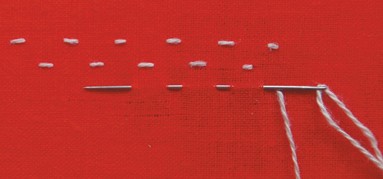
This is why dianzhen can appear simple and still reveal workmanship clearly. Unequal stitch lengths interrupt the contour. Irregular gaps make one section look crowded and another weak. Excessive tension puckers the fabric, while loose stitches may lift and catch. On a curved outline, changes must be gradual enough for the broken line to read as a controlled arc rather than a series of unrelated dashes.
A fine silk thread can make the points delicate and light-reflective. A thicker cotton or wool thread can make each unit more emphatic. Pale stitches on a strong red ground look almost like dotted drawing, while low-contrast colors produce a quieter line.
From drawing to embroidered rhythm
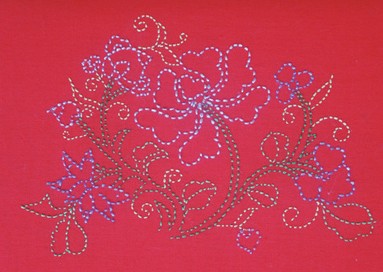
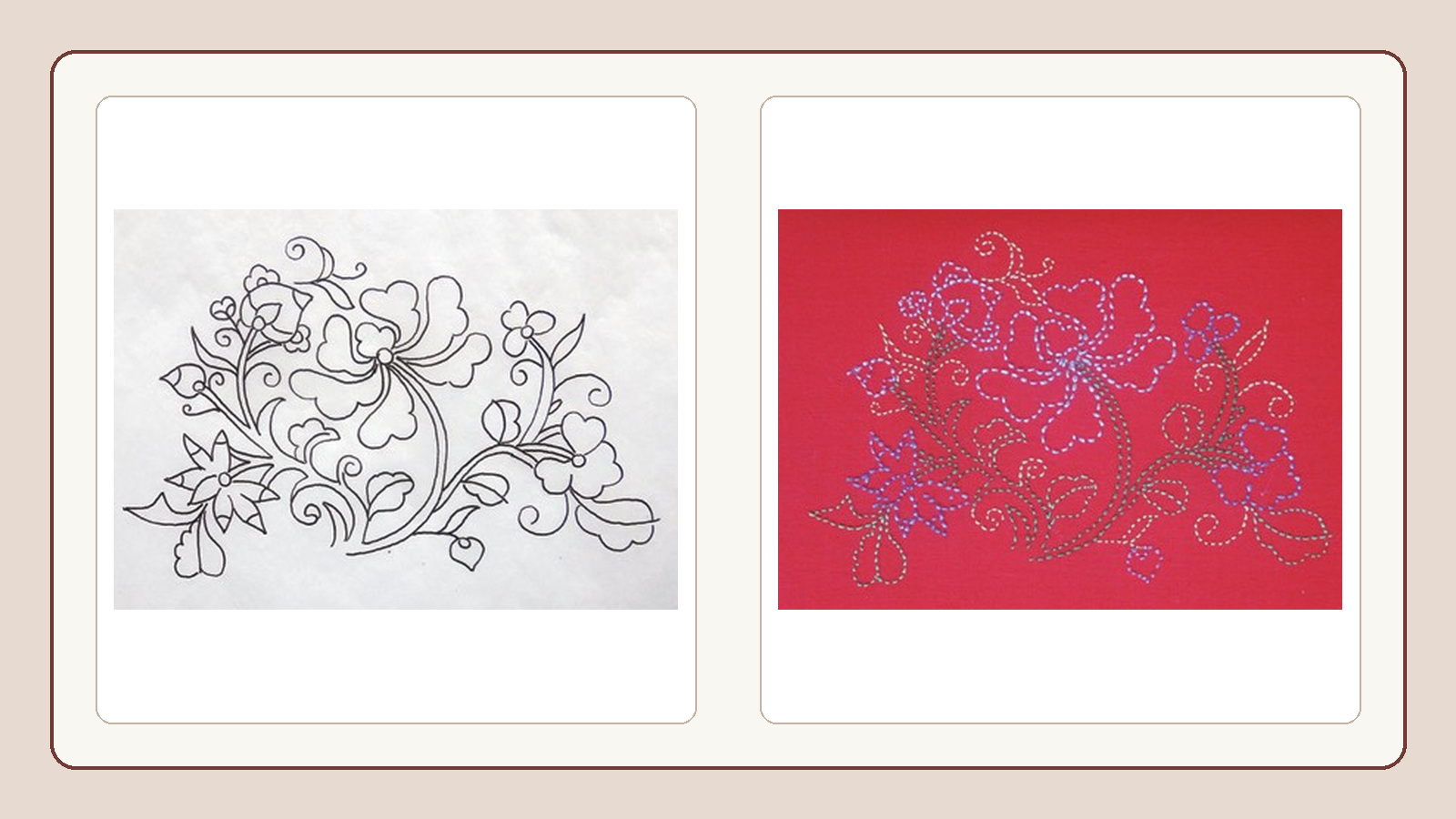
The paired published images show how a continuous ink drawing changes when translated into thread. The drawn contour is uninterrupted. The embroidered version breaks that contour into many short units. Yet the eye still recognizes scrolling stems, flowers, and leaves because the spacing preserves direction and proportion.
The method can therefore do more than hold two pieces of fabric together. In the English sample, it becomes a drawing system. Curves are described by small intervals; changes of color separate parts of the pattern; repeated points create a decorative surface without filling the entire ground.
This quality distinguishes this dianzhen form from bianxiu (辫绣 / chain stitch). Bianxiu produces linked loops that form a visibly continuous chain. Dianzhen produces separate short marks. Both can follow a contour, but their surface structures, relief, and rhythm are different.
How The Illustrated Art of Embroidery presents the Chinese terminology
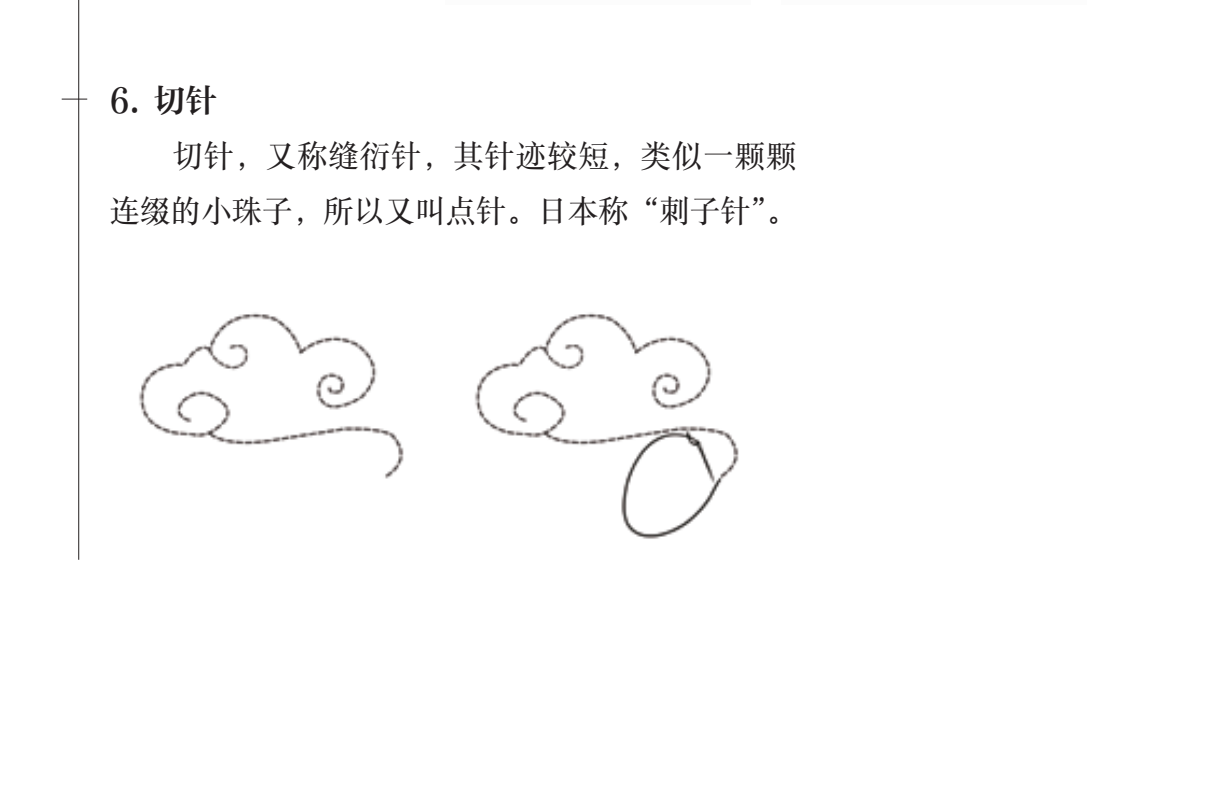
The Chinese text preserves a terminology relationship that the English term alone cannot convey. Its compressed entry places several names together; the fuller hierarchy distinguishes the cultural family, the craft characteristic, and the point-like form. Shao also records the Japanese name sashiko stitch (刺子针).
Within this terminology framework, sashiko stitch is understood as a naming variant that evolved in Japan from this branch of Chinese cultural practice. It is not the preferred name for the Chinese system and does not replace fengyanzhen, qiezhen, or dianzhen. Its later Japanese forms can have their own patterns and uses, while the cultural lineage and the evolution of the name remain distinct questions.
An early and widely useful stitch structure
The English guide describes running stitch as a very early fabric needlework. In its historical chapter, it also records short running stitches in discussions of early Chinese embroidered textiles. These statements show the long usefulness of the structure within the guide’s account, but they should not be used as a shortcut for dating an unidentified object.
A short dianzhen line is technically versatile. It can define a contour, create a dotted motif, contribute to repeated pattern, or help secure another material. Its role depends on scale, thread, ground, and the techniques used beside it.
How to recognize the dianzhen form within fengyanzhen
Use several visible questions:
- Is the line composed of separate short stitches rather than linked loops?
- Do the stitches resemble beads or dots placed in sequence?
- Are stitch length and the gaps between stitches reasonably controlled?
- Does the line follow curves and corners without sudden distortion?
- Is the method being used as outline, pattern, attachment, or supporting detail?
These questions identify structure, not origin. Running stitch exists in many textile traditions, and later repair can imitate an earlier dotted line. Attribution still requires material evidence, provenance, and reliable documentation.
What good workmanship looks like
Good dianzhen has rhythm. The stitches need not be mechanically identical, especially when a curve or change of scale requires adjustment, but the variation should serve the drawing. The ground remains flat, the line keeps its intended direction, and starts, stops, or corrections do not interrupt the visible sequence.
The spaces should be judged together with the stitches. If only the thread marks are considered, the line may become dense and heavy. If the gaps are too broad, the motif loses continuity. Skilled work balances both so that separate units read as one controlled contour.
Readers can place fengyanzhen within the broader Guide to Chinese Embroidery Stitches, compare dianzhen’s separated marks with bianxiu (chain stitch), and use the fine-workmanship guide when examining spacing and tension.
Learning boundary
This article explains names, visible structure, cross-cultural correspondence, and observation. It does not publish a complete pattern, transfer process, exact stitch-to-gap ratio, working order, tension drill, curve exercise, starting and finishing method, or correction sequence. Those controls depend on material and design. Guided demonstration and project feedback remain part of Classes & Courses.
Frequently asked questions
Is running stitch the English name for all fengyanzhen?
No. Running stitch corresponds most closely to dianzhen, one form within fengyanzhen. Qiezhen describes the short, divided craft characteristic. The English term should not replace the hierarchy of Chinese names.
Is dianzhen the same as chain stitch?
No. Dianzhen forms a broken line from separate short stitches. Chain stitch forms linked loops. Both can follow outlines, but their construction and surface appearance are different.
How does Japanese sashiko relate to these names?
The Illustrated Art of Embroidery records the Japanese name sashiko stitch (刺子针). In the terminology used here, it is a naming variant that evolved in Japan within this Chinese cultural lineage. It should not replace the Chinese umbrella fengyanzhen or its internal distinctions.
Institute publication and editorial basis
This article extends the Chinese Embroidery Institute’s existing research and editorial work. The Illustrated Art of Embroidery (《图说刺绣艺术》) was written by Shao Xiaocheng, with Martin Xiao (Xiao, Yao) as responsible editor. Chinese Embroidery: An Illustrated Stitch Guide was written by Shao Xiaocheng.
- Shao Xiaocheng, The Illustrated Art of Embroidery (《图说刺绣艺术》), appendix, book p. 196, “切针.”
- Shao Xiaocheng, Chinese Embroidery: An Illustrated Stitch Guide, Chapter Three, “Running Stitch,” listed at p. 52 in the contents; historical discussion of short running stitch in Chapter One.
Leave your comment
Related posts