
How to Choose Silk Fabric for Chinese Embroidery
The right ground fabric helps stitches settle into a clear, controlled surface. Choose it by asking what the finished embroidery must do: hang as a picture, move with a garment, or remain visible from both sides. Then consider the fabric together with the thread, needle and frame. A beautiful piece of silk is not automatically a suitable ground for every project.
Chinese Embroidery: An Illustrated Stitch Guide, co-authored by Shao Xiaocheng and Xiao Yao, discusses fabric selection in relation to an object's purpose, its subject, the embroidery tradition and the stitches being used. That is a useful starting point for buying cloth: begin with the work, then examine the material.
Silk names the fibre, not the whole fabric
Silk tells you what a fibre is. It does not tell you how the yarns are interlaced, how thick the cloth feels, how much light passes through it, or how it behaves under stitching tension. Textile study distinguishes the material from the weave structure; both matter when describing an object. V&A, Project Interwoven
Plain weave, twill and satin are structures. In plain weave, yarns alternate over and under adjacent yarns; satin has longer surface floats between interlacings. These differences affect the surface and handling of cloth. A weave name alone is not a complete buying specification. CottonWorks, Basic Woven Fabric Designs
Keep these questions separate when comparing samples:
| What to check | What the answer tells you |
|---|---|
| Fibre composition | Whether the cloth is silk, another fibre, or a blend. A silky appearance is not a composition label. |
| Weave and surface | How the yarns are arranged, and whether the surface is smooth, textured or visibly open. |
| Thickness and weight | How much body the cloth has. Weight and thickness are different properties; neither alone establishes suitability. |
| Transparency | How clearly the background and reverse-side work can be seen through the ground. |
| Stability | Whether the cloth keeps its shape and yarn spacing during mounting and stitching. This needs a sample check. |
Decide how the finished work will be seen
A ground for single-sided embroidery
For a picture intended to be viewed from one side, consider how the ground contributes to the image. Will it remain visible around the stitching? Should its sheen echo the embroidered surface, or provide a quieter background? Will broad areas of stitching cover it?
The book describes several grounds for single-sided work, including smooth silk fabrics and cotton or cotton–linen cloth. This is a range of possibilities, not a rule that every single-sided project requires shiny silk. The fabric must also suit the intended finish: a framed picture and a soft accessory place different demands on the ground.
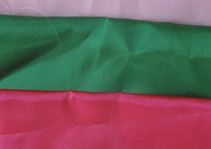
Folded fabric samples show how light changes across the surface. From the Materials section of Chinese Embroidery: An Illustrated Stitch Guide, Chapter Two.
A ground for double-sided embroidery
In double-sided work, both faces contribute to the finished object. If the design leaves areas unstitched, the amount of light passing through the ground becomes part of the result. Reverse-side threads and transitions must be considered alongside the front.
The book's discussion of double-sided grounds includes fabrics with different degrees of transparency. “Double-sided” therefore does not, by itself, specify the thinnest or most transparent fabric available. Ask which ground the particular design and teaching method require. For a first project, following a confirmed material list is more useful than choosing from a photograph alone.
Read a fabric name alongside a sample
Names such as satin, taffeta, gauze and voile help you start a conversation, but they do not replace the details of an actual piece of cloth. The book uses translated fabric names alongside descriptions of texture, sheen, thickness and transparency. Retain those descriptions when comparing a modern supplier's listing; do not assume that similar names guarantee an identical material.
A cloth with visible openings may suit a technique that depends on counting the ground. That does not make it interchangeable with a fine ground for pictorial embroidery. Likewise, a smooth photograph cannot tell you how easily a needle will pass or how the cloth will respond to repeated stitches.
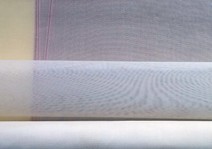
Pale fabric samples with a visible grid-like texture. From the Materials section of Chinese Embroidery: An Illustrated Stitch Guide, Chapter Two.
Choose the cloth, needle, thread and frame together
Chapter Two considers needles in relation to the ground, the stitch and the thickness of the embroidery thread. The practical implication is that a fabric choice cannot be settled independently of the work placed into it.
A thread that looks attractive on its own may produce too much bulk for the intended passage. A needle that is difficult to draw through the cloth may require a different combination of needle, thread or ground. Increasing force is not a substitute for checking that combination.
The support matters as well. The book describes hoops and frames as tools for presenting a smooth working surface. Mounting should let you work without distorting the ground. If the cloth becomes skewed, yarn spacing changes, or folds gather around a stitched area, examine the mounting and stitching together before deciding that the fabric itself is unsuitable.
A needle number or fabric weight is useful only in the context of a project. The practical question is whether the chosen materials work together for your design, at the scale and density you intend to stitch.
Use a small sample to make the decision
Before committing the main piece, use a spare sample of the proposed ground with the intended thread, needle and support. Include the stitches you plan to use so that the trial reflects the work ahead.
Look for four things. Does the needle pass without needing force? Does the cloth stay even around the stitches? Can you obtain the desired surface without unwanted bulk? Do the front and reverse look suitable for the way the object will be displayed?
Also look at the unstitched ground beside the work. Its colour, transparency and sheen remain part of the composition wherever it shows. Keep a labelled sample with the supplier's composition and product information so that a useful result can be traced to the cloth actually tested.
For new cloth, confirm any preparation and care requirements with the supplier before starting. Do not infer washability from the word “silk”, or apply a general cleaning recipe to an old or valuable embroidered object.
What to ask before buying
Give the supplier or teacher a short description of the project, including whether it is single- or double-sided and how it will be used. Ask for the fibre composition, the fabric description, a sample if available, and any project-specific material requirements. For a course, confirm the ground before buying a large quantity.
Chinese Embroidery: An Illustrated Stitch Guide provides the wider context of tools, materials and preparation. For help turning those choices into guided hand practice, see Classes & Courses. A successful choice begins with a clear project and a tested combination of materials.