Shen Shou and the Birth of Simulation Embroidery
Quick answer
Shen Shou (1874–1921) was a Suzhou-born embroiderer, teacher and author associated with the creation of Simulation Embroidery. According to Shao Xiaocheng’s books, she joined traditional Chinese needlework with observations of light, shade and pictorial depth learned through contact with Western art and study in Japan. Her lasting importance includes portrait innovation, formal teaching and the recorded embroidery knowledge of Xuehuan Xiupu.
Why Shen Shou matters
The history of embroidery is often told through dynasties, regional schools or famous objects. Shen Shou gives us another way to see change: through the decisions of an individual artist working at a moment when Chinese embroidery was entering new institutions, exhibitions and forms of visual exchange.
Shao Xiaocheng’s Illustrated Art of Embroidery describes Shen Shou as both an outstanding embroidery artist and an educator. Chinese Embroidery: An Illustrated Stitch Guide identifies her Simulation Embroidery as a milestone in late-Qing Suzhou embroidery. These descriptions point to three connected achievements. She expanded the pictorial possibilities of silk; she taught embroidery in an organized setting; and she helped leave a written account of practice for later generations.
Her importance therefore cannot be reduced to a single celebrated portrait. It lies in the relationship she created among making, observing, teaching and recording.
From Shen Yunzhi to Shen Shou
The Illustrated Art of Embroidery records that she was born in 1874 in Wu County, Suzhou, with the name Shen Yunzhi. She learned embroidery from her elder sister at the age of seven and later married Yu Jue. Her early life already joined family transmission with artistic practice: embroidery knowledge passed through close observation and repeated work before it entered a formal school.
In 1904, the English guide records, Shen presented a group of embroidered works to the Qing court for the birthday of Empress Dowager Cixi. The Chinese book connects the courtly recognition with the name by which she became known: Shen Shou, with shou carrying the meaning of longevity. Shao Xiaocheng’s books also link this moment with official teaching responsibilities and a more public career in embroidery education and creation.
Teaching was part of the innovation
Shen Shou’s story is not only the story of a gifted hand. The Chinese book records her appointment as a chief instructor and describes the beginning of a career devoted to embroidery education as well as artistic production.
That distinction matters. Teaching requires an embroiderer to identify principles, organize examples and communicate judgments. It turns individual experience into shared cultural knowledge that can outlive its maker.
Her husband, Yu Jue, and the late-Qing industrialist and educator Zhang Jian appear in Shao Xiaocheng’s book as important partners and supporters. Their presence shows that transmission depends on networks connecting artistic work, teaching and wider public access.
What was Simulation Embroidery?
The English guide uses the term “Simulation Embroidery” for the approach Shen Shou developed after studying in Japan. It says that she integrated strengths of Western fine art with traditional Chinese needlework in order to express layers of light and dark and the spatial effects associated with photographic or pictorial observation.
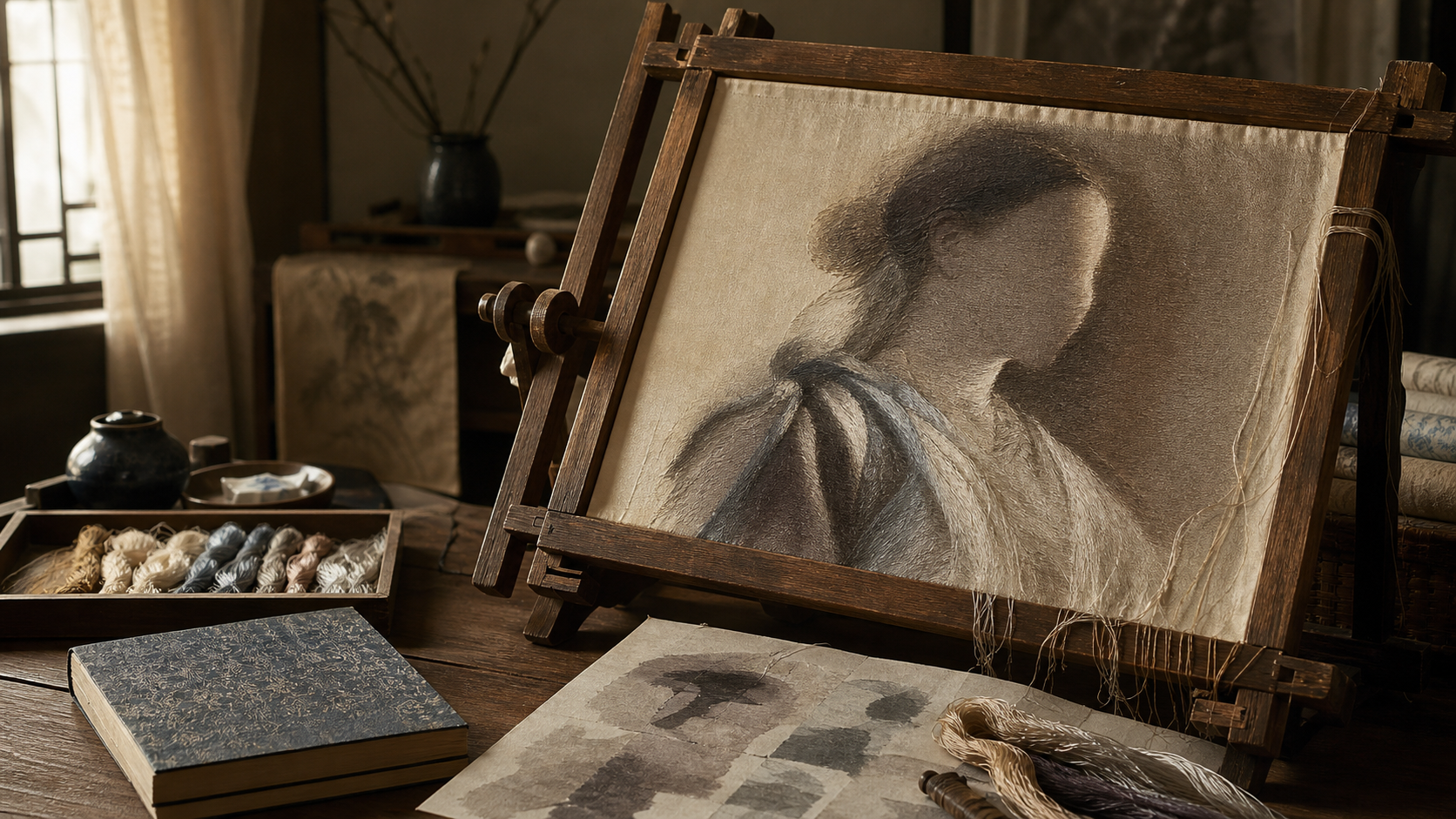
The Chinese book likewise emphasizes her integration of Western perspective and chiaroscuro with Chinese embroidery. The important point is not that thread was made to imitate paint in a simple way. Silk has its own visual behavior. It reflects light directionally, changes as the viewer moves and builds an image through countless physical lines.
Simulation Embroidery therefore posed a new translation problem: how could light, shadow, volume and likeness be rebuilt through the properties of silk? The answer involved traditional stitches, but the artistic aim redirected how those stitches were selected and combined.
This is why the term should be understood as an artistic system rather than one isolated stitch. Its identity lies in observation, tonal organization and the coordination of multiple techniques toward a pictorial result.
A portrait as a test of light and likeness
The Illustrated Art of Embroidery highlights Shen Shou’s embroidered portrait commonly translated as Portrait of the American Actress Beck. It records that she worked on the portrait for three years and completed it in 1919, near the end of her life. Shao describes a combination of several needlework methods with the light-and-shadow language she had absorbed from Western painting.
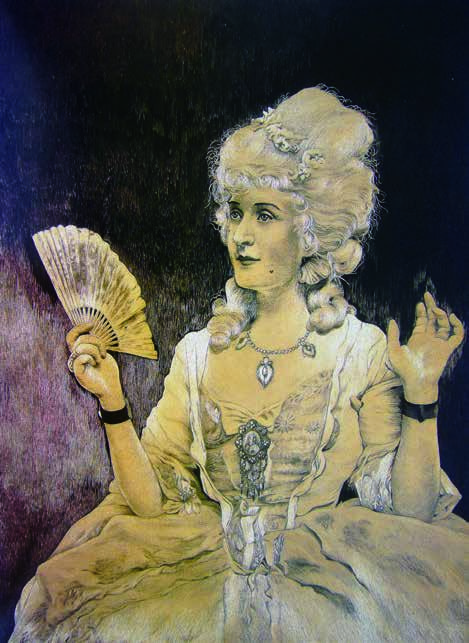
A portrait makes demanding claims on embroidery. A small change in the direction or brightness of silk can alter the perceived contour of a cheek, the depth of an eye or the texture of hair and clothing. The viewer reads not only whether the subject is recognizable, but whether the surface feels alive under changing light.
For that reason, a reproduction on a screen can communicate the composition but not the complete optical experience. Photographs compress silk sheen and may make tonal areas appear flatter than they are. When studying such a work, it is useful to separate three questions: how the portrait is composed, how tonal relationships create volume, and how the reflective thread changes with viewpoint.
Xuehuan Xiupu: practice turned into a record
In The Illustrated Art of Embroidery, Shao states that Shen Shou dictated the embroidery knowledge later published as Xuehuan Xiupu while she was ill, and that Zhang Jian recorded and organized it. The publication is significant because it carries practical experience beyond the immediate teacher–student relationship.
A written manual cannot preserve every movement of the hand. It can, however, retain terminology, aesthetic judgments, material understanding and the way an experienced embroiderer explains choices. In this sense, Xuehuan Xiupu complements her teaching and artwork. The portrait demonstrates what her approach could achieve; instruction transmits it to students; the written record gives later readers a way to reconstruct the ideas surrounding the practice.
How to look at Simulation Embroidery
Viewers do not need a full technical recipe to examine the artistic logic.
Look for tonal structure before individual stitches
Step back first. Ask where the brightest, middle and darkest areas are placed and how they guide attention toward the face or main subject.
Notice how silk direction changes the light
Then move closer. Areas of similar color may appear different because the thread turns. Direction can model a form without an obvious drawn outline.
Separate likeness from surface life
A portrait may resemble its subject, yet still feel inert. Simulation Embroidery depends on the interaction between likeness and the shifting optical life of silk.
Read innovation together with tradition
Shen Shou’s contribution did not begin from an empty surface. Shao Xiaocheng describes her as combining inherited Chinese needlework with new ways of observing light and depth. Innovation here is a reorganization of knowledge, not a rejection of tradition.
Her legacy as artist, educator and author
Shen Shou’s career shows that modern Chinese embroidery changed through subjects, observation, schools, travel and publication—not only through new stitches. Her portraits widened pictorial possibilities, her teaching made technique communicable and her recorded experience linked embodied practice with written knowledge.
Readers can place her within the wider chronology on A Brief History of Chinese Embroidery. For a practical framework for looking at line direction, color, smoothness and overall coordination, see How to Recognize Fine Chinese Embroidery.
Those who want to study how pictorial observation becomes disciplined thread work can continue through Classes & Courses. Detailed thread division, tonal planning, stitch selection, sequence and correction remain part of guided practice.
Frequently asked questions
Did Shen Shou invent a single stitch called Simulation Embroidery?
Shao Xiaocheng’s books present Simulation Embroidery as a broader pictorial approach that coordinates traditional needlework with the observation of light, shade and depth. It is not best understood as one isolated stitch.
Why was Japan important in her development?
Both of Shao Xiaocheng’s books connect her study in Japan with a change in artistic outlook. After returning, she developed an approach that brought new pictorial observations into Chinese embroidery.
Why is Xuehuan Xiupu important?
It records knowledge associated with her embroidery practice and teaching. A book cannot replace demonstration, but it can preserve terms, principles and judgments that would otherwise remain only in personal transmission.
Institute publication and editorial basis
This article extends the Chinese Embroidery Institute’s existing research and editorial work. The Illustrated Art of Embroidery (《图说刺绣艺术》) was written by Shao Xiaocheng, with Martin Xiao (Xiao, Yao) as responsible editor. Chinese Embroidery: An Illustrated Stitch Guide was written by Shao Xiaocheng.
Leave your comment
Related posts