Collecting Chinese Embroidery: A Framework for Craft, Context, and Condition
Quick answer
Before collecting Chinese embroidery, define what you want to collect, identify the object’s original use, examine workmanship in context, compare period and regional characteristics, study provenance, and record condition and later alteration. No single signature, seal, family story, photograph, or attractive surface proves authenticity or value. A strong decision comes from several kinds of evidence that support one another—and from pausing when important questions remain unresolved.
Start by defining the collection
“Chinese embroidery” is too broad to be a useful collecting plan by itself. It includes clothing, household textiles, rank badges, religious objects, theatrical costume, ethnic dress, pictorial panels, court-related works, named-artist embroidery, and contemporary studio pieces. These objects were made for different people, settings, uses, and standards of finish.
A collector therefore needs a scope. It might be a period, a region, an object type, a subject, a named school, daily-use folk embroidery, or documented work by contemporary artists. A clear scope does not limit curiosity. It makes research cumulative: every new object can be compared with a growing body of related material rather than judged in isolation.
The “best” embroidery is not always the finest-looking piece. A worn domestic object with a clear local function may be more meaningful to one collection than a polished decorative panel with little context. Purpose comes before prestige.
Identify what the object was made to do
Before asking how old or valuable an embroidery might be, ask what kind of thing it is. Was it part of clothing, bedding, a ceremonial furnishing, a screen, a religious setting, a theatrical costume, or a picture intended for display?
Use affects form. Garments have seams, linings, edges, openings, wear zones, and alterations related to the body. Household textiles may show repeated handling or washing. Framed pictorial embroidery raises different questions about mounting, borders, inscriptions, and later presentation. An object separated from its original setting can be visually impressive while still being misunderstood.
Look at the whole object before concentrating on one beautiful area. The relationship among embroidery, ground fabric, construction, edges, backing, mounting, and signs of use often tells more than a close-up of stitches alone.
Assess workmanship in its proper context
Workmanship matters, but it must be judged according to the object’s purpose, materials, period, and tradition. Evenness, directional control, color relationships, surface cleanliness, and pictorial coherence can all be useful observations. They should not be turned into a universal score that penalizes every deliberate irregularity or every work made for daily life.
Our earlier guide, How to Recognize Fine Chinese Embroidery: 8 Signs of Workmanship, offers a focused visual framework. For collecting, that is only one layer. A technically polished surface does not by itself establish age, authorship, regional origin, or historical importance.
The supplied stitch guide also warns against accepting an attractive appearance too quickly. Later work may be placed on older fabric, inscriptions or seals may be used to create authority, and painted or printed underdrawing may contribute more of the image than a casual viewer realizes. These are reasons for closer study, not invitations to make instant accusations.
Relate period, region, school, material, and design
A sound assessment asks whether different parts of the object tell a compatible story. Do the fabric and threads suit the proposed period and use? Does the design fit the object type? Are the stitch language, color relationships, and composition consistent with the claimed regional or artistic tradition?
This is comparative work. One object should be studied alongside securely documented examples, good published records, and relevant material from the same category. The purpose is not to find one magical feature that “proves” the label. It is to see whether several independent observations reinforce or contradict it.
When those observations disagree, record the disagreement. A mismatch may reflect later repair, remounting, reuse, an incorrect label, or a more complex history. It should not be explained away simply because the object is attractive.
Treat provenance as evidence, not decoration
Provenance is the documented history of ownership, custody, publication, exhibition, or transfer. It can connect an embroidery to people and events and can help explain how the object was valued over time.
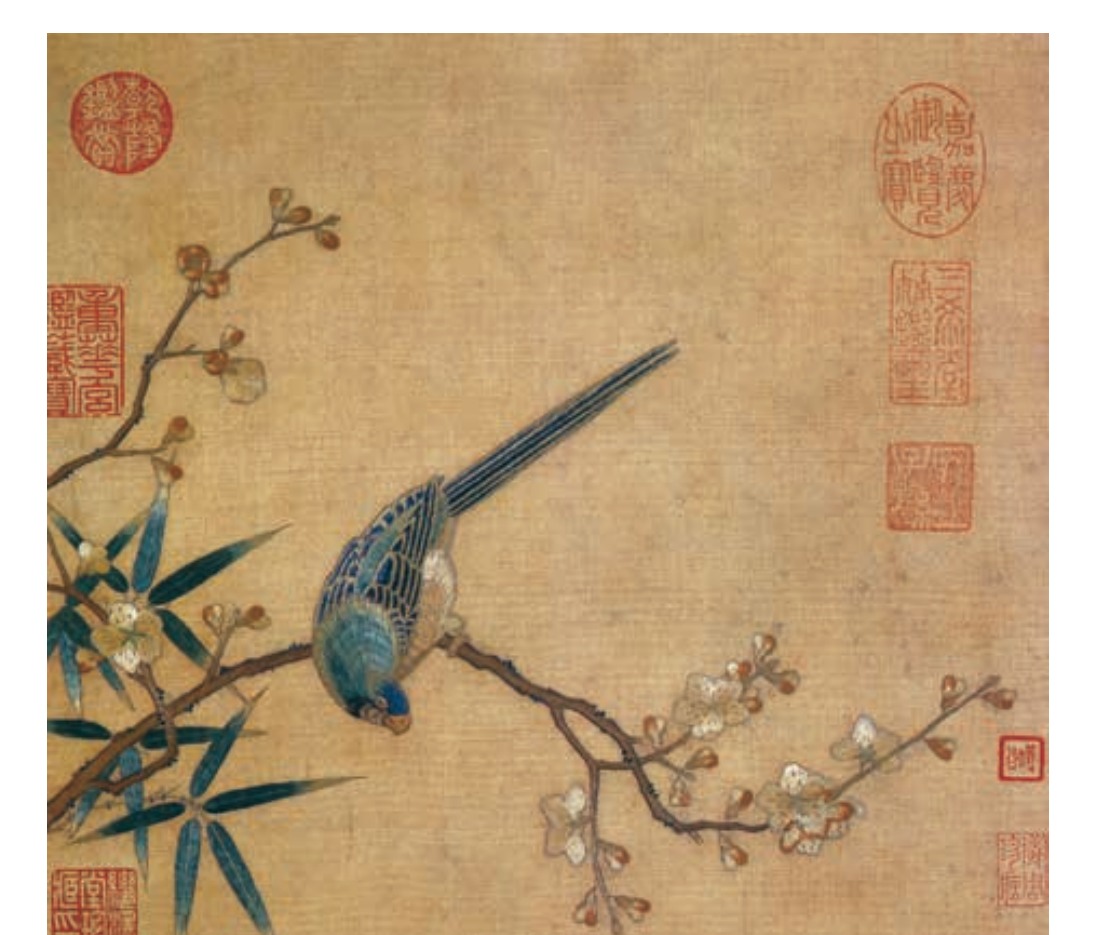
The hero image is useful here. Illustrated Art of Embroidery records a sequence of collector seals around Plum Blossom, Bamboo and Parrot. The seals are part of the work’s historical life and add context to its study.
Yet a seal, signature, inscription, family story, auction description, or seller’s certificate must still be examined critically. A convincing provenance is a chain that can be read and checked. It is stronger when names, dates, photographs, invoices, publications, and earlier descriptions agree. If one link cannot be verified, say so plainly.
For contemporary embroidery, documentation can begin at the time of acquisition: the artist’s name, title, date, materials, dimensions, photographs, statement, invoice, and any record of the creative process. Good records created now become future provenance.
Separate condition from later alteration
Condition asks what has happened to the object physically. Look for fading, staining, abrasion, broken threads, losses, weakened ground fabric, distortion, insect activity, unstable attachments, and changes caused by earlier mounting or repair.
Later alteration is related but distinct. A lining, border, frame, backing, patch, over-stitching, repainting, or remounting may have been added after the original embroidery was made. Some additions may be historically meaningful; others may obscure the earlier object. The task is first to recognize and document them, not to remove them automatically.
Do not let surface brightness stand in for condition. A vivid object may contain replaced, recolored, or recently worked areas. A faded object may still preserve important original evidence. “Old-looking” and “well-preserved” are not the same judgment.
Before cleaning or attempting repair, read How to Examine and Preserve Embroidery Safely. The article follows Shao Xiaocheng’s The Illustrated Art of Embroidery and emphasizes supported handling, careful documentation, and avoiding irreversible action before the object is understood.
Seven questions to ask before acquiring a work
- What is the object, and what was its original use? Record type, construction, dimensions, and present mounting.
- What collecting scope does it serve? A purchase should strengthen a body of study, not merely repeat what is already present.
- What supports the proposed period, region, school, or maker? Separate the seller’s description from observations you can document.
- How does the workmanship relate to function and tradition? Judge a court panel, folk garment, rank badge, and contemporary picture by appropriate contexts.
- What is the provenance chain? List what is documented, what is only reported, and what remains unknown.
- What is original, repaired, replaced, remounted, or otherwise altered? Photograph the whole object and details before any intervention.
- Which unanswered question could change the decision? If the answer matters, pause. Seeking a qualified second opinion is part of collecting, not a failure of confidence.
What this framework cannot decide
This article cannot authenticate a specific object, establish a market value, predict investment performance, or prescribe a restoration treatment. Those decisions require direct examination, appropriate comparison material, and specialist responsibility.
The Chinese Embroidery Institute’s Restoration & Reproduction work approaches an object as a combination of material, technique, image, history, and use. For inquiries involving a particular work, use the Contact page and provide clear overall and detail photographs without carrying out tests or cleaning first.
For readers building deeper visual and technical knowledge, Classes & Courses provide structured study. Exact dating indicators, authentication procedures, counterfeit analysis, market judgment, treatment decisions, and individual object feedback remain outside this public article.
Frequently asked questions
Is a collector’s seal proof that an embroidery is authentic?
No. A seal may be important provenance evidence, but it must be studied with the object, the seal impression, documented ownership history, and other records. It is not a guarantee by itself.
Should collectors buy only technically perfect embroidery?
No. Workmanship should be understood in relation to function, period, region, and collecting purpose. A used domestic or ethnic textile may be historically and culturally important without resembling a polished pictorial panel.
Can bright colors show that an embroidery is well preserved?
Not by themselves. Color can be affected by light exposure, replacement, later work, recoloring, materials, and storage. Condition requires examination of the full object and its construction.
Institute publication and editorial basis
This article extends the Chinese Embroidery Institute’s existing research and editorial work. The Illustrated Art of Embroidery (《图说刺绣艺术》) was written by Shao Xiaocheng, with Martin Xiao (Xiao, Yao) as responsible editor.
Leave your comment
Related posts