Dazi (Seed) Embroidery: Texture and Auspicious Meaning
Quick answer
Dazi embroidery (打籽绣), or seed embroidery, forms raised seed-like units. Western embroidery systems commonly call comparable workmanship and effects “knot stitch.” The technique is broadly similar; the names reflect different cultural emphasis. Western terminology highlights the knotted structure, while the Chinese name sees a seed. Many seeds gathered into a pattern can evoke continuing descendants and the blessing of many children.
Why the Chinese name “dazi” matters
“Knot stitch” and “dazi embroidery” need not be treated as rival technical categories. They describe substantially similar construction and surface effects through different cultural vocabularies. Western terminology emphasizes the knot made by the thread. The Chinese term emphasizes how the finished unit looks and what it can signify: a seed. “Dazi embroidery” preserves that Chinese name, while “seed embroidery” gives English readers the same visual entry point.
The seed image connects technique and auspicious thought. A single seed suggests the beginning of life; many seeds joined into flowers, fruits, animals, borders, or a complete field can suggest descendants continuing from generation to generation and the wish for many children and abundant blessings. In an auspicious composition, the stitch structure can therefore participate in the meaning rather than merely filling a pre-drawn shape.
This does not make every use of dazi embroidery an automatic fertility symbol. Object type, title, companion motifs, number, placement, and occasion still determine whether that cultural association is active. The Chinese name gives the interpreter an important possibility; the complete design confirms how it is being used.
What dazi embroidery looks like
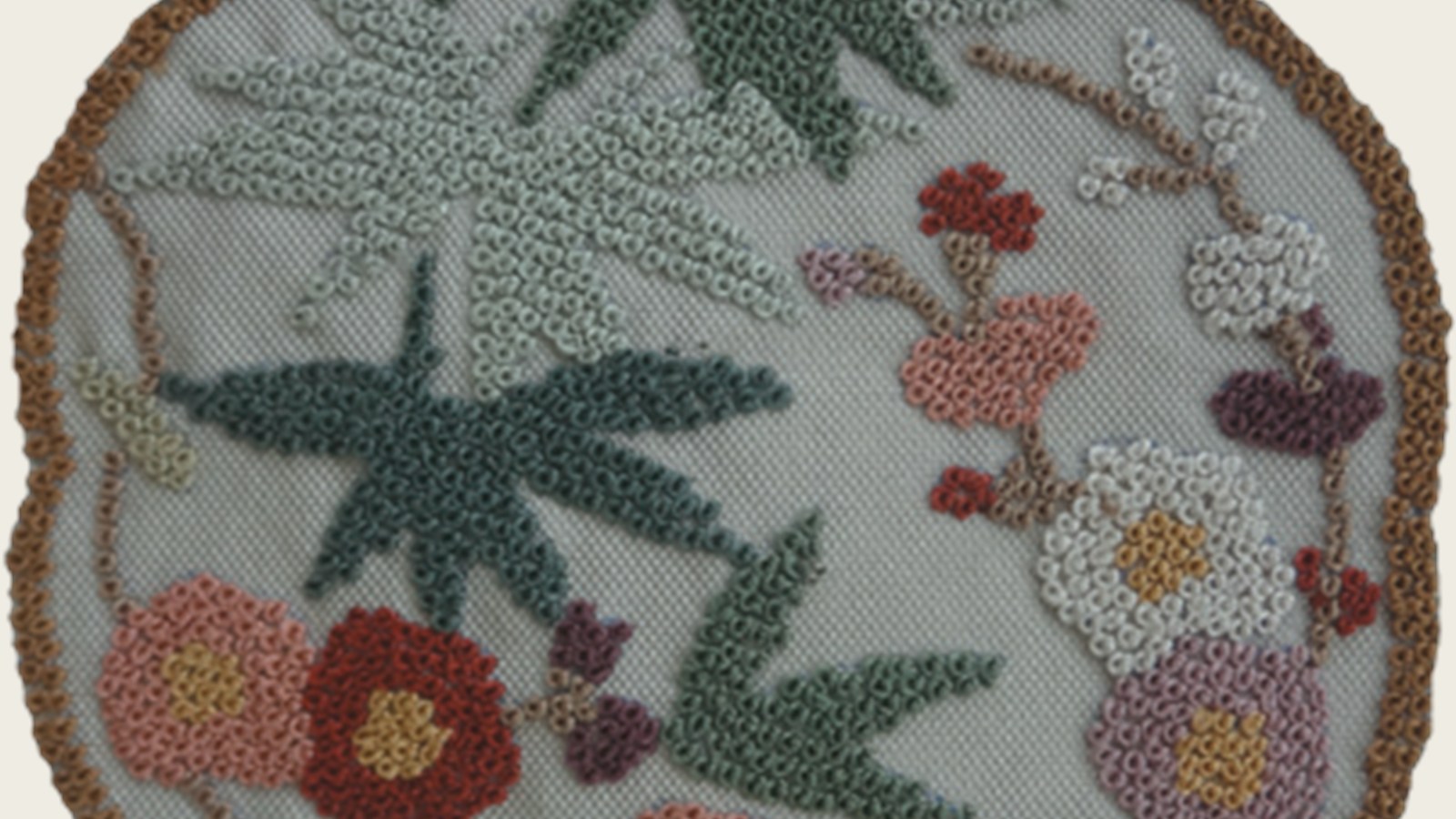
At normal viewing distance, dazi can resemble scattered beads, flower centers, tiny seeds, pebbled outlines, or a densely packed granular field. At close range, each seed is a raised thread unit. The surface catches light differently from satin stitch because the thread turns around itself instead of lying mainly as a smooth span across the ground.
The visual effect depends on scale and spacing. Widely separated seeds punctuate an open ground; tight clusters behave more like a fill. A regular row can define an edge, while differently colored groups can model a flower, leaf, animal, or geometric unit. Dazi is therefore not only a decorative accent. It can become the main language of an entire design.
Why dazi matters in Chinese embroidery
Shao Xiaocheng’s Chinese Embroidery: An Illustrated Stitch Guide defines its “Knot Stitch” as silk thread coiled into small, particle-like units and densely arranged into forms. It emphasizes fullness, evenness, firmness, resistance to wear, and a three-dimensional effect comparable to shallow relief. Shao also notes that the technique was already present in Chinese embroidery during the Song dynasty.
That history should not be turned into a claim that every dazi surface is Song-period. A technique can persist, be revived, travel between communities, or be used in later reproductions. Stitch identification helps describe how a surface was made; it does not date or authenticate an object by itself.
Four variants in the supplied stitch guide
The English edition groups four related constructions under “Knot Stitch”: basic, loose, Miao-style, and tailed forms. They are useful visual subdivisions inside that publication, but the public name for the Chinese technique remains dazi embroidery. The translated labels should not be assumed to replace every regional name or workshop vocabulary.
Basic form
The basic form establishes the compact seed unit used for points, outlines, and granular fill.
Loose form
The loose form has a more open looped character and appears softer and less tightly packed.
Miao-style form
Shao’s account of the Miao-style form uses slightly larger loops; this translated label is not a complete account of Miao embroidery traditions or evidence of regional attribution by itself.
Tailed form
The tailed form adds a visible extension, giving the seed direction like a dot followed by a short stroke.
These are visual distinctions, not a working lesson. Hand position, wrapping, entry and exit points, tension, spacing, and practice sequences remain teaching material.
Do not confuse dazi with bullion knot
Both families create raised thread forms, and English terminology can make them sound interchangeable. The supplied guide treats them separately.
Dazi builds compact seed points and related looped or tailed units. Bullion knot creates a longer wrapped unit that can be used straight or curved into a circle. The guide names two types—straight bullion knot and circle bullion knot—and describes good work as full, three-dimensional, well proportioned, and free from loose, irregular excess.
In design terms, the difference is useful. A dazi unit behaves like a seed point. A straight bullion can behave like a short bar, petal, or elongated segment. A circular bullion can become a ring-like unit. A finished embroidery may combine several families, so one raised area should not be used to label the whole object.
Our broader Guide to Chinese Embroidery Stitches places dazi texture within a larger system that also includes line, fill, counted, couching, and openwork families.
What dazi can do in a design
Create points of emphasis
A few raised seeds can draw the eye to a flower center, bud, fruit, eye, or other small detail. Their shadows and highlights contrast with surrounding flat stitches.
Build a clustered fill
When repeated densely, small seeds merge into a tactile mass without losing their granular character. Changes in color, density, or edge shape can organize the mass into petals, leaves, animals, or abstract units. In auspicious work, abundance of seed forms can also reinforce the wish for continuing descendants.
Define outlines and borders
A line of dazi creates a pebbled edge rather than a continuous smooth line. In the hero roundel, repeated seeds contribute to the border and structural elements as well as the flowers.
Create relief through combination
Dazi can be paired with smoother stitches or couched metal threads. In Shao Xiaocheng’s Five Happiness to the Family, discussed in Chinese Embroidery Motifs and Meanings, dazi builds the blue bats and interwoven lotus forms while gold-thread couching sharpens their outlines. Seed imagery, texture, brilliance, and auspicious motifs reinforce one another.
How to examine dazi workmanship
Begin with the complete object, then move closer. Ask whether the scale of the seed units suits the motif and ground fabric. Look for intentional rhythm in size, spacing, density, direction, and color. Check whether raised areas hold their form and whether outlines remain legible.
Evenness is not the same as mechanical sameness. A pictorial or organic form may require controlled variation. The useful question is whether variation supports the design or appears accidental. Our article How to Recognize Fine Chinese Embroidery offers a wider framework for judging line, surface, direction, color, cleanliness, and overall coherence.
What this guide deliberately leaves out
This article identifies cultural meaning, visual roles, and terminology. It does not provide the exact working route for the four dazi variants or for straight and circular bullion knots. Thread selection, fabric preparation, hand position, wrapping direction, entry and exit points, tension, spacing, secure finishing, exercises, and correction of failed seed units require structured demonstration and feedback.
Those methods remain in Classes & Courses. Keeping the boundary clear also prevents a descriptive article from encouraging readers to practise a tension-sensitive stitch from abbreviated instructions.
Frequently asked questions
How is dazi embroidery related to Western knot stitch?
Their constructional features and raised effects are broadly comparable. Western embroidery terminology commonly emphasizes the knot structure and calls this kind of work “knot stitch.” Chinese embroidery calls it dazi, or seed embroidery, because the finished units are understood as seeds. The main distinction here is cultural naming and interpretation, not a claim that the workmanship is unrelated.
Is bullion knot a type of dazi embroidery?
It belongs to the wider world of raised wrapped stitches, but Shao Xiaocheng’s Chinese Embroidery: An Illustrated Stitch Guide treats bullion knot as a separate family with straight and circular forms. Its units are generally more elongated or ring-like than compact dazi seeds.
Can dazi identify the age or region of an embroidery?
Not by itself. Dazi has a long history and can be used in different periods and traditions. Attribution requires the whole object, materials, construction, motif, provenance, and documented comparisons.
Institute publication and editorial basis
This article extends the Chinese Embroidery Institute’s existing research and editorial work. Chinese Embroidery: An Illustrated Stitch Guide was written by Shao Xiaocheng.
Leave your comment
Related posts