Satin and Shading Stitches in Chinese Embroidery: How Their Surfaces Differ
Quick answer
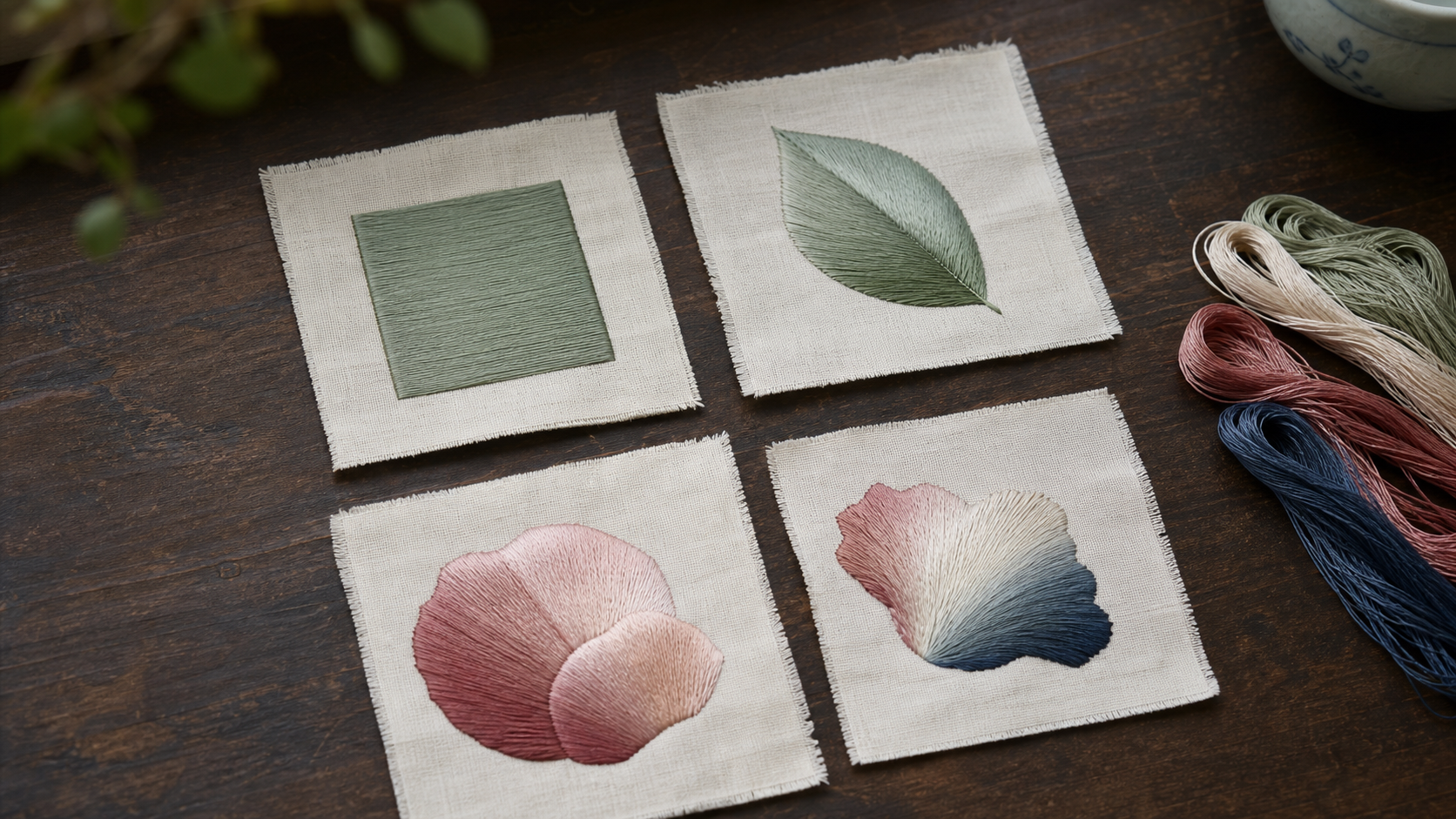
Straight satin stitch builds a compact field of parallel silk, while slanted satin stitch changes the angle of the threads to follow a small form. Shaded satin stitch is designed for color transition: its threads may be arranged in orderly bands or in a less regular structure that softens the joins. The names describe different visual problems, not a simple ladder from beginner to advanced.
Why these stitch names are easy to confuse
English embroidery vocabulary often groups several smooth filling stitches under the word “satin.” From a distance, they may all appear to cover the ground with closely placed thread. In Chinese embroidery, however, the direction of the silk, the edge of the filled area and the relationship between colors can be as important as coverage itself.
Shao Xiaocheng’s Chinese Embroidery: An Illustrated Stitch Guide treats Straight Satin Stitch, Slanted Satin Stitch and Shaded Satin Stitch as related but distinct structures. The differences become clearer when we ask what each one is expected to do. One emphasizes an even field; another redirects the surface around a form; the third organizes tonal change.
That distinction matters to viewers as well as makers. It helps us describe what we see without assuming that every smooth embroidered area was produced in the same way.
Straight satin stitch: a compact, directional field
The guide traces Straight Satin Stitch to the Western Han period and describes it as a dense arrangement of short, parallel lines that can cover the ground or form a pattern. Its visual identity comes from order: the threads advance in one direction, the boundary remains controlled and the color is generally unified.
Under changing light, a supposedly “flat” field is not visually inactive. Silk reflects light according to its direction. A compact area of aligned thread can therefore appear bright from one angle and quieter from another. This is one reason direction should be observed before color is judged.
Straight satin stitch is easiest to recognize in a relatively small, clearly bounded form. On a worn or distorted textile, however, the edge may no longer show the original intention. Age, abrasion and later mounting can interrupt the parallel surface, so condition should not be confused with workmanship.
Slanted satin stitch: direction follows the form
Slanted Satin Stitch also creates a smooth filled surface, but its thread lines are set at an angle. Shao associates it especially with small leaves, stems and branches, where a fixed vertical field would not respond as naturally to the shape.
The important visual clue is not simply that the stitches are diagonal. Their angle helps the embroidered form turn, narrow or flow. A leaf may seem to fold or point because the silk changes the way it receives light. A slender branch may gain movement even when it is worked in a single color.
This makes slanted satin stitch a useful reminder that line direction is part of drawing. In embroidery, the needle does not merely add pigment to a surface. Thread itself has length, sheen and orientation, and those properties participate in the image.
Shaded satin stitch: color becomes structure
Shao places the development of Shaded Satin Stitch in the Tang period and describes it as mature by the Song period. Its defining purpose is the integration of related colors and tonal changes. Shao compares its effect with shaded dyeing in Chinese painting: color does not sit in isolated blocks but moves across the embroidered form.
This family is especially valuable for petals, leaves, feathers, garments and pictorial subjects that need volume or atmosphere. The result is not created by color choice alone. The joins between areas, the direction of the silk and the degree of regularity all affect whether a transition appears banded, luminous, soft or abrupt.
Regular shaded satin stitch
In the regular form described by the guide, the threads are organized in neat bands. Each band remains legible while the sequence of colors gradually softens the change across the surface. The finished embroidery can look smooth and disciplined, with a measured rhythm.
Regularity does not mean that the image must look mechanical. The bands can support a formal petal, an ordered decorative form or a deliberate transition in which the viewer is meant to sense structure as well as color.
Long and short shaded satin stitch
Shao’s long-and-short form uses a less even boundary between successive areas. Because the joins do not read as a single straight division, one color can enter another more gently. Shao characterizes the transition as more natural and tender than the regular version.
For public understanding, the key point is visual: regular shaded satin tends to reveal an orderly progression, while long-and-short shaded satin can soften the meeting of colors. The exact sequence, overlap, thread preparation and control of those joins belong to practical instruction.
Four questions for reading the surface
When examining a finished work, begin with four observations.
1. Is the area one color or a tonal sequence?
A unified color field may suggest straight or slanted satin stitch. A gradual change through related colors points toward a shaded structure, although fading must first be ruled out.
2. What direction does the silk follow?
Look across the surface under gentle side light. Parallel vertical or near-parallel lines create a different effect from angled lines that turn with a leaf or branch.
3. Are color boundaries orderly or softened?
Visible bands may be intentional. A less regular transition may be designed to reduce the sense of a boundary. Neither is automatically better; each serves a different pictorial purpose.
4. Does the thread direction support the image?
The strongest clue is often the relationship between stitch direction and form. Does the silk help a petal open, a leaf bend or a surface recede? Technique should be read through what it contributes to the image.
Common misunderstandings
One mistake is to use “satin stitch” as a universal label for every smooth filled area. Another is to assume that a softer gradient is always more accomplished than a visible band. A regular transition may be exactly right for a formal design, while an irregular transition may suit a pictorial subject.
It is also risky to identify a stitch from a compressed online image. Silk sheen can hide or exaggerate direction, and a photograph may flatten relief or merge adjacent colors. Whenever possible, compare more than one light angle and keep aging, fading and repair in mind.
From recognition to guided practice
Being able to name the visual difference is a useful beginning, but it does not replace hand training. Producing a stable surface requires decisions about the ground, silk preparation, direction, starting and finishing, edge control, color sequence and tension. Small changes in one factor can alter all the others.
For a broader map of stitch families, read Chinese Embroidery Stitches: Techniques, Materials, and Historical Context. To compare these surfaces with wider standards of workmanship, continue to How to Recognize Fine Chinese Embroidery.
Learners who want to see how silk direction and color transitions are controlled in practice can visit Classes & Courses. Guided study can demonstrate the complete sequence and correct problems that a finished photograph cannot reveal.
Frequently asked questions
Is shaded satin stitch simply satin stitch worked in several colors?
No. Color is important, but the way successive areas meet and the way thread direction supports the transition are also part of the structure.
Is long and short shaded satin stitch always better than regular shaded satin stitch?
No. The long-and-short form can create a softer transition; the regular form offers a clearer, more orderly rhythm. The image determines which effect is appropriate.
Can these stitches be identified from the front alone?
Often they can be described provisionally from the surface, especially under side light. A confident technical identification may require closer examination and knowledge of condition, repair and construction.
Institute publication and editorial basis
This article extends the Chinese Embroidery Institute’s existing research and editorial work. Chinese Embroidery: An Illustrated Stitch Guide was written by Shao Xiaocheng.
Leave your comment
Related posts