Essential Tools and Materials for Chinese Embroidery: A Practical Starter Guide
Chinese embroidery begins with a relationship between thread, needle, ground fabric and support. A beautiful silk thread can work poorly on an unsuitable ground; a useful needle in one project may be too large or too restrictive in another. The aim is not to buy the most elaborate kit. It is to choose a small set of materials that work together and let you see what each decision changes.
For a first project, you need a suitable hoop or frame, needles, small sharp scissors, embroidery thread and ground fabric. Choose them around the intended work: a practice sample, a picture, a two-sided piece or an object that will be handled. Those are different material problems, even when all four involve silk.
Start with the piece, not the shopping list
Before buying, describe the result you want in plain terms. Will the ground remain visible? Will the embroidery be seen from one side or both? Do you want a soft transition of tone, a distinct line or an area of metallic brilliance? These answers are more useful than a label promising a “professional” kit.
| Your starting point | What to decide first | What to examine together |
|---|---|---|
| A small practice sample | One ground and one thread type | Needle passage, thread abrasion and how well the support holds the fabric |
| A shaded embroidered picture | The relationship between ground, colour and surface | Thread thickness, direction and sheen against the actual ground |
| Work intended to be viewed from both sides | How the ground and thread will appear from each side | Transparency, visible thread paths and the support required by the design |
| A textile that will be handled | Intended use and care requirements | Ground, thread, dyes, construction and finishing—not fibre alone |
The same thread can look very different against a pale or dark ground. A fabric that feels pleasant in the hand may behave differently once supported for stitching. Wherever possible, judge a representative sample rather than making every choice from a colour photograph.
Hoop, frame and stand: three related jobs
A hoop or frame holds the fabric. A stand supports the frame or work at a usable height. These are related functions, not interchangeable names for a complete setup.
A small hoop can be convenient for a compact study. A larger design may need a frame that supports a broader working area. The important questions are whether the support suits the size and delicacy of the ground, whether its surfaces are smooth, and whether you can work without repeatedly crushing completed stitching.
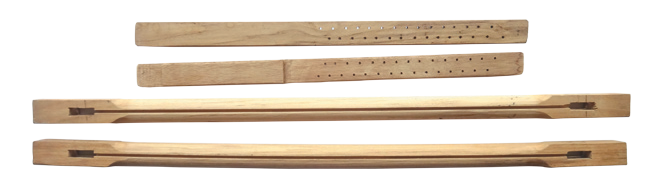
Wooden frame components illustrated in Chapter Two of Chinese Embroidery: An Illustrated Stitch Guide. This photograph shows the parts, not a complete mounting procedure.
The book distinguishes several forms of embroidery equipment. That variety should not become a beginner's compulsory shopping list. Start with the support your project actually needs. A frame that is too large for the available workspace can make careful handling harder, however substantial it appears.
Needle choice is a fit test
An embroidery needle has to do two things: pass through the ground and carry the thread. Look at the eye as well as the shaft. If the eye constricts or abrades the selected thread, choosing a finer needle simply because it looks more delicate may make matters worse.
Conversely, a needle that leaves conspicuous openings in a fine ground may be unsuitable for that combination. Needle numbering is a useful product reference, but it should not replace checking the particular needle, thread and fabric together.
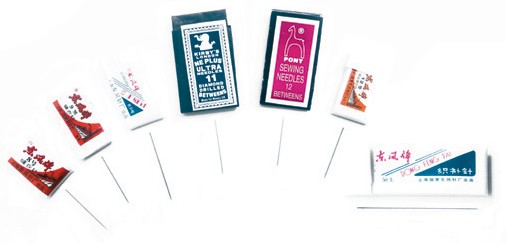
Needles and packaging reproduced from the book's tools chapter. The visible packets document the illustrated examples; they are not a current shopping recommendation or a universal size guide.
Use a separate piece of the intended ground to observe whether the thread passes cleanly and whether the surface is being disturbed. Repeated resistance is a reason to reconsider the combination, not to force the needle through valuable work.
Scissors: control matters more than decoration
A small, sharp pair of embroidery scissors makes it easier to cut a thread without pulling the surrounding work. Check that the blades close cleanly and that the tool is comfortable to control. Keep thread-cutting scissors for that purpose so the cutting edge remains useful.
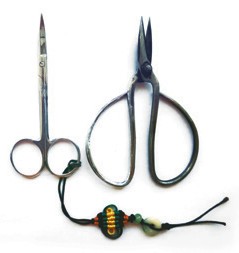
Two scissors illustrated in Chinese Embroidery: An Illustrated Stitch Guide. Shape alone does not tell you which pair will be most comfortable for your hand or task.
Do not treat every pointed tool as interchangeable. A photograph may show the outline of a tool, but it cannot establish the condition of its blade or how safely it can be controlled near the textile.
Flat Tips, Curved Tips, and What a Scissors Photograph Cannot Decide
In Chapter Two of Chinese Embroidery: An Illustrated Stitch Guide, flat-tip embroidery scissors are described for cutting embroidery threads. Curved-tip scissors are described for cutting thread during embroidery and for trimming irregular thread ends on the reverse after embroidery is complete.
This describes task roles, not a ranking or an exclusive rule. It does not make either form universally better, nor say that one shape can serve only one situation. Naming the task does not replace observing the actual work.
Figure 39 records different visible forms. It cannot prove a particular pair’s sharpness, blade closure, feel in a particular hand, or safe control near a particular textile. It documents appearance, not performance.
Embroidery thread: choose structure as well as colour
Silk is important in many Chinese embroidery traditions, especially where changes of light and tone are part of the image. But “silk thread” is not one fixed construction. Some threads are suitable for division into finer working elements; others have a construction intended to remain together. Check the thread itself and the supplier's description before treating it as divisible.
Thickness, twist, flexibility and surface appearance matter alongside colour. Finer is not automatically better: the working thread must suit the intended marks and the ground. Read the silk embroidery thread guide for a closer comparison of these choices.
Metallic threads ask different questions. Their structure can make surface attachment more appropriate than drawing the decorative thread repeatedly through the fabric. Our guide to gold and silver thread couching explains their visual role. Cotton and manufactured threads may serve other purposes; none should be judged by colour or prestige alone.
Ground fabric is part of the finished image
Silk describes a fibre. It does not, by itself, specify a weave, thickness, transparency or finish. A smooth, lustrous ground and a fine, open ground can both contain silk yet present very different conditions for stitching.
Look at the ground in the way the finished piece will be seen. If much of it remains visible, its colour and surface become part of the composition. If the design is viewed from both sides, examine what can be seen through it. The guide to silk ground fabrics separates these questions so that a fabric name does not stand in for a practical decision.
What a small sample can tell you
A sample is most useful when it resembles the intended project and you change one variable at a time. It is not a miniature finished artwork and need not use a complex design.
| What you observe | What to reconsider |
|---|---|
| The thread frays during passage | The needle eye, surface friction, thread condition and the chosen ground |
| Needle openings remain conspicuous | The needle–ground combination and the way the fabric is supported |
| The fabric puckers | Support, handling and the relationship between the stitching and the ground; not merely the fabric's price |
| The surface looks unexpectedly bright or flat | Thread direction, working thickness, coverage, ground and viewing light |
These observations narrow the question; they do not identify a single cause with certainty. Keep a short note of the actual materials used, rather than only the brand or colour name. That makes a successful combination easier to repeat and a disappointing one easier to investigate.
What to ask before buying
Ask for the fibre composition of both thread and fabric; the thread's construction and intended use; the ground's weave and dimensions; and whether a small sample is available. If washability, colourfastness or a particular care method matters, request the relevant information for that product. Silk fibre alone cannot establish those properties for a dyed, finished embroidered object.
You do not need to buy every colour or every frame first. A coherent starter set gives you a useful basis for comparison. Add specialised materials when a particular technique or design gives you a reason to use them.
Continue reading or learn through practice
For the wider picture, see Chinese Embroidery Stitches. For an illustrated reference that connects materials with stitches and finished work, explore Chinese Embroidery: An Illustrated Stitch Guide. If you would like help applying these decisions to an actual project, Classes & Courses explains the current learning options.
Frequently asked questions
What do I need to start Chinese embroidery?
A suitable hoop or frame, needles, small sharp scissors, embroidery thread and ground fabric, chosen around the intended work.
Do I need a complete professional kit?
No. The aim is a small set of materials that work together. You do not need to buy every colour or every frame first; add specialised materials when a technique or design gives you a reason.
What is the difference between a hoop, a frame and a stand?
A hoop or frame holds the fabric; a stand supports the frame or work at a usable height. They are related functions, not interchangeable names.
Where do these material categories come from?
From Chapter Two of Chinese Embroidery: An Illustrated Stitch Guide, co-authored by Shao Xiaocheng and Xiao Yao.
Source note: The tools and material categories in this guide draw on Chapter Two of Chinese Embroidery: An Illustrated Stitch Guide, co-authored by Shao Xiaocheng and Xiao Yao. The compatibility tables are editorial explanations, not a tested specification for every product or textile.
Leave your comment
Related posts