Bianxiu (Chain Stitch) in Early Chinese Embroidery
Quick answer
Bianxiu (辫绣), particularly bianzigu embroidery (辫子股绣), is the Chinese term used in Shao Xiaocheng’s The Illustrated Art of Embroidery for the linked-loop stitchwork that its English edition renders as chain stitch. It was especially important in Warring States and Han embroidery. Repeated linked units could trace long curves, organize dense patterns, and give dragons, phoenixes, animals, and vines a strong rhythmic movement. The name describes both linked structure and braid-like visual character.
What does bianxiu mean?
The word bian (辫) evokes something braided or plaited. In 《图说刺绣艺术》, the early technique is discussed as bianxiu and more specifically bianzigu embroidery—literally, a plaited-strand form of embroidery. Chinese Embroidery: An Illustrated Stitch Guide renders the corresponding linked-loop structure as chain stitch, a familiar term for English readers because each unit appears to connect with the next like a chain.
These names describe the surface through different visual habits. “Chain stitch” emphasizes a sequence of linked loops. Bianxiu emphasizes a line that resembles a braid or plait. In this article, the Chinese name comes first; “chain stitch” remains the English search bridge and the wording used in Shao Xiaocheng’s Chinese Embroidery: An Illustrated Stitch Guide.
The correspondence should not be turned into a claim that every object called bianxiu is identical to every chain stitch in every embroidery system. Historical period, regional vocabulary, materials, scale, tension, and workshop practice can all matter. Shao Xiaocheng’s books nevertheless make the connection clear enough to help readers move between Chinese and English descriptions.
Why bianxiu mattered in early Chinese embroidery
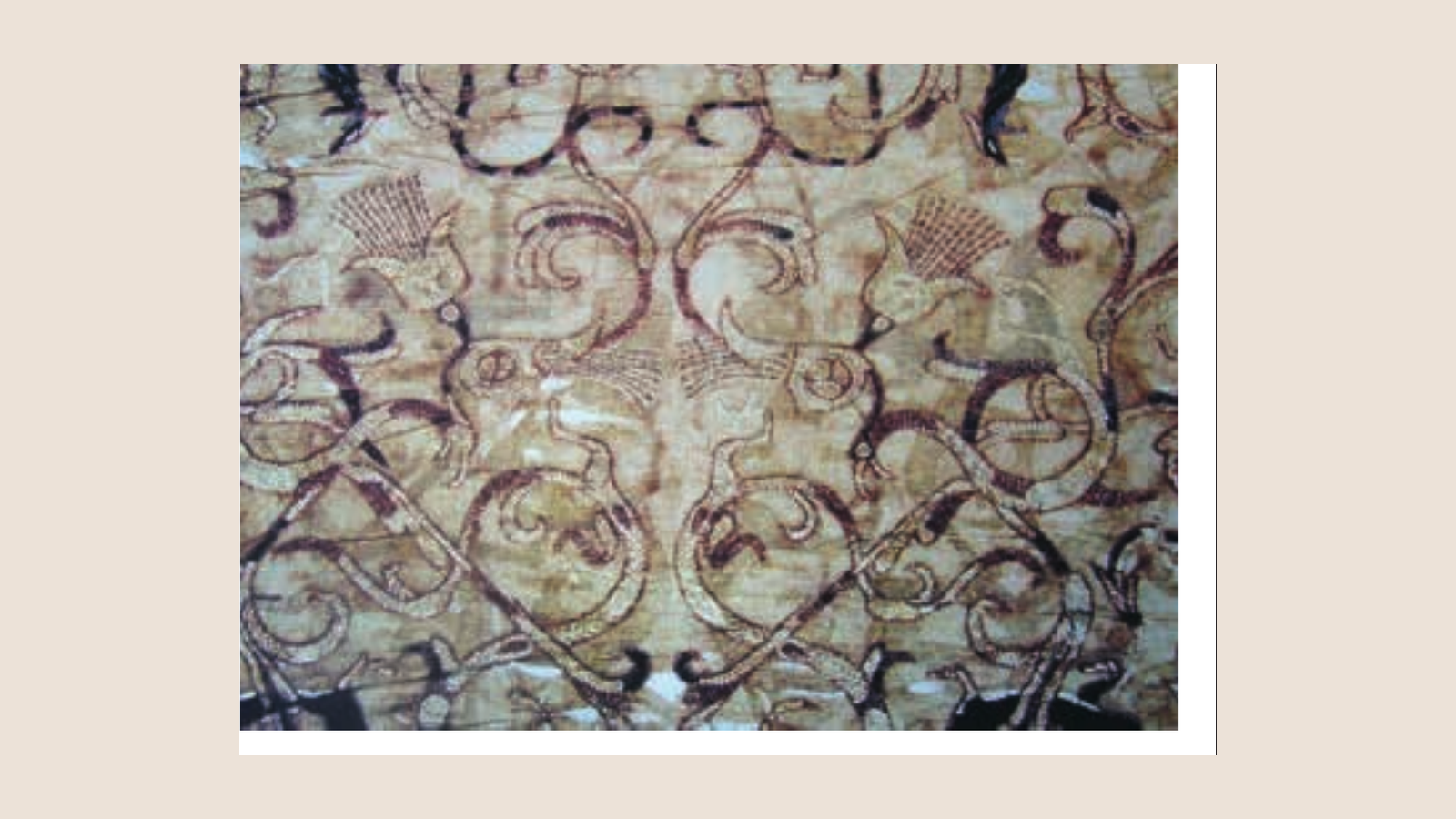
The Warring States period provides the strongest group of examples discussed in Shao Xiaocheng’s books. 《图说刺绣艺术》 describes embroidered objects from mid- to late-Warring States Chu tombs, dating from 475 to 221 BC. Their grounds include gauze and other silk fabrics, while the designs use bianzigu embroidery to organize dragons, phoenixes, tigers, flowers, vines, and geometric structures.
One stitch family did not produce a visually monotonous result. The surviving designs vary line weight, spacing, color, symmetry, and the way one creature interlocks with another. Curves bend back on themselves, animal bodies merge with scrolls, and smaller vegetal forms enter the spaces between major motifs. A linked line could therefore serve as contour, internal structure, pattern boundary, and rhythmic movement at the same time.
The English guide similarly describes chain stitch as a representative technique between the Warring States and Han periods. It notes that the linked structure could produce smooth lines and, when arranged densely, a more substantial textured field. The importance of the stitch was not simplicity alone; it was the range of visual work that could be built from repeated units.
For a wider chronology around these objects, see A Brief History of Chinese Embroidery.
How linked lines create movement
Continuous curves
A chain-like line can follow a turn without breaking the eye’s movement into isolated dashes. In Warring States designs, this quality helps long bodies, wings, tails, horns, and vines remain legible even when they cross or curl around neighboring forms.
Repetition with rhythm
The eye registers both the complete line and the small linked units within it. Regular repetition gives order, while controlled changes in curvature, density, and color keep the surface alive. This is one reason a design made largely with one stitch structure can still feel expansive rather than mechanical.
Boundaries and filled areas
Linked lines can define an edge, but close rows can also build broader passages of texture. Shao Xiaocheng’s books describe both the smooth linear effect and the fuller appearance created by denser arrangement. The viewer should therefore look beyond the word “outline”: the same family can help articulate a motif from its outer contour to its internal patterning.
From a leading technique to a larger stitch vocabulary
Bianxiu did not disappear after the Warring States period. The supplied history describes mature linked-loop work alongside short running stitches, blanket stitch, and bead work in the Qin and Han periods. Embroidery also expanded across garments and daily objects, including bags, ribbons, footwear components, and other accessories.
By the Tang dynasty, however, chain stitch no longer held the same leading position. Straight satin stitch, gold-thread couching, bead work, and other techniques offered additional ways to model color, brilliance, volume, and pictorial detail. This shift is best understood as an expanding vocabulary, not a simple replacement of an “old” stitch by a “better” one.
The broader Guide to Chinese Embroidery Stitches places line stitches beside satin and shading, texture, couching, counted, and applied families.
Three chain-stitch forms in the supplied guide
The English book presents three forms under its “Chain Stitch” heading: closed chain stitch, open chain stitch, and ancient chain stitch. These are the publication’s working labels and should not be treated as a complete historical taxonomy for every region or collection.
Closed chain stitch
The linked units form a compact sequence, producing a clearly articulated line. At normal viewing distance, the loops read together as a continuous boundary or curve.
Open chain stitch
The structure spreads laterally, so the line has a more open, band-like character. The wider spacing changes how much ground remains visible within and around the linked units.
Ancient chain stitch
The guide uses this name for a related linked construction with a different visual connection between units. The label is useful when reading that book, but it should not be used by itself to date an unidentified embroidery as ancient.
This overview identifies visible differences only. Exact entry and exit points, loop control, spacing, working direction, secure finishing, and correction are intentionally not reproduced here.
How to examine bianxiu on an object
Start with the whole composition. Which lines carry the main movement? Do linked units remain clear where curves tighten or motifs intersect? Does their scale suit the fineness of the ground fabric? Then compare outlines, filled passages, and transitions between colors.
Good workmanship does not require every loop to look mechanically identical. Historical silk, burial conditions, abrasion, later mounting, and repair can alter spacing and tension. The useful question is whether the surviving variation supports the original design or reflects damage and later intervention. Our guide to recognizing fine Chinese embroidery provides a broader framework for line, surface, color, material, and overall coherence.
Stitch structure alone cannot establish date, authorship, region, or authenticity. It must be read with the object type, ground weave, thread, dyes, motif, construction, archaeological or collection record, and documented comparisons.
What this article deliberately leaves out
This article explains terminology, history, and visual function. It does not give a complete working route for closed, open, or ancient chain stitch. Thread preparation, ground selection, hand position, loop size, direction changes, tension, starting and finishing, practice patterns, and troubleshooting require demonstration and feedback.
Those methods remain in Classes & Courses. The boundary keeps a historical article useful to readers without turning an abbreviated description into a substitute for structured practice.
Frequently asked questions
Is bianxiu simply another name for chain stitch?
In Shao Xiaocheng’s two books, bianxiu and bianzigu embroidery correspond to the linked-loop structure rendered in English as chain stitch. The terms offer different visual emphases—plaited line and linked chain. Regional and historical usage may be more specific, so the equivalence should be applied with context.
Was all early Chinese embroidery made with bianxiu?
No. Shao Xiaocheng’s books also discuss running stitch in early wool embroidery and the later appearance of short running, blanket, bead, satin, couching, and other structures. Bianxiu was highly important, especially in Warring States and Han work, but it was not the only technique in ancient China.
Can chain stitch prove that an embroidery is from the Warring States period?
No. A long-lived stitch can be used in many periods and places. Dating requires the complete material and documentary context, not one visible stitch family.
Institute publication and editorial basis
This article extends the Chinese Embroidery Institute’s existing research and editorial work. The Illustrated Art of Embroidery (《图说刺绣艺术》) was written by Shao Xiaocheng, with Yao Xiao (Martin Xiao) as responsible editor. Chinese Embroidery: An Illustrated Stitch Guide was written by Shao Xiaocheng.
Leave your comment
Related posts