Han Dynasty Embroidery: Warring States to Qin–Han
Quick answer: Han dynasty embroidery (汉代刺绣) belongs to a formative span that the Institute’s Chinese Embroidery: An Illustrated Stitch Guide discusses together with the Warring States and Qin periods. Chain stitch was a representative technique, but the Qin–Han account also describes short running stitch, blanket stitch and bead work. Embroidery became more professionally organised and extended across garments, accessories and everyday objects.
This guide follows that book’s early-history chapter and The Treasury of Chinese Embroidery Appreciation (《中国刺绣鉴赏宝典》). It distinguishes the Warring States examples from the later Qin–Han discussion rather than assigning every early dragon or phoenix design to the Han. For the complete sequence, see our origin and development timeline. The longer history of Chinese embroidery places these early examples alongside the later traditions.
Why begin before the Han dynasty?
The English guide groups the Spring and Autumn, Warring States, Qin and Han periods under “Taking Form.” Within that broad account, it treats the mid-to-late Warring States embroideries from Chu tombs at Jiangling, Hubei, as a particularly important group. Their mature stitching and lively designs provide the starting point for understanding the linked-loop tradition that remained important into Han times.
The Chinese Treasury then moves from those Warring States examples to the two Han dynasties, dated in its account from 206 BCE to 220 CE. The English guide discusses the combined Qin–Han span as 221 BCE to 220 CE. Keeping those scopes separate avoids turning an observation about earlier Chu embroidery into a claim about every Han textile.
Chain stitch: a limited vocabulary, not a limited art
The English guide identifies chain stitch as representative between the Warring States and Han periods. The Chinese Treasury calls the early linked technique bianzigu embroidery (辫子股绣). Our published bianxiu and chain-stitch guide, drawing on 《图说刺绣艺术》 and the English book, explains the braid-like line and its linked-loop structure.
One principal stitch family did not make the Warring States designs monotonous. The books describe neat but unrestrained needlework, regular layouts with variation, and flowing relationships among the motifs. Dragons, phoenixes, tigers and flowers could be arranged in changing combinations. The achievement lies in what the embroiderer made that structure do, not simply in the number of stitch names available.
Colour and design in the Warring States examples
The Treasury lists more than ten colours across the Jiangling group, including browns, reds, yellows, greens, blue and grey. It describes individual motifs combining three to five colours, mainly warm hues with clear contrasts. These are observations about the book’s Warring States examples, not a fixed colour recipe for all Qin or Han embroidery.
The same account emphasises symmetry with variation and movement within orderly compositions. Paired creatures and interlocking dragon-and-phoenix arrangements give the surface rhythm. A repeated stitch can therefore support a complex design through changes in direction, spacing, colour and the relationship between one form and the next. For a broader discussion of reading motifs together, see Chinese embroidery motifs and meanings.
The phoenix in the early design vocabulary
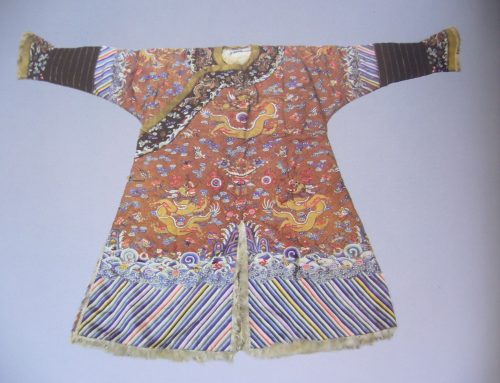
The books give particular attention to the phoenix in Warring States Chu embroidery. The Treasury describes it as an auspicious bird whose flowing, changing posture conveys the imaginative character of Chu design. Its discussion of an embroidered robe notes the high crown, spreading wings and carefully conceived body and feet.
This is useful context for appreciating early embroidery, but the distinction between subject and date remains important. A phoenix motif does not by itself make an unidentified textile Warring States or Han. Here the description belongs to the examples discussed in the Institute’s books; it is not offered as an authentication shortcut.
What changed in the Qin–Han account?
The English guide connects Qin–Han development with wider economic and cultural exchange, flourishing handicrafts and a growing textile industry. It describes the emergence of professional embroiderers. The Chinese Treasury likewise places increasingly specialised embroidery production within its Han discussion, alongside the maturity of technique and a richer range of patterns.
There is continuity as well as change. Mature chain stitch remains part of the account, while short running stitch, blanket stitch and bead work broaden the vocabulary. The English book also discusses mineral and plant dyestuffs expanding the available thread colours. These are developments described across the combined period, not precise invention dates for individual stitches or dyes.
Silk, wool and objects used in daily life
The English guide does not restrict the early record to silk. In its Qin–Han discussion, it notes embroidery on woollen products among excavated textiles from north-west China. This material distinction matters: the history cannot be reduced to one fibre simply because silk is so prominent in later artistic embroidery.
Both books also describe a broad range of practical objects. Their lists include sachets, gloves, pillow textiles, needlework containers, knee-pads, face-powder bags, mirror bags, footwear components, ribbons and embroidered trousers. The English guide illustrates an Eastern Han face-powder bag with cloud patterns. Such an example makes the connection between ornament and a specific everyday object especially clear.
The English guide additionally names swallow and auspicious-cloud motifs as representative Qin–Han patterns and says that corresponding embroidery terms occur in literature of the period. We retain that general statement without supplying unattested workshop labels, inscriptions or translations of ancient pattern names.
Place early embroidery within the longer history
The early material shows accomplished decorative stitching and expanding uses. Our Tang dynasty embroidery guide follows the later expansion of religious imagery and stitch techniques. It should not simply be described through the painting-style standards of later periods. Our Song dynasty embroidery guide explains the later flowering of artistic embroidery influenced by painting. The Ming and Qing hubs continue that chronology.
For stitch families across the tradition, explore Chinese embroidery stitches. The Institute’s books are the basis of this article. Practical study is available through our classes and courses; lessons are taught in Chinese with professional AI translation.
Frequently Asked Questions
What characterises Han dynasty embroidery?
The Institute’s books place it within a formative early history marked by mature chain stitch, a widening stitch vocabulary, increasingly specialised production and embroidery on many practical objects.
Why discuss Warring States embroidery with Han embroidery?
The English stitch guide groups the early periods in its “Taking Form” account. Warring States Chu examples help explain the chain-stitch tradition that remained important into Han times.
Was chain stitch the only Qin–Han technique?
No. The English guide also describes short running stitch, blanket stitch and bead work in its combined Qin–Han account. It does not give a precise invention date for each.
Was early embroidery always made on silk?
No. The English guide also records embroidered woollen products among excavated textiles from north-west China in its Qin–Han discussion.
Which Han object does the English guide illustrate?
It illustrates an Eastern Han face-powder bag with cloud patterns, alongside its discussion of embroidery extending beyond garments to accessories and daily objects.
Leave your comment
Related posts