Tang Dynasty Embroidery: Stitches, Colour and Buddhist Art
Quick answer: Tang dynasty embroidery (唐代刺绣, 618–907) represents a period of growing technical variety and pictorial expression in the Institute’s books. Religious embroidery, including Buddhist images and embroidered scriptures, encouraged this development. Chain stitch continued, but no longer held its earlier leading position as satin stitching, bead work, metal-thread couching and other techniques broadened the embroiderer’s choices.
Our Chinese Embroidery: An Illustrated Stitch Guide groups the Southern and Northern Dynasties, Sui and Tang under “Maturity.” This article follows that framing, with Tang as its main subject, and draws on The Treasury of Chinese Embroidery Appreciation (《中国刺绣鉴赏宝典》). The preceding Warring States and Qin–Han guide explains the earlier chain-stitch tradition.
Before the Tang: religious images and an expanding subject range
The Treasury discusses a fragment of embroidered Buddhist figures and donors from the Northern Wei period. It dates the fragment to 487 from its surviving inscription. Its account emphasises continued chain stitching alongside a growing interest in accurate figures, lively natural forms and compositions resembling pictures with a setting and atmosphere.
The English guide likewise treats religious objects as important to this earlier development. It explains donors as benefactors whose images could appear below Buddhist figures. This is the book’s context for understanding the embroidered people, not a claim that all early religious embroidery followed one layout. The section helps show why the Tang story involves changes in subject and visual ambition as well as changes in stitches.
Why religious embroidery matters in the Tang account
The Chinese Treasury describes the Tang’s long span, 618–907, as a period of continuing development. It gives embroidered scriptures and Buddhist pictures a prominent role in stimulating craftsmanship. The English book connects the prosperity of Sui and Tang with the same broad expansion of religious embroidery.
One detailed example in the Treasury is the embroidered scene of Shakyamuni preaching at Vulture Peak, discussed as a Tang Buddhist image. The book describes the central Buddha, attendants, bodhisattvas, a canopy, flying celestial figures and donors. This organised scene is more than a repeated ornamental unit: figures and their surroundings form a connected religious composition.
The book notes that much of this work still uses chain stitch, with some joining stitches in flat embroidery. Its significance therefore cannot be reduced to replacing an old technique. Existing stitches were being used within a more pictorial arrangement while additional methods enlarged what the needle could express.
A broader stitch vocabulary, not the disappearance of chain stitch
The English guide identifies bead work, straight satin stitch and gold-thread couching among Tang techniques. The Treasury also names kou xiu, pan jin, ping jin and qiang zhen in its discussion. We retain those Chinese terms where a precise English equivalence is not established in the passage rather than make the historical vocabulary seem more uniform than it is.
Both accounts describe chain stitch losing its former leading position, not vanishing. Our bianxiu and chain-stitch guide explains its linked-loop structure and early importance. Read that beside the broader Chinese embroidery stitches guide to distinguish a change in relative prominence from the invention or extinction of a technique.
Colour, contours and metal-thread brilliance
The Treasury describes graded colour in Tang floral embroidery, couched outlines for plants and leaves, and gold- and silver-thread work used for mandarin ducks. Its account links these choices with greater vividness, dimension and visual emphasis. Colour, line and material work together rather than serving as isolated decoration.
A couched contour can make an edge emphatic while graded colour changes the interior of a flower or leaf. These are different visual tasks within the same textile. For the technical family behind metal-thread attachment, see our published gold and silver thread couching guide. This historical overview does not supply a complete working sequence for reproducing an antique design.
A close reading of the book’s peony-and-bird example
The English stitch guide’s Tang illustration Mandarin Ducks and Peonies, on dark yellow twill damask, receives unusually detailed commentary. The text describes peony forms and small birds worked with gold-thread couching, green leaves in several grades, and simple couching along stems and leaf outlines. It stresses bright colour, varied needlework and the interplay of decorative and realistic effects.
The same commentary praises curved branches, changes of colour across leaves and layered colour in flowers. Importantly, it contrasts this example with the comparatively stiff plant structures it describes in other Tang floral works. We should preserve that distinction: the book is explaining why this particular embroidery is accomplished, not saying that every Tang piece has identical modelling or equally fluent branches.
Garments, bags and pictorial textiles
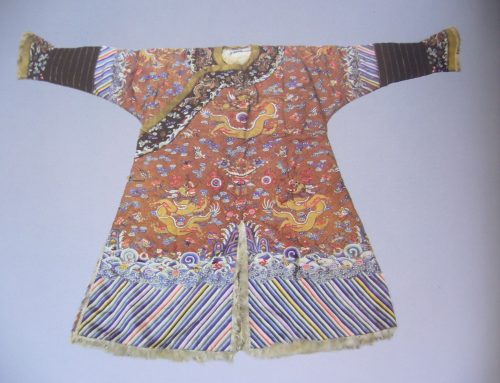
The English guide discusses embroidered garments, bags and a kasaya, a Buddhist robe. Its commentary on the kasaya notes petals with a feathering-like effect. The Treasury also discusses floral, bird and religious examples as evidence of embroidery’s growing expressive range. Practical objects and pictorial concerns belong to the same historical development rather than two entirely disconnected stories.
In the Chinese book’s account, improving workmanship in practical embroidery and the influence of painting and religious art prepared the way for appreciation embroidery developing alongside everyday needlework. This does not mean every Tang robe was an independent picture or every religious textile lacked a practical setting. The books describe a broadening field of possibilities.
From Tang development to Song artistic embroidery
The English guide explicitly connects Tang changes with the later development of realism in Song embroidery. Our Song dynasty guide follows that next stage, including the close relationship with painting. The origins timeline and longer history of Chinese embroidery keep these changes within the full chronology.
The Institute’s books provide the basis for this article. For practical study of thread handling and stitches, explore our classes and courses. Lessons are taught in Chinese with professional AI translation.
Frequently Asked Questions
What characterises Tang dynasty embroidery?
The Institute’s books emphasise religious imagery, a wider stitch vocabulary and increasingly pictorial effects. Chain stitch continued alongside satin stitching, bead work and metal-thread couching.
Why include the Northern and Southern Dynasties and Sui?
The English stitch guide groups the Southern and Northern Dynasties, Sui and Tang under “Maturity.” Earlier religious imagery and continued chain stitching help explain the Tang developments.
Did chain stitch disappear in the Tang dynasty?
No. The books describe it losing its earlier leading position, not disappearing. The Treasury discusses substantial chain stitching in a Tang Buddhist composition.
Were all Tang embroideries equally realistic?
No. The English book distinguishes an accomplished floral example from comparatively stiff plant structures in other Tang works. Its praise should not be applied indiscriminately to every piece.
How does Tang embroidery relate to Song embroidery?
The English stitch guide describes Tang changes in patterns, techniques and visual expression as laying foundations for the later development of realism in Song embroidery.
Leave your comment
Related posts