The Four Famous Embroideries of China — and the Traditions Beyond Them
The Four Famous Embroideries of China — and the Traditions Beyond Them
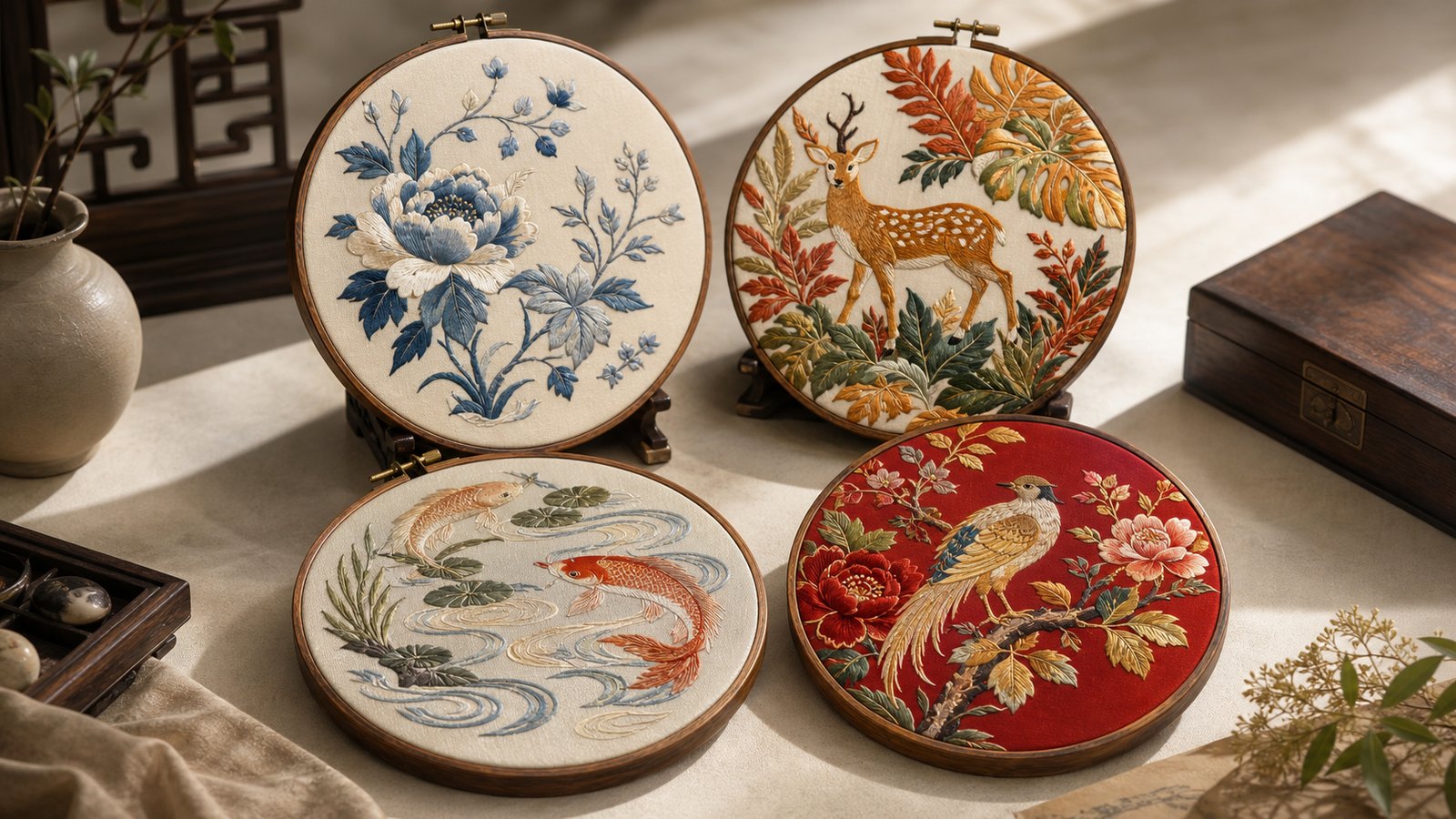
The Four Famous Embroideries of China are Su embroidery, Xiang embroidery, Shu embroidery, and Yue embroidery. These names identify four influential regional traditions associated respectively with Jiangsu, Hunan, Sichuan, and Guangdong. Each developed through local materials, visual preferences, workshop systems, markets, and relationships with painting and everyday life.
The phrase is useful, but it is not a complete map. China has many court, urban, household, religious, and ethnic textile traditions outside these four labels.
Quick Answer: What Are the Four Famous Embroideries?
- Su embroidery is widely associated with refined color, smooth surfaces, fine silk work, and a close relationship with painting.
- Xiang embroidery is often recognized for stronger tonal contrasts, vigorous modeling, and celebrated animal subjects.
- Shu embroidery is known for orderly workmanship, clear structure, balanced color, and a long connection with Sichuan’s silk culture.
- Yue embroidery includes Guang embroidery and Chao embroidery and is especially noted for brilliant color, rich decoration, gold-toned effects, and festive subjects.
These descriptions are starting points rather than rigid rules. A regional name does not guarantee the date, quality, authorship, or authenticity of an individual piece.
Why Did These Four Traditions Become Famous?
Regional embroidery existed across China long before the four-part label became familiar. By the late imperial period, commercial workshops, urban patrons, designers, guilds, exhibitions, and expanding markets helped certain regional traditions gain wider reputations. The schools learned from older court and pictorial traditions, household practices, painting, imported visual ideas, and one another.
Shared tools and materials could therefore produce very different results. What distinguished a school was not one exclusive stitch, but a recurring combination of subject matter, color, surface treatment, composition, workshop practice, and aesthetic preference. A single bright color or animal motif is rarely enough to establish a regional attribution.
Su Embroidery: Refined Surfaces and Pictorial Sensibility
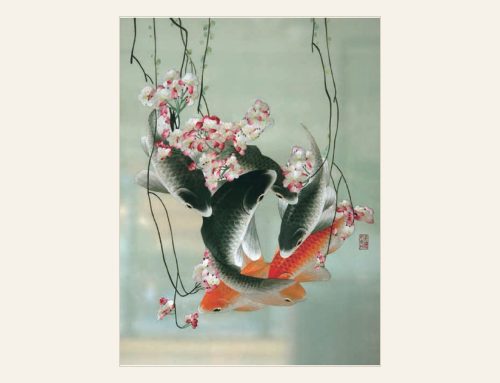
Su embroidery is associated with Suzhou and the wider Jiangsu region. It became one of the best-known Chinese embroidery traditions and is often described through qualities such as flatness, evenness, fineness, density, harmonious color, smooth thread direction, and luminous surface.
Many admired examples have a close relationship with Chinese painting. Floral subjects, birds, animals, landscapes, and portraits may be organized with the compositional restraint of a painted work. In refined pictorial embroidery, changes in thread direction and silk sheen can help suggest volume, texture, and light.
Su embroidery also includes practical and decorative work. It should not be reduced to extremely fine display pieces or to one modern technique. When viewing a work described as Su embroidery, look for the relationship among design, surface, color transitions, and thread direction rather than judging fineness alone.
Xiang Embroidery: Strong Modeling and Vigorous Expression
Xiang embroidery developed from embroidery traditions in Hunan, with Changsha becoming an important center. It is frequently associated with fuller forms, stronger contrasts, vigorous expression, and a relatively bold visual presence.
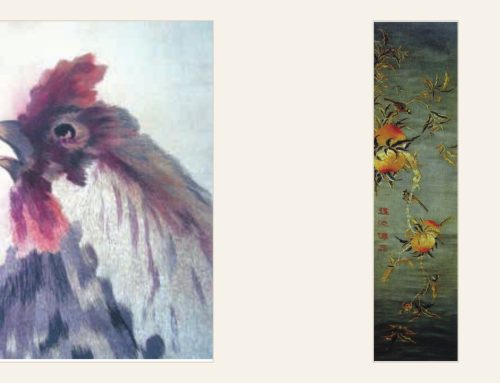
Animals became especially prominent in the public image of Xiang embroidery. Lions and tigers are often mentioned because fur, muscle, gaze, and movement allow embroidery to demonstrate tonal modeling and directional texture. Yet Xiang embroidery is not limited to animal subjects. Flowers, birds, landscapes, portraits, and designs connected with local customs also form part of the tradition.
Designers and painters helped translate pictorial ideas into textile form, encouraging volume and atmosphere while retaining the physical character of thread. A bold subject does not automatically make an embroidery Xiang; attribution should also consider structure, handling of color and form, historical setting, and documentation.
Shu Embroidery: Order, Balance, and Sichuan Silk Culture
Shu embroidery is centered on Chengdu and the surrounding region of Sichuan, an area with a long history of sericulture and silk production. Historical descriptions praise Shu textile work, while later workshop and institutional development helped the regional tradition reach broader markets.
Shu embroidery is often characterized as disciplined and clear: smooth surfaces, orderly stitches, balanced color, open composition, and rounded modeling. Traditional subjects include flowers, birds, fish, animals, landscapes, and practical textiles. Images of carp and pandas have become familiar in modern presentations, although they represent only a portion of the tradition.
Local painting also shaped display works. Designers provided compositions suited to the textile surface, while embroiderers interpreted them through thread direction, texture, and color. The useful question is not whether a piece contains a familiar Sichuan subject, but whether its materials, workmanship, and documented origin support the claimed identity.
Yue Embroidery: Brilliant Color and Decorative Energy
Yue embroidery is an umbrella term that includes Guang embroidery, associated with Guangzhou and nearby areas, and Chao embroidery, associated with the Chaozhou cultural region. The two are related but should not be treated as identical.
Yue embroidery is widely recognized for saturated color, rich decoration, energetic composition, and frequent use of brilliant materials. Birds, flowers, dragons, phoenixes, auspicious objects, and celebratory subjects appear often. Historical trade through southern ports also connected Guangdong textile production with overseas markets.
Guang embroidery is often discussed in relation to bright color and clearly separated forms. Chao embroidery is particularly celebrated for raised, sculptural, and gold-toned effects in ceremonial and festive work. These are broad tendencies, and fine work still depends on controlled structure, coherent composition, secure materials, and a convincing relationship between technique and subject.
The Four Traditions at a Glance
The following comparison is a viewing guide, not an authentication chart:
- Su: restrained elegance, refined pictorial surfaces, subtle color relationships.
- Xiang: vigorous modeling, stronger contrast, expressive animals and pictorial subjects.
- Shu: orderly workmanship, balanced color, clear and rounded forms.
- Yue: brilliant color, decorative richness, festive energy, and prominent gold-toned effects.
Regional traditions evolve. Artists borrow, teachers travel, markets change, and modern studios may work in more than one visual language. For that reason, serious attribution requires more than matching an object to a short list of style words.
Chinese Embroidery Beyond the Famous Four
The framework leaves out Gu-style pictorial embroidery, Shandong and Beijing embroidery, court and religious textiles, household needlework, and many ethnic traditions.
Textiles made by Miao, Dong, Yao, Zhuang, Yi, Qiang, Uyghur, Kazakh, and other communities may encode identity, memory, belief, age, family role, celebration, and local aesthetics. The category therefore works best as an entrance to a much wider textile culture.
Common Misconceptions
“Every Chinese embroidery belongs to one of the four schools.”
No. The four schools are prominent regional traditions, not an exhaustive classification.
“Each school uses completely different stitches.”
No. Traditions may share stitches and materials. Distinction often comes from how subjects, colors, techniques, and workshop practices are combined.
“A typical motif proves where a piece was made.”
No. Motifs travel and are reproduced. A credible attribution also needs material, technical, historical, and provenance evidence.
“The finest embroidery is always the most densely stitched.”
No. Quality also depends on composition, thread direction, color, condition, purpose, and appropriate technique.
How to Continue Learning
Begin with comparison: observe how different works handle contour, open space, sheen, color, texture, and pictorial depth. The Institute’s history overview provides a chronological framework, while the Chinese embroidery stitches guide explains the main functional stitch families.
Recognizing a regional tendency is different from reproducing it. Complete working sequences, thread preparation, tension control, regional stitch combinations, and correction methods require demonstration and guided practice. Readers interested in that deeper level can continue through Classes & Courses.
Frequently Asked Questions
Which of the Four Famous Embroideries is the oldest?
All four regions have deep textile histories. “Oldest” changes depending on whether we mean archaeological evidence, regional naming, commercial organization, or the modern school.
Is Su embroidery the same as double-sided embroidery?
No. Double-sided embroidery considers both faces; Su embroidery is a regional tradition. Celebrated double-sided work comes from Suzhou, but the terms are not interchangeable.
Are Guang embroidery and Chao embroidery the same?
They are both included under Yue embroidery, but each has its own local history and visual tendencies.
Can style alone authenticate an old embroidery?
No. Style is only one form of evidence. Age, materials, construction, condition, provenance, inscriptions, and comparison with documented works may all matter. Valuable or historically important textiles should be assessed by qualified specialists.
Editorial Source Notes
- Shao Xiaocheng, Chinese Embroidery: An Illustrated Stitch Guide, Introduction and Chapter One.
- 邵晓琤,《图说刺绣艺术》,第三章,书内页 099–127。
- This article summarizes cultural and visual distinctions. It does not reproduce Shao Xiaocheng’s books’ illustrations, detailed working methods, or complete regional technique systems.
Institute publication and editorial basis
This article extends the Chinese Embroidery Institute’s existing research and editorial work. The Illustrated Art of Embroidery (《图说刺绣艺术》) was written by Shao Xiaocheng, with Martin Xiao (Xiao, Yao) as responsible editor. Chinese Embroidery: An Illustrated Stitch Guide was written by Shao Xiaocheng.
Leave your comment
Related posts