Xiang Embroidery: History, Style, and the Lion-Tiger Tradition
Quick answer
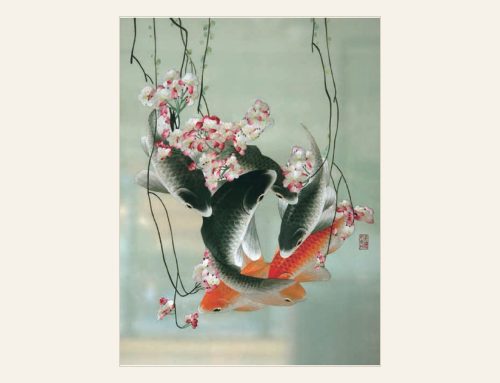
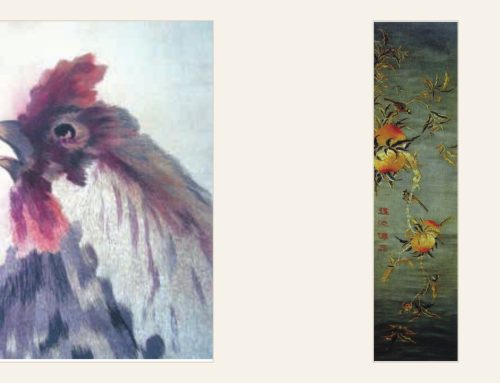
Xiang embroidery (湘绣) developed from embroidery practiced in Hunan and became closely associated with Changsha. It is often recognized by strong color, substantial forms, pictorial realism, and animal subjects, especially lions and tigers. These traits are useful points of reference, not a rigid identification formula. Historical Xiang work also includes household textiles, flowers, birds, portraits, and designs adapted from painting.
What does Xiang embroidery mean?
Xiang is a historical name for Hunan. Xiang embroidery therefore refers to an embroidery tradition centered in Hunan, with Changsha becoming its best-known production and commercial center. It is one of the categories commonly grouped as the Four Famous Embroideries of China.
That familiar classification can hide the variety within each regional tradition. Xiang embroidery was never limited to one stitch, one workshop, or one subject. Household sewing, commercial embroidery studios, painter-designed art embroidery, portraiture, flowers and birds, and animal pictures all contributed to its development.
The name is regional, but region alone does not authenticate an object. A reliable attribution also needs evidence from materials, stitch structure, inscriptions, workshop history, provenance, and the object’s later condition.
A regional history older than the name
In The Illustrated Art of Embroidery, Shao Xiaocheng places Xiang embroidery within a much older history of embroidered textiles in Hunan. She discusses Warring States embroidery excavated from a Chu tomb in Changsha and the embroidered textiles found in the Western Han tombs at Mawangdui. These finds show that sophisticated embroidery existed in the region long before “Xiang embroidery” became a recognized commercial and artistic name.
The distinction matters. Archaeological textiles document regional skill and visual culture; they should not be treated as products of the later workshop category without further evidence. The name Xiang embroidery came into use much later, during the Qing dynasty.
Shao quotes an 1818 Xiangtan gazetteer that records embroidery as part of women’s work in both rural and urban communities. By the Tongzhi period of the Qing dynasty, the term Xiang embroidery was in use. The tradition developed quickly as local practice met techniques and workshop experience associated with Su and Yue embroidery.
From household embroidery to workshops
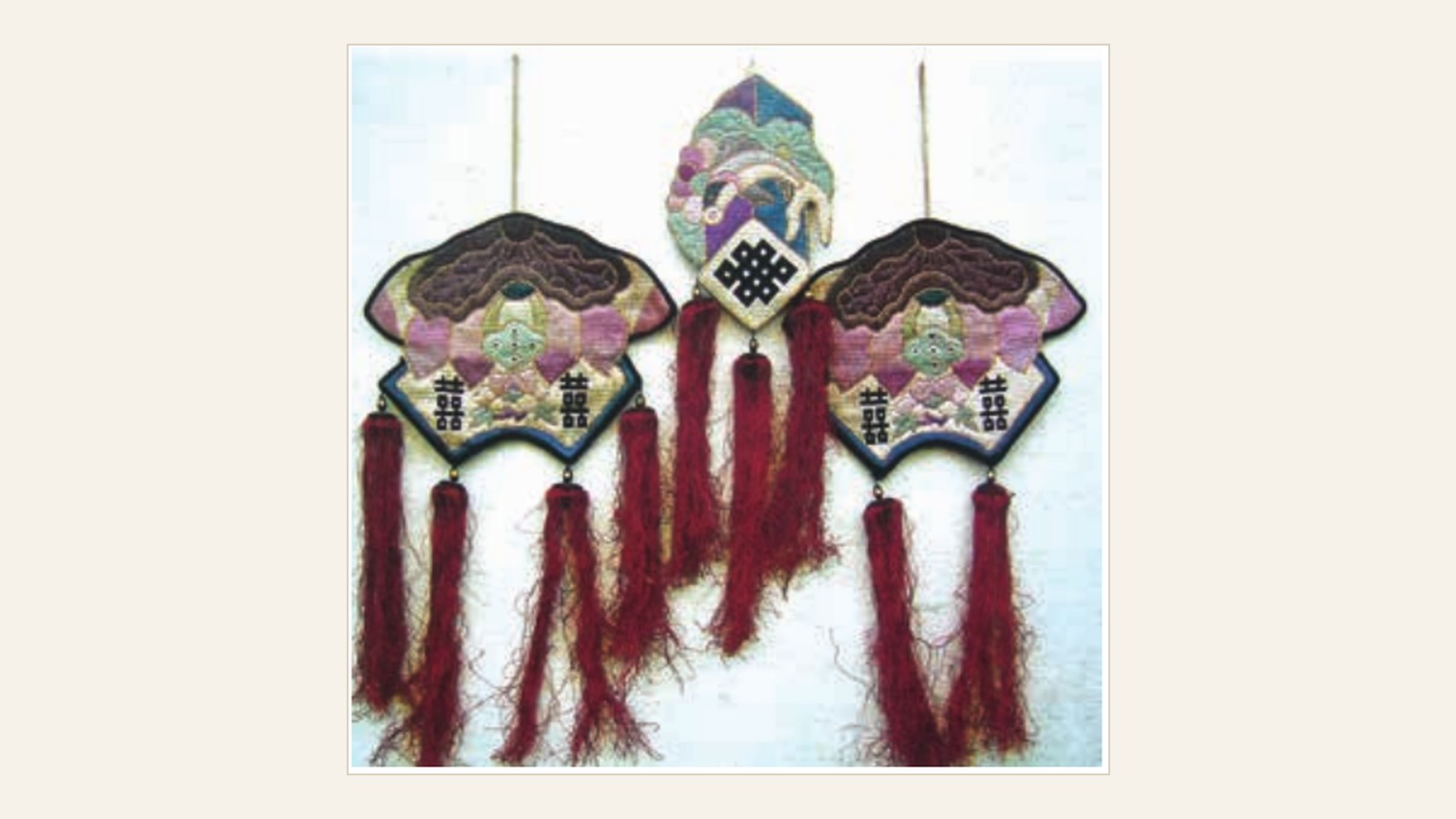
Late Qing workshops changed how Xiang embroidery was organized and circulated. Hu Lianxian (1832-1899), who had learned Su embroidery before moving to Hunan, taught embroidery and operated a workshop. Her sons later opened the Wu Caixia Embroidery Workshop in Changsha in 1898. Shao identifies this workshop as an important point in the commercial development of Xiang embroidery.
Workshop production did not erase household practice. It created another route for designs, training, commissions, and sales. It also brought painters and embroiderers into closer contact. A design could begin as a drawing, be adjusted for thread and fabric, and then pass through several skilled hands before becoming a finished object.
This history helps explain why Xiang embroidery can look markedly different from one object to another. A bed furnishing, a shop product, a portrait, and a large animal picture served different purposes even when they were made within the same regional tradition.
Painting changed Xiang art embroidery
Shao associates Li Yihui (1854-1928) with the development of chanzhen (掺针), a method used to carry tonal and pictorial changes across an embroidered surface. For English readers, “overlapping shading stitch” is a useful description of its visual role, but it is not presented here as a universal Western equivalent. The Chinese name remains primary.
The Wu Caixia workshop later expanded the use of chanzhen in pictorial embroidery. Painter Yang Shizhuo (1840-1910) also linked painting and embroidery through design and teaching. His students and other local artists supplied drawings that asked embroidery to handle brush-like transitions, animal bodies, figures, flowers, and landscape space.
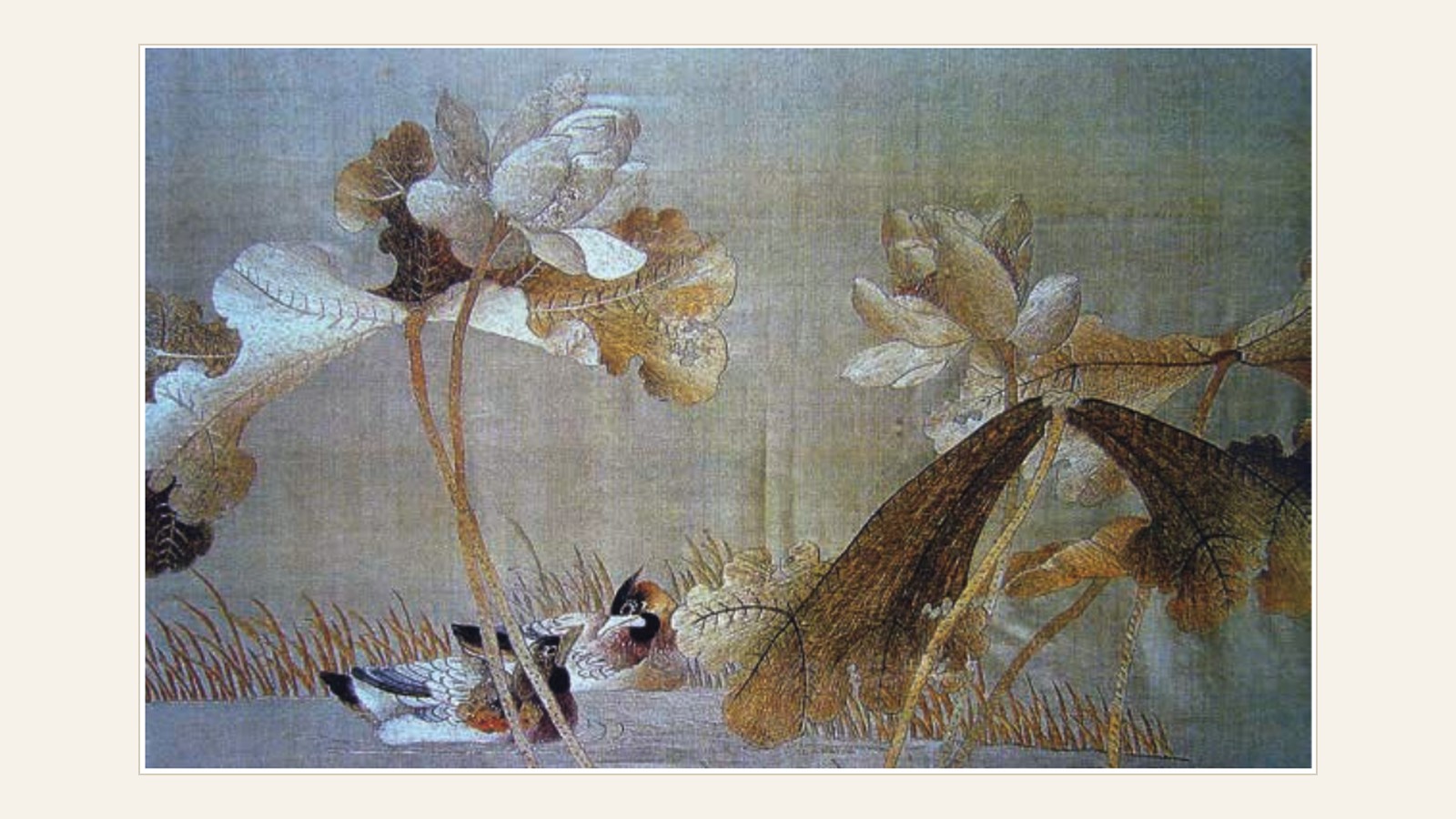
Pictorial ambition does not mean that Xiang embroidery simply copied painting. Thread catches light differently from ink or pigment. Direction, density, color changes, and the visibility of the ground all alter the image. The painter’s design was a starting structure; the embroidered surface had to solve its own material problems.
This can be compared with Shen Shou’s Simulation Embroidery, which also responded to pictorial light and modeling. The comparison is visual and historical, not a claim that the two traditions share one technical lineage.
Why lions and tigers became signature subjects
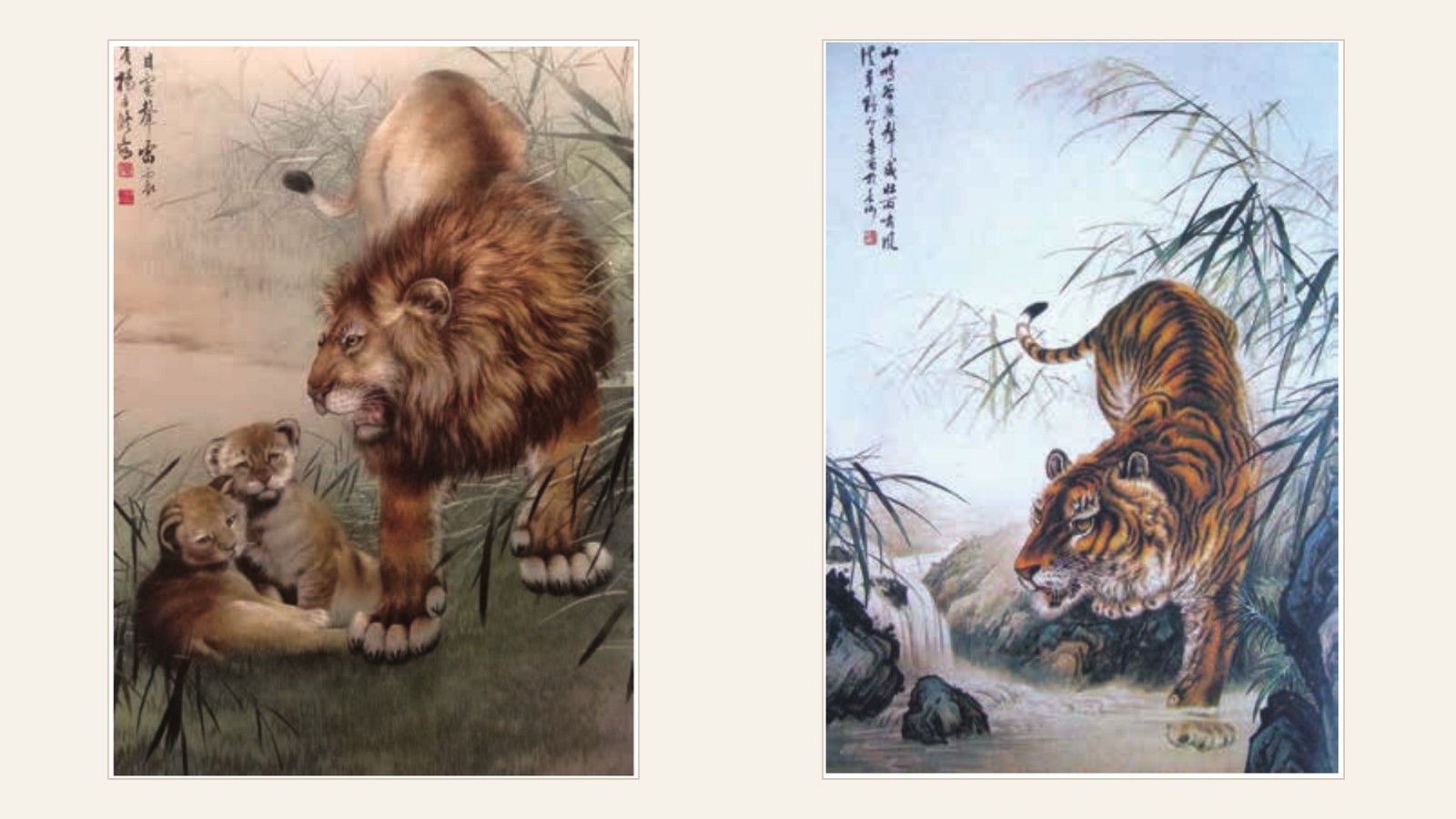
Shao identifies lions, tigers, and squirrels as traditional Xiang subjects, with lion and tiger embroidery receiving particular attention. These animals suited the tradition’s strong color and full-bodied modeling. Fur, muscle, eyes, whiskers, and changes in posture gave embroiderers a demanding test of observation.
The finished image depends on more than accurate outline. A tiger whose stripes lie flat and uniform may read as pattern rather than fur. Dark areas need depth without becoming dead blocks; pale hairs around the muzzle must remain distinct; the direction of the thread has to follow the turn of the head and body.
Such features are useful when examining workmanship, but subject matter alone proves nothing. A tiger may be embroidered in another Chinese regional tradition, made later in imitation of Xiang work, or produced from a widely circulated design. The broader guide to recognizing fine Chinese embroidery offers a more complete viewing framework.
Pengmao stitch and the problem of fur
Shao describes early Xiang tiger embroidery made with flat stitches and chanzhen as visually smooth but weak in fur texture. Embroiderers developed pengmao stitch (鬅毛针) from that problem. A descriptive English bridge is “fluffed-fur stitch”: peng suggests hair opening or spreading rather than lying flat.
In visible structure, the threads gather and open so that one end reads thicker and looser while the other becomes finer and denser. This change makes the fur appear to grow from the body and lift at the outer end. The stitch does not work in isolation. Other needle methods support the eyes, stripes, facial planes, whiskers, and surrounding landscape.
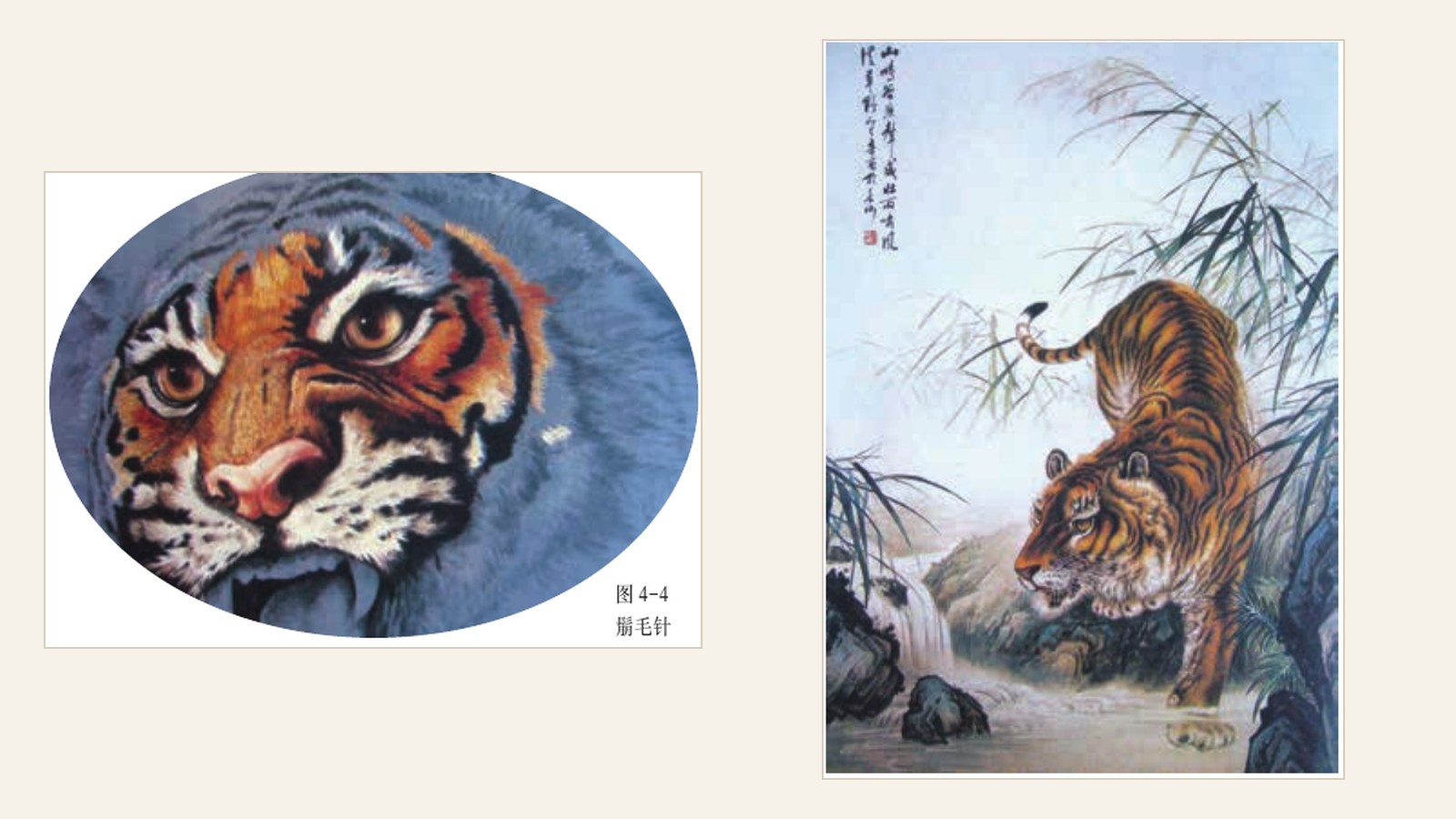
Pengmao stitch is therefore best understood through the problem it solves: how to move from a flat striped surface to fur with direction, volume, and a soft outer edge. Exact thread preparation, stitch order, spacing, and control belong to supervised technical study rather than this public overview.
How Xiang embroidery differs from Su embroidery
Shao makes a relative comparison: Xiang embroidery is generally stronger in color, more robust and full in style, and often more openly realistic than the restrained elegance associated with much Su embroidery. This is a tendency, not a border that every object obeys.
The two traditions also influenced one another. Hu Lianxian brought experience of Su embroidery into Hunan, and late Qing Xiang workshops learned from both Su and Yue embroidery. Regional identity grew through selection and adaptation, not isolation.
For viewers, the safest approach is to compare several kinds of evidence at once: subject, palette, thread direction, stitch structure, ground fabric, inscriptions, workshop labels, and documented history. The article on collecting Chinese embroidery explains why condition and later alteration must also be considered.
Frequently asked questions
Is Xiang embroidery the same as all embroidery made in Hunan?
No. The term names a regional tradition that developed from Hunan folk embroidery and later became associated with Changsha workshops and art embroidery. “Made in Hunan” is useful evidence, but it does not by itself define style, date, workshop, or quality.
Is every embroidered tiger a Xiang embroidery?
No. Tigers became a famous Xiang subject, but the animal appears in other embroidery traditions and in later reproductions. Construction, documentation, materials, and provenance must support the attribution.
What is chanzhen?
Chanzhen (掺针) is a Chinese stitch name. Shao relates it to tonal transitions and pictorial modeling in Xiang embroidery. “Overlapping shading stitch” is used here only as a descriptive English bridge.
What is pengmao stitch?
Pengmao stitch (鬅毛针) is associated with Xiang lion and tiger embroidery. It controls how thread gathers and opens so that embroidered fur appears to have direction, volume, and a lifted edge.
Can Xiang embroidery be learned from a written article?
An article can explain terminology, history, surface structure, and what to observe. Thread handling, sequencing, tension, and correction require demonstration and feedback. Embarts classes and courses keep those practical elements within guided study.
Institute publication and editorial basis
This article extends the Chinese Embroidery Institute’s existing research and editorial work. Its principal publication basis is Shao Xiaocheng’s The Illustrated Art of Embroidery (《图说刺绣艺术》), “Xiang Embroidery,” book pp. 105-111, and “Innovative Modern Embroidery,” book pp. 129-132. The book was written by Shao Xiaocheng, with Yao Xiao (Martin Xiao) as responsible editor.
Editorial and course boundary
This web article reorganizes selected material from the Institute’s own publication for online reading. It does not reproduce the book’s full text or provide a complete stitch sequence, exact spacing, thread preparation, tension settings, design transfer, or correction method. The proposed images are reproduced from the same Institute publication with the user’s authorization, retain their original proportions, and have not been generatively altered.
Leave your comment
Related posts