Chinese Embroidery for Beginners: Your First Practice Piece
Quick answer: To begin Chinese embroidery, mount a smooth silk or cotton ground evenly in a hoop or frame, transfer a simple design, and practise running stitch, chain stitch, stem stitch and small areas of straight satin stitch with consistent tension and stitch direction. Leave shading, metal-thread couching and double-sided work until those basics are steady.
This guide is written by the Chinese Embroidery Institute and follows the order used in Shao Xiaocheng’s Chinese Embroidery: An Illustrated Stitch Guide and the Institute’s guide to Chinese embroidery stitches.
1. Choose a small first project
Start with the piece, not the shopping list. A palm-sized motif — a leaf, a petal or a single flower — lets you practise outlines and a small filled area without managing a large ground. A small sample also tells you how your thread and fabric behave before you commit to a bigger work.
2. Gather the essentials
- Hoop or frame: keeps the ground taut. A hoop suits small samples; a traditional frame holds larger pieces evenly. See traditional Chinese embroidery frames. For the choice between supports, read hoop or frame for Chinese silk embroidery.
- Needles: choose by fit — the needle should pass through the ground without forcing a large hole. Our needle-selection guide explains the thread, eye and fabric checks.
- Scissors: small, sharp and easy to control.
- Thread: choose structure as well as colour. Flat (untwisted) silk can be divided; twisted silk gives firmer lines. See how to choose silk thread.
- Ground fabric: part of the finished image. See how to choose silk fabric.


Full list: Essential tools and materials for Chinese embroidery.
3. Prepare the work
- Transfer the design carefully. Keep lines light and accurate so they are covered by stitching.
- Mount the ground evenly. The fabric should be smooth and free of wrinkles; uneven tension can make stitches pucker or distort an outline.
- Control reverse-side bulk. Keep starts and finishes neat so the work lies flat when removed from the frame.
- Divide silk consistently. Splitting silk means separating a thread into finer filaments and using only part of its thickness. Keep the selected thickness the same within one passage unless the design calls for a change.
4. Learn four first stitches
| Stitch | What it does | Practise it on |
|---|---|---|
| Running stitch | Simple line of evenly spaced stitches | Stems, guide lines |
| Chain stitch | Linked loops forming a continuous line; used in early Chinese embroidery (bianxiu) | Outlines |
| Stem stitch | Overlapping line that reads as a smooth cord | Curved stems |
| Straight satin stitch | Parallel stitches laid side by side to fill a shape | A small petal or leaf |


When these are even, move on to encroaching and shaded satin stitch, then to seed (dazi) knots.
5. Common beginner mistakes
- Pulling stitches too tight, so the ground puckers.
- Changing stitch direction without a reason, which makes silk catch light unevenly.
- Over-handling split silk, which roughens it and changes its sheen.
- Starting with shading, gold couching or double-sided work too early.

Once your first stitches are even, learn to look at finished work with How to Recognize Fine Chinese Embroidery, see how stitches build images in Chinese embroidery motifs and meanings, or follow one technique in depth, such as Chinese appliqué embroidery or Yue embroidery. The history of Chinese embroidery puts these techniques in order.
6. When to learn with a teacher
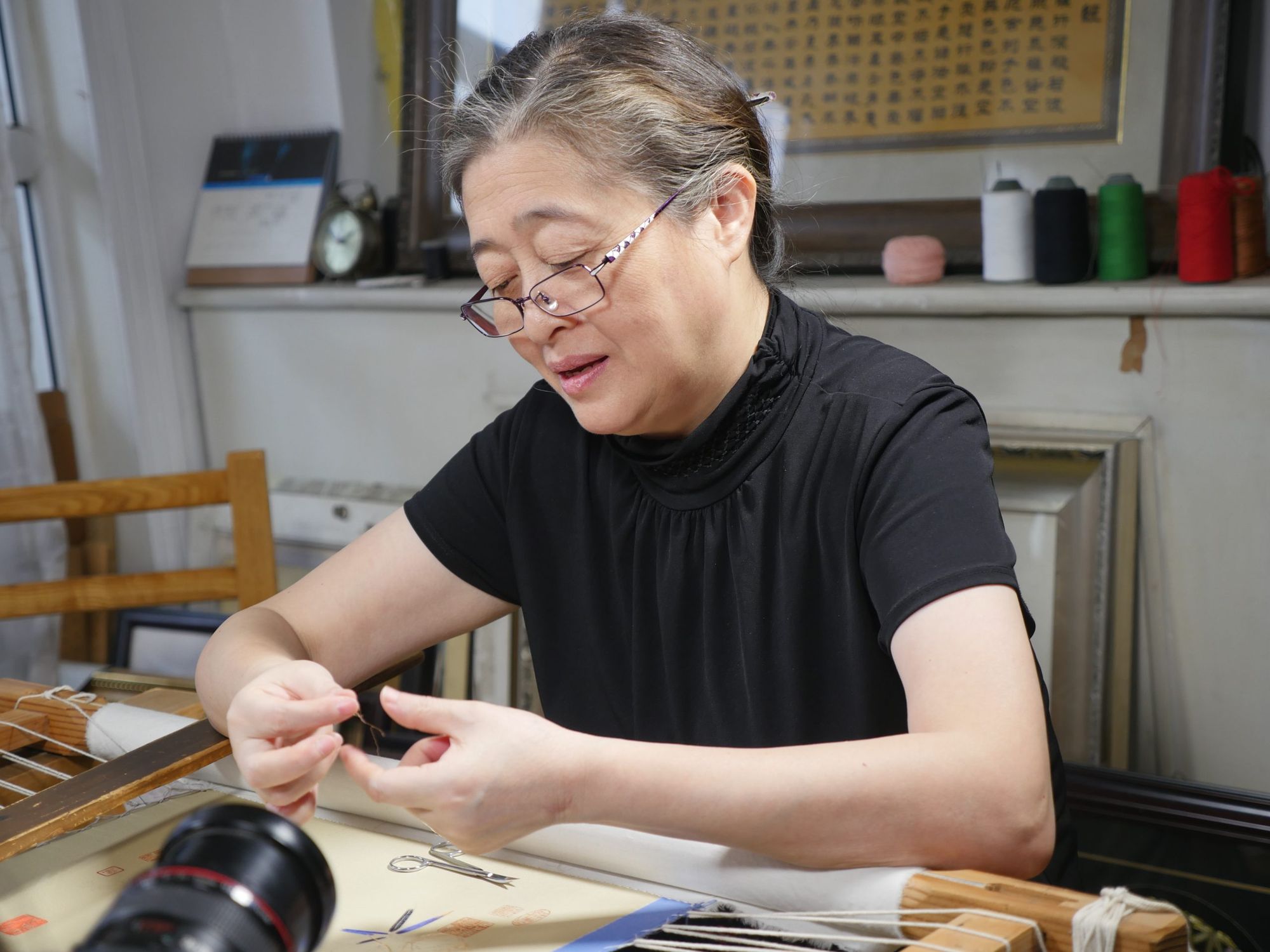
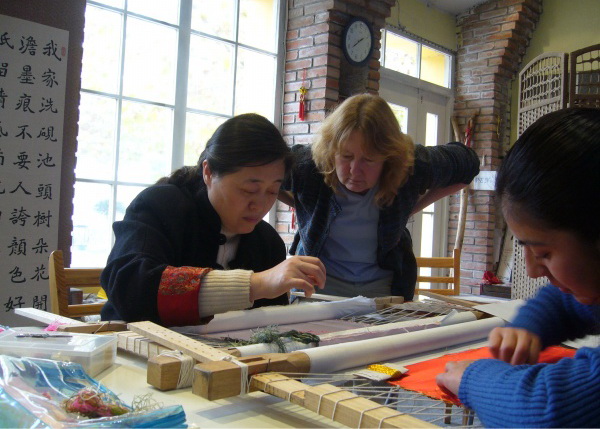
Design transfer, mounting, starts and finishes, silk division, hand position and tension are best learned through demonstration, guided practice and correction. For a source-grounded introduction to this preparation step, read how to split silk thread. The Institute offers a 3-hour one-to-one online class and private online lessons, usually three hours a week, beginning with a free video call. Overseas visitors coming to Beijing may also arrange one-to-one in-person study at the Institute’s working studio in Shunyi.
Frequently asked questions
Is Chinese embroidery hard for beginners?
The first stitches are approachable. The difficulty lies in fine silk division, shading and double-sided work, which take sustained guided practice.
Do I need silk thread to start?
Silk is traditional and gives the characteristic sheen, but a beginner can practise structure first. Try silk once tension is even.
Which book should a beginner use?
Chinese Embroidery: An Illustrated Stitch Guide by Shao Xiaocheng (Shanghai Press paperback, ISBN 978-1-60220-159-0) sets out stitches step by step in English.
Can I learn Chinese embroidery online?
Yes. The Institute teaches live, one-to-one online lessons, usually three hours once a week, and they begin with a free video call. Lessons are taught in Chinese with professional AI translation.
Written by the Chinese Embroidery Institute, drawing on the stitch guidance of Shao Xiaocheng.