Double-Sided Chinese Embroidery: Same, Different, and Fully Different Designs
Quick answer
Double-sided Chinese embroidery is designed to be viewed from both faces of a transparent or light-supporting ground. The two faces may present the same image, different images, or a more complex “three differences” relationship in design, stitch language, and color. Its achievement is best understood by comparing both faces as one coordinated work—not by treating one as the front and the other as a hidden reverse.
A work with two intended faces
Most viewers first meet embroidery as a one-directional image. The decorated face is meant to be seen, while the reverse is protected by a mount, backing, frame, garment lining, or another layer. Double-sided embroidery changes that basic relationship. Both faces belong to the finished visual experience.
This is why many double-sided works are presented in table screens or other open display forms. A viewer can move around the object, watch light pass through the ground, and compare how the image behaves from each side. The display is not merely decorative furniture. It makes the two-face conception visible.
The supporting fabric also matters. The English edition of Chinese Embroidery: An Illustrated Stitch Guide discusses real silk voile as light, thin, and transparent, while a silk tabby is denser and more opaque. These qualities influence what can be seen through a completed work. They are material and viewing principles, not a substitute for learning the controlled handwork behind the result.
“Double-sided” does not mean only one thing
The term describes a family of visual relationships. The most useful way to understand it is to ask what the two faces are meant to share—and where they are meant to differ.
Matching images on both faces
In the most immediately recognizable form, the two faces present substantially the same subject. From either side, the viewer encounters a coherent image rather than an exposed working reverse.
“Same” should not be reduced to a quick mirror effect. The importance lies in the deliberate coordination of the two viewing faces. The work must remain visually resolved when seen from either direction, and the surrounding display must allow that comparison to happen.
Different images on the two faces
Double-sided embroidery later developed beyond matching subjects. One face could present one image and the other face another. The object then becomes a paired visual experience: face A and face B may contrast in subject, mood, color, or historical reference, yet they still occupy the same physical field.
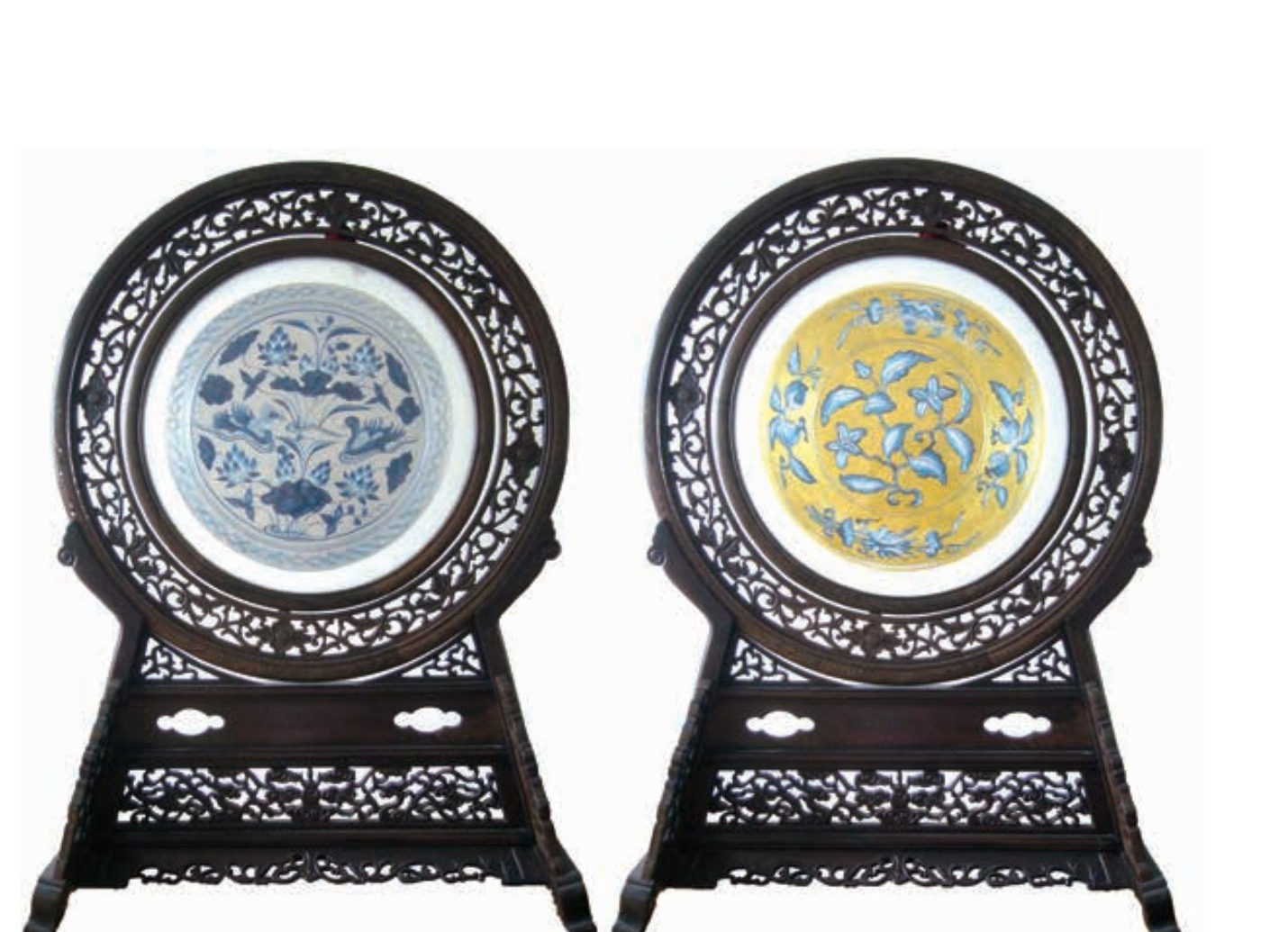
The hero image above shows this principle clearly. The two circular screens are not photographs of unrelated works placed together for comparison. They are the two intended faces of one fully different double-sided embroidery. Each face must be read in relation to the other.
Fully different and the idea of “three differences”
Illustrated Art of Embroidery describes a more complex category in which the two faces may differ in design, stitch language, and color. This is sometimes summarized as “three differences.” The phrase is useful because it reminds viewers that difference is not limited to changing the subject alone.
For public appreciation, the essential point is conceptual. A fully different work coordinates two distinct images within one object. The detailed routes, hand movements, working order, alignment decisions, thread preparation, and tension control that make this possible belong to systematic teaching, not to a general viewing article.
How to look at a double-sided embroidery
A photograph can document the two faces, but it cannot reproduce the full experience of moving around a screen. When viewing the actual work—or a careful sequence of photographs—use a few simple questions.
First, identify the intended relationship. Are the faces matching, differently colored, differently designed, or fully different in several ways? Do not assume that one category is automatically superior. Each establishes a different artistic problem.
Second, compare the compositions rather than hunting only for technical “secrets.” Notice how each image uses the same overall shape. A round, rectangular, or fan-shaped field sets a common boundary even when the subjects differ.
Third, look at the role of light. Transparent grounds make light part of the work’s appearance. Changes in illumination can affect the clarity of outlines, the apparent density of color, and the separation between the embroidery and its surroundings.
Fourth, read the display as part of the work. The frame, stand, and viewing height determine whether both faces can be approached. A double-sided piece loses much of its meaning if one face is placed permanently against a wall.
Finally, allow time for comparison. The interest is not exhausted by the surprise that “there is another picture on the back.” The deeper experience comes from moving between the two faces and considering why the artist paired them.
Four common misunderstandings
One misunderstanding is that the second face is simply a clean reverse. In a true double-sided work, both faces are planned for viewing; neither is merely leftover evidence of construction.
Another is that the highest goal must always be perfect sameness. Matching faces are one important category, but different and fully different works deliberately pursue other visual relationships.
A third is that any transparent-looking embroidery is double-sided. Transparency helps both faces remain visible, but the category depends on the completed work being conceived for two-face viewing.
The fourth is that close photographs reveal enough to reproduce the technique. They do not. A finished surface can support appreciation and comparison, but it does not disclose the full sequence of decisions, corrections, and trained control required during making.
Historical development as artistic expansion
The Chinese edition, Illustrated Art of Embroidery, notes that double-sided embroidery existed in the Qing period, while highly accomplished surviving examples were uncommon. It then describes the broader development of double-sided table-screen work in modern Suzhou embroidery and the expansion from matching faces to different-image and fully different forms.
This history is significant because it shows innovation within tradition. Double-sided embroidery is not only a display of neatness. It changes how an embroidered object organizes images, space, light, and movement. The viewer is invited to circle the work, compare two visual statements, and understand them as one artistic conception.
Readers who want a broader regional context can continue with The Four Famous Chinese Embroidery Traditions. For the role of smooth tonal stitching in pictorial surfaces, see Satin and Shading Stitches in Chinese Embroidery. Related objects and visual records can also be explored through the Digital Museum of Chinese Embroidery.
Learning beyond the finished surface
A public article can explain categories, viewing principles, material relationships, and common misconceptions. It cannot responsibly replace guided training in how the two faces are planned and controlled.
The Chinese Embroidery Institute’s Classes & Courses reserve step-by-step working order, exact thread handling, directional changes, alignment, tension, corrections, progressive exercises, and individual feedback for structured study. That boundary keeps the public discussion useful while respecting the depth of the craft.
Frequently asked questions
Is double-sided embroidery always the same picture on both sides?
No. Some works present matching images, while others use different subjects, colors, or stitch languages. Fully different works may coordinate differences in design, stitch, and color across the two faces.
Can double-sided embroidery be appreciated in a wall frame?
It can be documented in photographs or temporarily shown from one side, but a permanent wall mount prevents the intended comparison. Open screens and other two-directional displays better reveal the work’s conception.
Does a finished photograph teach the technique?
No. It may help viewers recognize categories and compare surfaces, but it does not reveal the complete working sequence, hand control, alignment, tension, or correction process.
Institute publication and editorial basis
This article extends the Chinese Embroidery Institute’s existing research and editorial work. The Illustrated Art of Embroidery (《图说刺绣艺术》) was written by Shao Xiaocheng, with Martin Xiao (Xiao, Yao) as responsible editor. Chinese Embroidery: An Illustrated Stitch Guide was written by Shao Xiaocheng.
Leave your comment
Related posts