Qing Dynasty Embroidery: Four Famous Schools and What Came Before
Quick answer: Qing dynasty embroidery (1644–1911) is the period when Chinese needlework spread widely in great numbers and variety, and when the four major regional schools — Su, Xiang, Shu and Yue — took shape as a useful map. Our Institute books place this after Ming Gu and Lu styles, and treat the four labels as a late, regional guide rather than the whole of Chinese embroidery.
When people search for Qing embroidery, they often meet court robes, export pieces and the four famous names with little context. This hub gathers what our books and live embarts.com guides already say: where Qing sits on the timeline, how the four schools formed, what continued from Ming Lu and Gu work, how Yue work peaked in trade, and how to look at a Qing piece without confusing embroidery with woven kesi.
Where Qing embroidery sits in Chinese history
Our origin and development timeline places artistic embroidery taking clear form in the Song, rarer techniques such as “fishing-net” embroidery in the Yuan, and Gu-style work in Shanghai among Ming representatives. By the Qing (1644–1911), embroidery spread across China in great numbers and variety, and the four major schools of art embroidery gradually took shape.
In the history chapter of Chinese Embroidery: An Illustrated Stitch Guide, Shao Xiaocheng writes that there were not yet real “schools” of embroidery in the Ming; Gu-style work in the south and Shandong work in the north stood out as the two representative faces. The Ming dynasty embroidery hub summarises that bridge: Ming prepared the ground; Qing is when the familiar Su, Xiang, Shu and Yue map became prominent.
The four famous embroideries take shape
The Four Famous Embroideries of China are Su embroidery (Suzhou), Xiang embroidery (Hunan), Shu embroidery (Sichuan) and Yue embroidery (Guangdong). Our books and regional guides treat these names as influential regional traditions, not a rigid formula for every Qing object.
- Su embroidery: refined colour, smooth lustrous surfaces, fine silk and a close relationship with painting. Shao Xiaocheng notes that the four-name classification became prominent in the late Qing, when specialist workshops and many embroiderers in the Suzhou region supported both production and pictorial experiment. Qing Su work in our books includes quiet, elegant palette pieces such as the rooster detail from Wisteria and Two Roosters in The Illustrated Art of Embroidery.
- Xiang embroidery: the name came into use in the Qing. Shao quotes an 1818 Xiangtan gazetteer that records embroidery as women’s work in rural and urban communities; by the Tongzhi period, local practice met workshop experience associated with Su and Yue. Late Qing workshops, including teaching linked to Hu Lianxian, changed how Xiang work was organised and circulated. Book examples include a Qing mosquito-net valance and Lotus Pond and Mandarin Ducks.
- Shu embroidery: centred on Chengdu and Sichuan. Shao records that by the Daoguang period embroidery in Sichuan had reached an organised scale and was widely practised; specialised small workshops became more visible, and an embroidery guild known as the Sanhuang Society organised local work. Qing pillow tops and a late-Qing Qilin Bringing a Son mirror-centre appear in The Illustrated Art of Embroidery.
- Yue embroidery: Guang embroidery from Guangzhou and the Pearl River Delta, and Chao embroidery from the Chaozhou region. Our books describe Yue work as brilliant in colour, crowded and lively in composition, and rich in style. The umbrella names became fixed from the mid-to-late Qing, when the four famous embroideries were classified by region. Qing was Yue embroidery’s peak of guilds, workshops and export; The Treasury of Chinese Embroidery Appreciation records pieces such as Phoenix Facing the Sun and Cranes and Deer in Spring.
Our timeline is clear: the four major schools are a small, late part of a much longer history. Read them as comparisons of surface, colour spacing and ground, not as the only Qing story.
What continued from Ming Gu and Lu work
Lu embroidery continued into the Qing. The Treasury of Chinese Embroidery Appreciation describes later pieces including Mountain Temple in Clear Mist from the Kangxi period and Peonies and Phoenixes from the Qianlong period. From the late Qing, Western drawn-thread work spread in Shandong, and the old twisted-thread Lu style became hard to find. Our books also point to the rise of Gu embroidery’s fame and the loss of the special twisted thread as reasons the old Lu manner was gradually forgotten.
Gu embroidery’s painting-like fine silk, soft colour and close link to calligraphy remained a southern reference point that later readers often meet before they meet the four Qing labels. Side-by-side differences between Gu and Shandong work are in our Gu-style and Shandong guide. Reading those Ming faces first makes the Qing four-school map easier to place.
Court dress, trade and everyday textiles
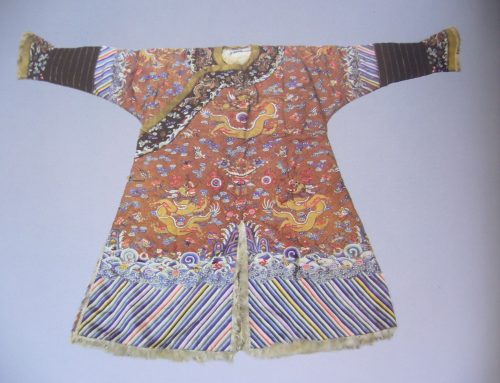
Not all Qing embroidery was a named regional “school.” Court dress used embroidery for dragons, clouds and rank animals; our Ming hub notes that books contrast the wide robes and broad sleeves of the Ming with the closer-fitting Qing style. Rank badges (buzi) and dragon robes can be embroidered or woven — and woven court surfaces are often kesi, which is silk tapestry, not embroidery.
Yue embroidery’s coastal trade is one reason Qing pieces travelled widely. Our Yue guide, following the Institute books, records that from 1757, when Western trading ships were restricted to the port of Canton (Guangzhou), export grew further, and eighteenth-century Yue work became fashionable abroad. Household textiles — mosquito-net valances, pillow tops, mirror-centres — also show how Qing needlework lived outside the framed pictorial hanging.
How to look at a Qing piece
- Place it on the timeline: after Ming Gu and Lu representatives; the four famous names are a late Qing regional map.
- Compare surfaces, not labels alone: Su tends toward quiet, flat, lustrous order; Xiang often shows shaded animals and pictorial space; Shu emphasises disciplined, luminous workshop surfaces; Yue favours bright contrast, crowded composition and clear water paths (水路).
- Check the thread and ground: twisted clothes-thread points toward the Lu line; hair-fine divided silk toward painting-like southern work.
- Separate embroidery from kesi: kesi is woven, not stitched. Do not assign a needlework school until the structure is clear.
- Be careful with modern look-alikes: Shao Xiaocheng warns that modern pieces stitched over computer-printed designs have blurred differences between the four famous embroideries.
For judging workmanship more generally, see how to recognize fine Chinese embroidery and our overview of Chinese embroidery stitches. For what “art embroidery” means in our books, see what is Chinese art embroidery.
Study Qing techniques with the Institute
Reading regional surfaces, thread structure and pictorial organisation are skills you can practise. Explore our classes and courses — lessons are taught in Chinese with professional, embroidery-specialised AI translation — and the English stitch guide on our books page. Have a textile you would like us to look at? Send clear photos through our remote initial review, or simply contact us.
Frequently Asked Questions
What is Qing dynasty embroidery?
Embroidery made in China during the Qing dynasty (1644–1911). Our books describe it as a period of wide regional variety when the four major schools — Su, Xiang, Shu and Yue — took shape, after Ming Gu and Lu styles.
When did the four famous embroideries appear?
Our timeline places the four major schools as taking shape in the Qing dynasty. They are a small, late part of a much longer history of Chinese embroidery.
Did the four famous embroideries already exist in the Ming?
No. Our books treat Gu embroidery in the south and Lu embroidery in the north as Ming representative styles. The Su–Xiang–Shu–Yue map became prominent later, in the Qing.
Is Lu embroidery one of the four famous embroideries?
No. Lu embroidery is the Shandong / clothes-thread tradition our books place with Gu embroidery as a Ming northern face. It continued into the Qing, then became hard to find after late-Qing drawn-thread work spread in Shandong.
What are the four famous embroideries?
Su (Suzhou), Xiang (Hunan), Shu (Sichuan) and Yue (Guangdong). See the four famous embroideries overview and the regional guides linked from that page.
Is Qing kesi a kind of embroidery?
No. Kesi is woven silk tapestry, not embroidery. Court garments and pictorial hangings can appear in either technique; structure must be checked first.
Leave your comment
Related posts