Chinese Appliqué Embroidery: Layered Cloth and Stitched Edges
Quick answer
Chinese appliqué embroidery builds a design by attaching shaped pieces of cloth to a ground and securing or decorating their edges with stitches. Shao Xiaocheng’s books use several terms, including the English appliqué, Chinese tiexiu (贴绣), and buhuaxiu (补花绣) in an Ewenki context. Applied color, silhouette, edge treatment, and added embroidery work together; the cloth patch is only one part of the design. Its identity lies in this layering, not in the patch alone.
What is Chinese appliqué embroidery?
In Chinese Embroidery: An Illustrated Stitch Guide, appliqué is defined as cloth cut from another fabric and sewn onto the ground as a form of embroidery. This direct description explains the basic layered structure: one textile becomes the support, while additional shaped pieces become visible parts of the motif.
Shao Xiaocheng’s books do not always use one universal label for every applied-fabric tradition. 《图说刺绣艺术》 captions a Southern Song object as tiexiu (贴绣), literally “attached embroidery.” In its chapter on Ewenki embroidery, it uses buhuaxiu (补花绣), a term associated with applied or patched floral decoration. These words overlap with the English category “appliqué,” but they also belong to specific historical and regional descriptions.
For that reason, this article uses Chinese appliqué embroidery as an accessible English umbrella while retaining the Chinese terms attached to the cited objects. It does not claim that tiexiu, buhuaxiu, and every regional applied-cloth method are interchangeable in all contexts.
Why appliqué is still embroidery
It may be tempting to think that the shaped cloth carries the entire design and stitching merely keeps it in place. The supplied guide shows a more integrated relationship. Edges can be finished or emphasized with gold- or silver-thread couching, blanket stitch, chain stitch, and related structures. Stitching can conceal a raw edge, sharpen a silhouette, add brilliance, or create a contrasting rhythm around the patch.
The technique therefore brings together four visible decisions:
- Silhouette: the cut shape establishes the main outline.
- Material and color: the applied fabric introduces a field that may differ from the ground in hue, weave, luster, or pattern.
- Edge: securing stitches determine whether the boundary looks crisp, soft, beaded, metallic, or strongly linear.
- Surface detail: additional embroidery can model veins, petals, feathers, facial features, borders, or other internal forms.
The result is not simply “fabric glued to fabric.” It is a constructed textile surface in which cutting, placement, attachment, and embroidery are designed together.
A Southern Song example
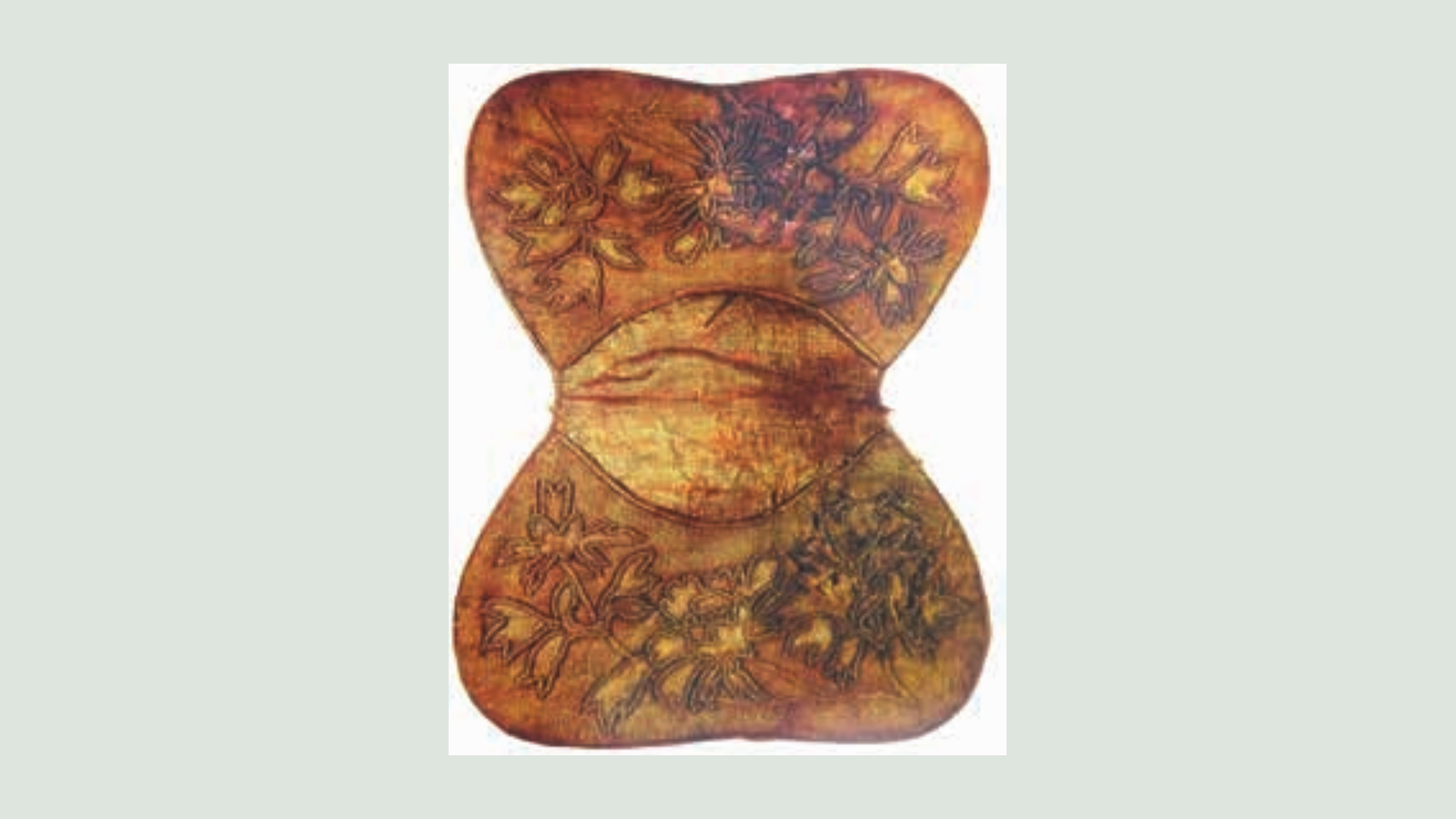
《图说刺绣艺术》 reproduces a Southern Song crimson gauze appliqué pouch with a peony pattern. Its silhouette immediately identifies it as a handled object rather than a framed picture. Applied floral forms occupy the upper and lower areas, while the central fold and curved divisions remain part of the object’s structure.
This example matters because it places tiexiu within the refinement of Song-period practical embroidery. Shao does not present the pouch as proof that every Song textile used appliqué, nor does it describe it as the origin of the technique. It is a documented example of applied floral decoration on an object made for use.
The image also reminds us to read appliqué at two scales. From a distance, the viewer sees the overall pouch and its floral arrangement. Closer inspection reveals how boundaries, thread, wear, fading, and the relationship between the applied shapes and ground affect the design.
Readers interested in the wider period can place the object within A Brief History of Chinese Embroidery.
An Ewenki example of buhuaxiu
The Illustrated Art of Embroidery describes Ewenki embroidery in areas of Heilongjiang and Inner Mongolia. It notes the use of flat embroidery and buhuaxiu on pouches and soft leather boots, with plants, flowers, and deer among the motifs. Designs may be representational or transformed into symmetrical forms with clear color contrast.
This passage gives appliqué a different material and cultural setting from the Southern Song silk pouch. It does not mean that one regional example can stand for all Ewenki work, or that all visible decoration on the illustrated boots is appliqué. The value of the example lies in the documented combination of applied decoration, daily objects, leather or textile grounds, strong silhouette, and contrast.
For a broader approach to regional specificity, see Ethnic Embroidery Traditions in China. That article explains why material, object type, place, community, and source should remain attached to every example.
How the edge changes the design
A quiet edge
When securing stitches visually recede, the applied cloth reads as a continuous color shape. The viewer notices the silhouette before the attachment method.
A drawn edge
Chain, blanket, or another visible stitch can turn the boundary into a line. The outline may unify an irregular patch, separate neighboring colors, or create a repeated rhythm around a flower, animal, or geometric unit.
A brilliant edge
Gold- or silver-thread couching can make the boundary reflective. The metal thread does not merely hide construction; it changes the visual hierarchy by making certain contours catch light. Our article on Gold and Silver Thread Couching explains this surface logic in more detail.
A combined edge
Some objects use more than one method: attachment stitches for stability, a decorative line for clarity, and interior embroidery for detail. The best description should identify these layers rather than naming the entire surface after only one visible component.
How to examine an appliqué object
Begin with the object type and complete composition. Are the applied shapes carrying the main motif, a border, a repair, or a later addition? Compare the weave, thickness, pattern, and aging of the patch with the ground. Then look at the edge: are stitches original-looking, interrupted, replaced, or unusually tight? Does the boundary follow the intended silhouette?
Do not assume every patch is decorative appliqué. Historical textiles may contain repairs, reinforcements, later mounting fabrics, labels, or conservation additions. Conversely, a deliberately applied form may have lost some of its edge stitching and now resemble damage. Identification requires the relationship between design, material, construction, and documentation.
Layered textiles also create condition concerns. Edges can lift; different fabrics can shrink or respond to humidity at different rates; metallic or dense borders can strain a lighter ground. Do not pull, trim, reattach, or wash a lifted patch before understanding the materials. How to Examine and Preserve Embroidery Safely provides a non-invasive starting framework.
What this article deliberately leaves out
This article explains structure, naming, visual roles, and documented examples. It does not publish patterns, cutting templates, seam allowances, adhesives, exact stitch routes, edge-turning methods, thread specifications, attachment sequence, tension, or troubleshooting.
Those decisions change with fabric, leather, silk, scale, edge condition, intended use, and regional method. They remain part of guided practice in Classes & Courses, where a demonstration can show how a patch behaves rather than reducing the method to a few unsafe universal instructions.
Frequently asked questions
Are tiexiu and buhuaxiu the same as appliqué?
Both terms can describe applied-cloth embroidery within the cited publications, so “appliqué” is a useful English bridge. They should still be retained when discussing the specific Southern Song and Ewenki examples, because historical and regional vocabulary carries context that a broad English category can lose.
Is appliqué only used for folk or ethnic embroidery in China?
No. The Illustrated Art of Embroidery includes a Southern Song silk pouch as tiexiu and also documents buhuaxiu in Ewenki embroidery. These examples show different settings; neither should be used to reduce the technique to one social category.
How can I tell decorative appliqué from a repair?
Look for planned repetition, coherent silhouette, intentional edge treatment, relation to the complete motif, and material evidence. A single photograph may not be enough. Construction, reverse-side access, condition, and provenance can be necessary, and invasive examination should be avoided.
Institute publication and editorial basis
This article extends the Chinese Embroidery Institute’s existing research and editorial work. The Illustrated Art of Embroidery (《图说刺绣艺术》) was written by Shao Xiaocheng, with Martin Xiao (Xiao, Yao) as responsible editor. Chinese Embroidery: An Illustrated Stitch Guide was written by Shao Xiaocheng.
Leave your comment
Related posts