Su Embroidery: History, Style, and the Suzhou Tradition
Quick answer
Su embroidery, or suxiu(苏绣), is the regional embroidery tradition associated with Suzhou and the wider Jiangsu area. It is known for controlled silk surfaces, balanced colour, orderly thread direction, and a close relationship with Chinese painting. Its history also includes practical textiles, auspicious folk imagery, named women artists, modern pictorial experiments, and influential double-sided work.
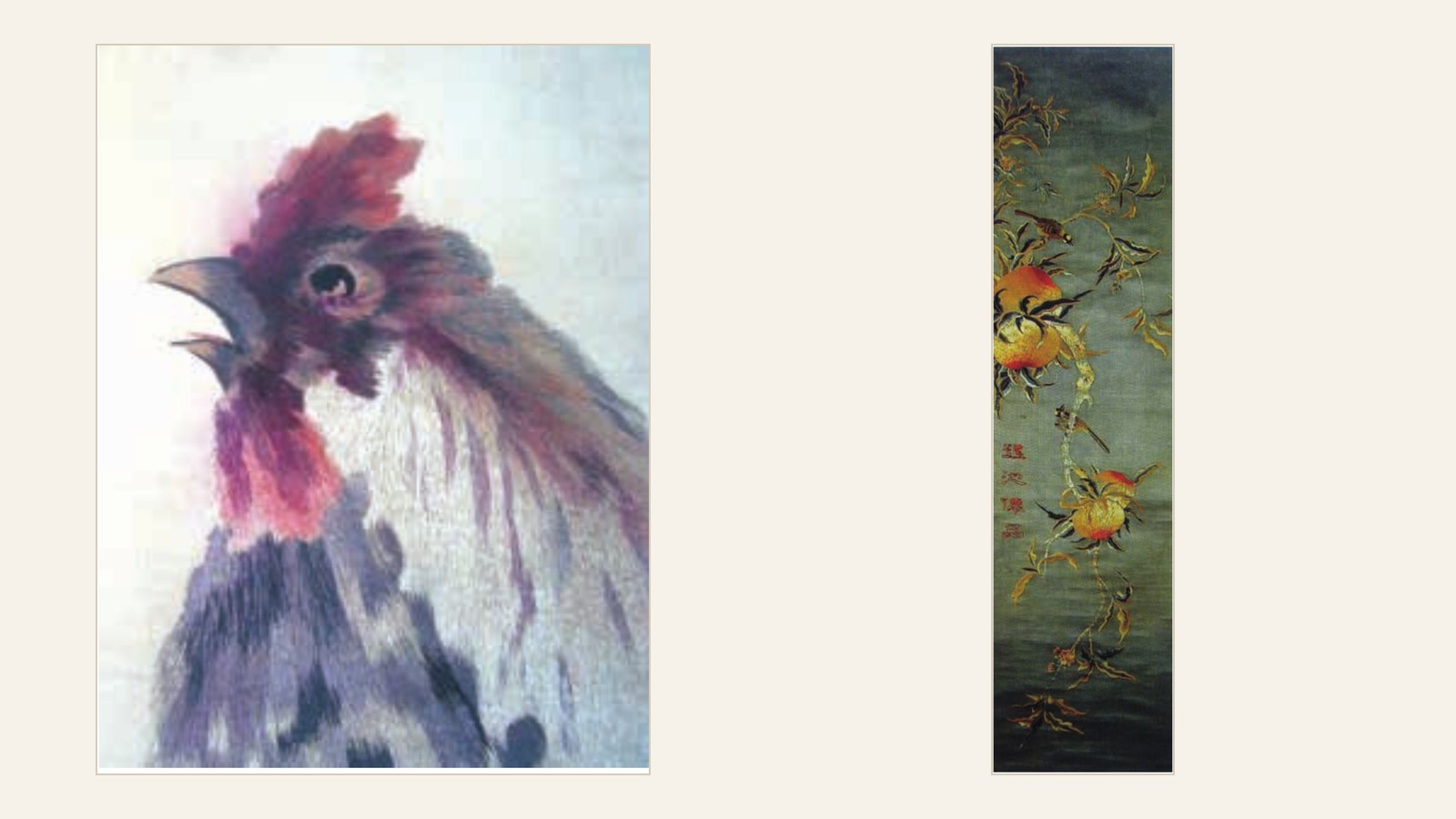
Qing-dynasty Su embroidery in two visual registers: the refined thread surface of a rooster detail and the balanced composition of an auspicious pictorial hanging. Images from Shao Xiaocheng’s The Illustrated Art of Embroidery, pp. 99-100, figs. 3-60 and 3-61.
What the name suxiu means
The public English name Su embroidery translates suxiu(苏绣). “Su” refers to Suzhou, although the term is commonly used for a broader Jiangsu-centred regional tradition rather than for work made only within the modern city boundary.
Shao Xiaocheng describes Su embroidery as one of the Four Famous Embroideries of China. That classification became prominent in the late Qing period, when Su, Xiang, Shu, and Yue embroidery were increasingly identified through regional workshops, markets, subjects, and visual preferences.
This history needs one distinction. Ancient embroidered objects found in Jiangsu, and records of embroidery activity around Suzhou, establish a long regional history. They do not prove that every early object already belonged to “Su embroidery” in the later, fully formed sense. A regional craft history can be old even when its familiar school name and stylistic category became established much later.
From a silk-producing region to a recognised embroidery tradition
Suzhou’s embroidery culture grew in a region with established sericulture, silk weaving, urban consumption, and close ties to painting and collecting. Shao’s research notes embroidery-related lanes in Song-dynasty Suzhou and describes the city as an important silk centre by the Ming period. By the Qing dynasty, specialist workshops and a substantial population of embroiderers supported both production and artistic experimentation.
The result was not one fixed workshop formula. Household work, commercial embroidery, garments, furnishing textiles, gifts, and pictorial pieces existed alongside one another. The name suxiu therefore identifies a regional field of practice, not a single stitch or a single level of refinement.
The eight qualities traditionally associated with Su embroidery
Shao summarises the admired workmanship of Su embroidery through eight Chinese terms:
- ping(平): the embroidered surface lies flat;
- qi(齐): stitches and edges appear orderly;
- yun(匀): divisions and transitions are evenly controlled;
- xi(细): fine silk is used with precision;
- mi(密): thread coverage is close and coherent;
- he(和): colours are harmonised;
- shun(顺): thread direction flows smoothly;
- guang(光): the silk surface carries light.
These terms describe visual control rather than a recipe. They help explain why a successful Su embroidery can look calm and effortless even when the making demanded sustained concentration. Fine thread alone is not enough. If direction, density, colour, and light do not work together, the surface may be technically minute but visually stiff.
Su embroidery and Chinese painting
Many pictorial Su embroideries were designed in conversation with Chinese painting. Composition, blank space, inscriptions, seals, tonal gradation, and the movement of line could all be translated into silk. This is why some works resemble hanging scrolls or album leaves rather than decorated cloth alone.
The translation is not literal. Ink sinks into paper, while silk thread reflects light according to its direction. An embroiderer must decide how a painted wash, dry brush, contour, or tonal shift can become layers of thread. The artistic problem is not simply “making embroidery look like a painting”; it is finding a textile equivalent for pictorial structure.
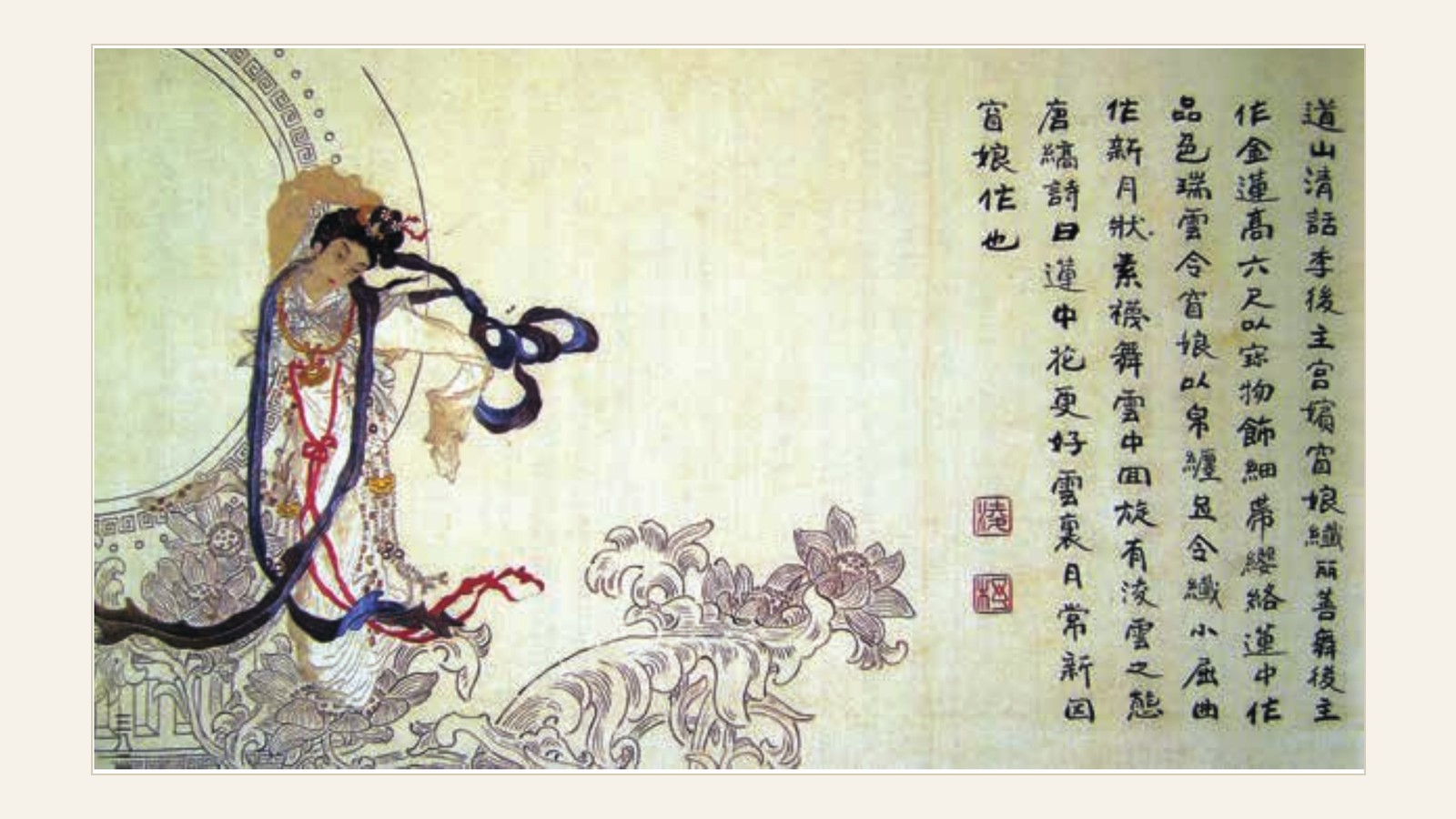
A Qing-dynasty Su embroidery with a female figure, architectural detail, inscription, and open ground. Its composition shows how pictorial embroidery could adopt the organisation of a Chinese painted work. From Shao Xiaocheng’s The Illustrated Art of Embroidery, p. 101, fig. 3-62.
Practical work, auspicious imagery, and pictorial embroidery
Su embroidery should not be reduced to elite pictorial pieces. Shao distinguishes practical embroidery from embroidery made primarily for appreciation. Folk display works could use homophones, visual puns, flowers, fruit, birds, and other combinations with auspicious meanings. Their compositions might be direct and balanced, with stronger colour and heavier thread than the most restrained literati-style work.
This wider range matters. “Delicate” does not mean colourless, and “refined” does not mean detached from everyday life. A regional tradition includes objects made for use, celebration, exchange, domestic display, and collecting. The relevant question is how design, material, subject, and workmanship operate together in a particular piece.
Women artists and the expansion of Su embroidery
The history of Su embroidery is also a history of named women artists. Shao records Qing and Republican-period embroiderers who could paint, interpret painting, teach, operate workshops, or develop new approaches to stitch direction and colour. Their work complicates the old habit of treating embroidery as anonymous household labour.
Among them, Shen Shou transformed pictorial embroidery by studying light, shade, perspective, and observed form. Her fangzhenxiu(仿真绣), commonly rendered in English as Simulation Embroidery, brought Western pictorial observation into dialogue with Chinese silk embroidery. The English term is a bridge to the idea of visual simulation; it does not turn the method into a Western stitch category.
The Institute has a separate study of Shen Shou and Simulation Embroidery. In the wider Su embroidery story, her importance lies in showing that regional tradition could remain recognisable while its pictorial language changed.
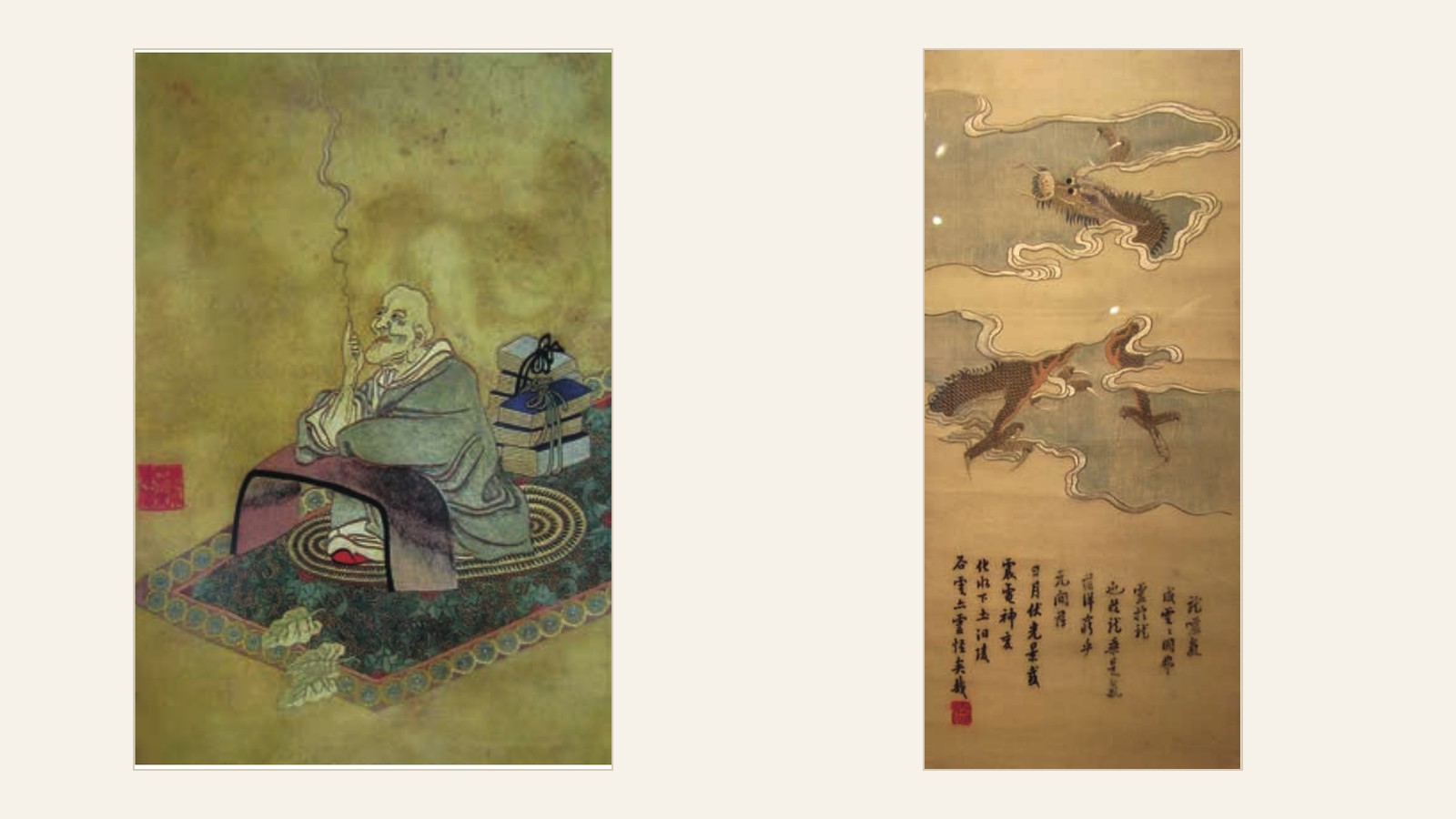
Two works by Shen Shou: the late-Qing Shenzhi Luohan and Dragon. They show different ways of translating figure, robe, cloud, scale, and tonal modelling into thread. From Shao Xiaocheng’s The Illustrated Art of Embroidery, p. 102, figs. 3-63 and 3-64.
Yang Shouyu and random-stitch embroidery
In the twentieth century, Yang Shouyu developed luanzhenxiu(乱针绣), usually translated as random-stitch embroidery. The English name can be misleading if “random” is taken to mean careless. The method uses intersecting stitches of different directions and lengths to build colour, volume, and pictorial atmosphere. Its visual logic is closer to organised variation than to disorder.
This surface differs from the conventional ideal of parallel, smooth thread direction. Yet it belongs to the modern history of the Jiangsu embroidery world because it emerged from close engagement with painting, tonal modelling, and the expressive capacity of silk. Innovation here did not mean abandoning embroidery; it meant asking the material to carry a different kind of image.
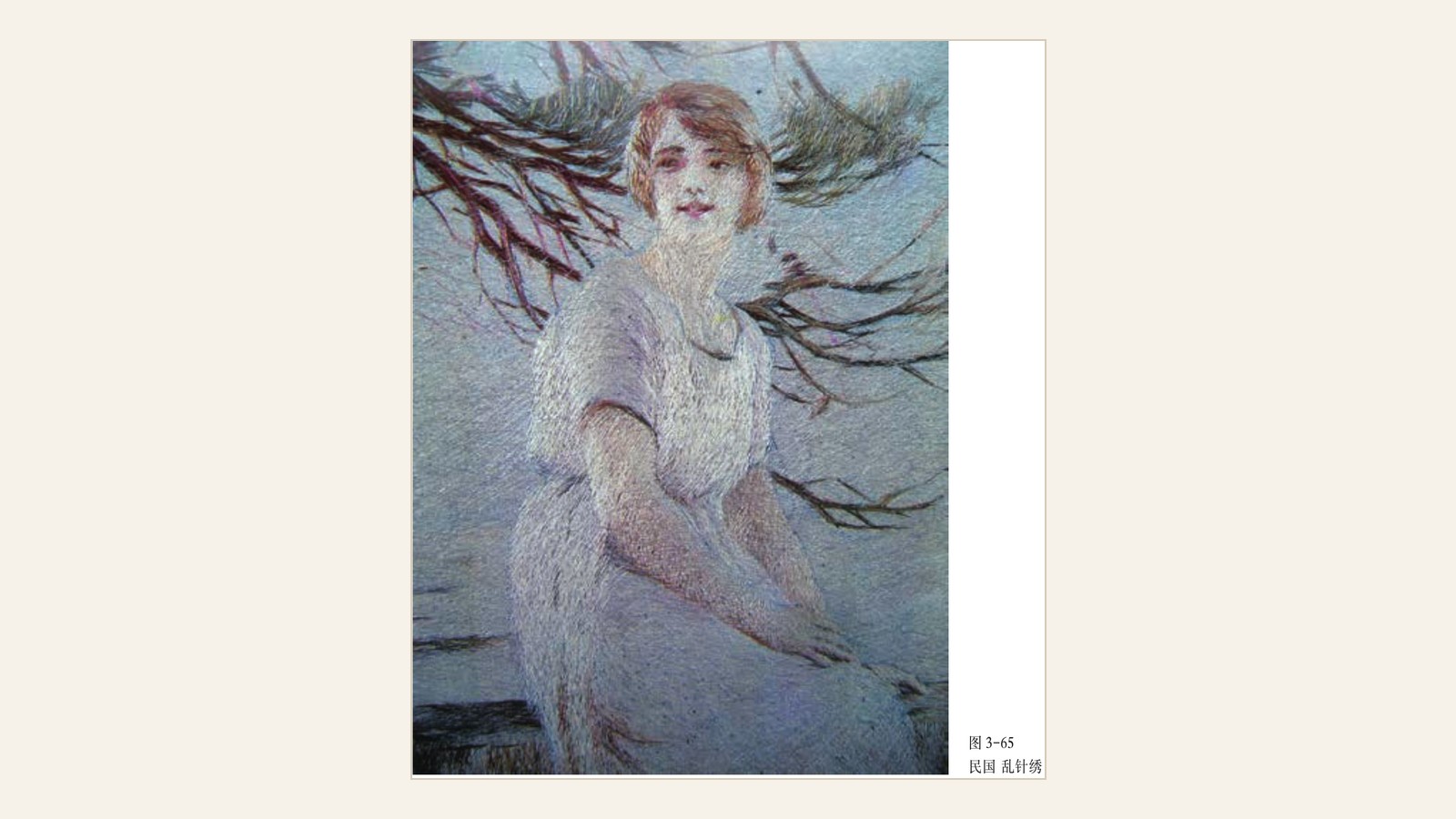
Yang Shouyu’s Republican-period Girl, made in random-stitch embroidery. Intersecting thread directions build the figure and surrounding atmosphere rather than forming a uniformly smooth surface. From Shao Xiaocheng’s The Illustrated Art of Embroidery, p. 103, fig. 3-65.
Is Su embroidery the same as double-sided embroidery?
No. Su embroidery is a regional tradition; double-sided embroidery is a structural form in which both faces are intended to be viewed. Suzhou workshops played an important role in the modern development of double-sided table screens and later different-image forms, but not every Su embroidery is double-sided, and double-sided work is not limited to Su embroidery.
Keeping the terms separate prevents a famous technical achievement from replacing the history of the whole regional tradition. Su embroidery includes single-faced and double-faced work, practical and pictorial objects, traditional smooth surfaces, and later experimental approaches.
How to look at a Su embroidery
Begin with the object rather than the reputation of the label. Look at the relationship between thread direction and reflected light. Check whether colour transitions support the subject or merely display technical fineness. Notice the treatment of outlines, blank ground, inscriptions, and the movement between densely worked and lightly worked areas.
Then ask what kind of object it is. A garment panel, an auspicious hanging, a pictorial screen, and a modern art embroidery were made for different settings. They should not be judged by one visual standard. The broader guide to recognising fine Chinese embroidery provides a condition-and-workmanship framework that can be used without assuming that every refined object must look alike.
Institute publication and editorial basis
This article extends research published by Shao Xiaocheng in The Illustrated Art of Embroidery(《图说刺绣艺术》)and Chinese Embroidery: An Illustrated Stitch Guide. The Illustrated Art of Embroidery was written by Shao Xiaocheng, with Xiao Yao(Martin Xiao / Xiao, Yao)as responsible editor. The historical sequence, eight workmanship terms, distinctions between practical and pictorial embroidery, and the discussion of Shen Shou and Yang Shouyu follow that research and editorial work.
The public article explains terminology, history, and visual structure. It does not provide a complete stitch sequence, thread-splitting specifications, tension settings, pattern transfer, or project workflow.
Frequently asked questions
What is Su embroidery called in Chinese?
It is called suxiu(苏绣). In English, both “Su embroidery” and “Suzhou embroidery” are used. “Su embroidery” is the closer translation of the established Chinese regional name.
Is all embroidery made in Suzhou Su embroidery?
Place matters, but location alone is not enough for historical or stylistic identification. Date, workshop context, material, subject, stitch structure, and documented attribution should also be considered.
Why does Su embroidery often resemble painting?
Pictorial Su embroidery developed in close conversation with Chinese painting and later with other forms of pictorial observation. Embroiderers translated composition, tonal change, line, blank space, and inscriptions into reflective silk thread.
Is random-stitch embroidery really random?
No. Luanzhenxiu(乱针绣) uses deliberately varied and intersecting stitch directions. “Random stitch” is the conventional English translation, but the visual structure is organised rather than accidental.
Leave your comment
Related posts