Chinese Embroidery Motifs and Meanings: How to Read the Whole Design
Quick answer
Chinese embroidery motifs do not have one meaning in every object. Start with the textile’s use, date, region, and audience; then examine which motifs appear together, where they are placed, how many are shown, and how color, material, inscriptions, and technique shape the design. A bat, bird, flower, dragon, or cloud can participate in different visual arguments. Context turns an image into a message.
A motif is not a one-word code
Online lists often reduce Chinese designs to equations: one animal equals one virtue, one flower equals one blessing. Such lists can be a useful starting point, but they become misleading when they are treated as universal translations.
A motif is a recurring visual element. A pattern is the way one or more elements are organized across a surface. Meaning is the interpretation produced by that arrangement in a particular setting. These three things are related, but they are not interchangeable.
The same flower can appear on a court-related furnishing, a wedding textile, a child’s garment, a scholar’s object, a religious hanging, or a contemporary decorative panel. Its scale, companions, color, placement, and technique may change with each use. Reading the flower without reading the object removes most of the evidence.
Begin with the object and its use
Before naming symbols, identify what kind of textile you are looking at. Is it a sleeve band, rank badge, robe, purse, bed hanging, altar textile, theatrical costume, picture, or modern studio work? Where would the embroidered area have been seen, and by whom?
Placement is part of meaning. A border can frame or protect a central field. A roundel can create a self-contained emblem. Repeated units may establish rhythm across clothing or furnishing, while a single pictorial scene asks to be read more like a painting. A motif on the front of a garment may carry a different emphasis from one hidden near an edge or lining.
Read combinations, not isolated icons
Chinese embroidery often builds meaning through relationships among motifs. A bird may be identified not only by its body but by the plant, season, landscape, or other birds around it. Flowers may form a seasonal group, a garden scene, a repeated border, or a rebus. Animals facing, chasing, enclosing, or circling a center create different compositional roles.
Titles and inscriptions matter as well. A recorded title can identify how a group was understood; an inscription may connect the image to a poem, person, occasion, or earlier painting. Neither should be accepted uncritically, especially if added later, but both belong to the evidence.
Number and arrangement can carry the message
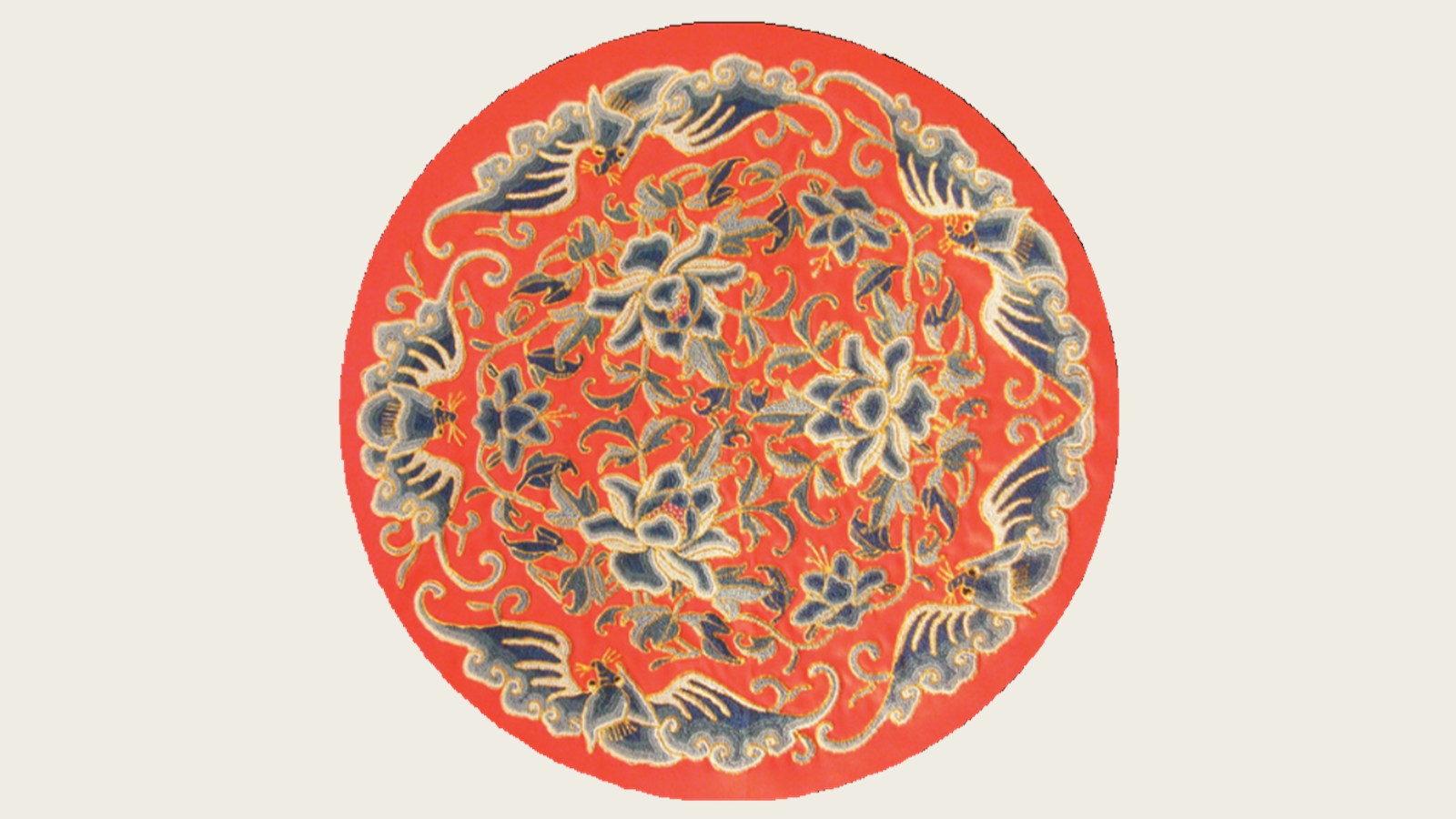
Counting is sometimes more informative than simply naming. In the hero work, the outer figures are not generic decoration: Shao Xiaocheng’s The Illustrated Art of Embroidery identifies five bats arranged as a ring and names the composition Five Happiness to the Family. The number, circular placement, and title work together.
The center is equally important. Interwoven lotus flowers occupy the inner field, so the design has a visual hierarchy: an enclosing ring of bats around a densely connected floral center. If one bat or one lotus were cut out and shown alone, much of that structure would disappear.
Numbers do not automatically mean the same thing in every textile. First establish that the count is intentional and that the design is complete. Damage, cropping, repeating yardage, or an incomplete garment can all make a surviving count deceptive.
Textual traditions can organize a whole scene
Some compositions depend on literary, ethical, religious, or pictorial traditions rather than a simple dictionary of auspicious signs. A useful example appears in Illustrated Art of Embroidery: the Song-period Embroidered Picture of the Five Relationships includes a phoenix, cranes, mandarin ducks, wagtails, and orioles. Shao relates the five bird types to five human relationships—ruler and subject, parent and child, husband and wife, elder and younger siblings, and friends—and cites earlier texts for the associations.
The lesson is methodological. The subject becomes legible because the birds form a named set supported by composition and textual references. It would be unsafe to remove one bird from that set and assume it must express the same relationship in every other embroidery.
Religious imagery needs the same care. A lotus in a Buddhist setting, a lotus in an auspicious domestic pattern, and a lotus copied from a painting may overlap visually while serving different purposes. Identify the setting before deciding which interpretive tradition applies.
Color, material, and stitch change the effect
Meaning is carried not only by outlines. Material and technique decide how a motif occupies the surface. Smooth silk shading can make a bird or flower appear pictorial and lifelike. Gold- or silver-thread couching can emphasize an edge, create brilliance, or establish visual hierarchy. Dazi embroidery (打籽绣), or seed embroidery, can turn a flat shape into a field of raised seeds. In auspicious contexts, those gathered seeds can also evoke continuing descendants and many children.
In Five Happiness to the Family, Shao calls the palette “three blues”: three grades of blue associated there with the colors of blue-and-white porcelain. Dazi builds the main bats and lotus forms, while gold-thread couching outlines their edges. Red ground, graded blue forms, gold contours, circular spacing, auspicious seed imagery, and the named motifs combine into one design. Translating only “bat” and “lotus” would miss how the embroidery communicates.
Period, region, and maker still matter
Chinese embroidery is not one uniform symbolic system. Court workshops, urban studios, local household traditions, ethnic dress, religious communities, commercial production, named artists, and contemporary designers use images in different ways. Meanings can persist, shift, overlap, or be revived.
Compare an object with documented works of similar date, place, function, and technique. Our overview of Ethnic Embroidery Traditions in China explains why a motif should not be detached from the community that made and used it. For historical objects, the research framework in Collecting Chinese Embroidery helps separate observation, reported history, and later alteration.
Named contemporary works deserve equal precision. Record the artist’s title and explanation when available instead of replacing them with a generalized “traditional meaning.” Makers can quote, combine, question, or redesign inherited imagery.
Seven questions for reading a Chinese embroidery pattern
- What is the complete object? Record its type, dimensions, construction, and likely use.
- Where is the motif placed? Note center, border, front, back, edge, lining, or repeated field.
- Which elements form one group? Read companions, direction, overlap, framing, and negative space.
- Is number deliberate? Count only after checking that the design survives intact.
- What do titles, inscriptions, or reliable records say? Keep early evidence separate from later labels.
- How do color, material, and stitch affect emphasis? Observe relief, shine, scale, density, and outlines.
- Which period, region, community, or maker provides the nearest comparison? Prefer documented parallels over a universal symbol list.
What motif reading cannot prove
A plausible interpretation does not authenticate an object, establish its age, identify an unknown maker, or determine market value. A familiar auspicious subject can be copied in a later period, and an old textile can be remounted or altered. Design analysis is one part of object study, not a substitute for it.
For closer technical observation, use How to Recognize Fine Chinese Embroidery alongside the object’s cultural context. The Digital Museum of Chinese Embroidery provides more material for comparative looking. Structured pattern design, stitch mapping, transfer methods, exact color planning, and project-specific feedback remain part of Classes & Courses, rather than this public interpretive guide.
Frequently asked questions
Do Chinese embroidery symbols always have auspicious meanings?
No. Many designs are auspicious, but others are pictorial, religious, official, theatrical, narrative, seasonal, personal, or primarily decorative. Establish the object and setting before applying an auspicious interpretation.
Does a bat always mean happiness or good fortune?
Bats are important in many auspicious designs, but the exact message depends on number, companions, composition, title, period, and use. In the documented hero work, five bats in a ring belong to a named “Five Happiness” composition.
Can color identify a motif’s meaning?
Color can strengthen hierarchy, atmosphere, group identity, or a named palette, but it rarely supplies a complete interpretation on its own. Material, technique, object type, and historical context must be considered with it.
Institute publication and editorial basis
This article extends the Chinese Embroidery Institute’s existing research and editorial work. The Illustrated Art of Embroidery (《图说刺绣艺术》) was written by Shao Xiaocheng, with Martin Xiao (Xiao, Yao) as responsible editor.
Leave your comment
Related posts