Essential Tools and Materials for Chinese Embroidery: A Practical Starter Guide
Quick answer
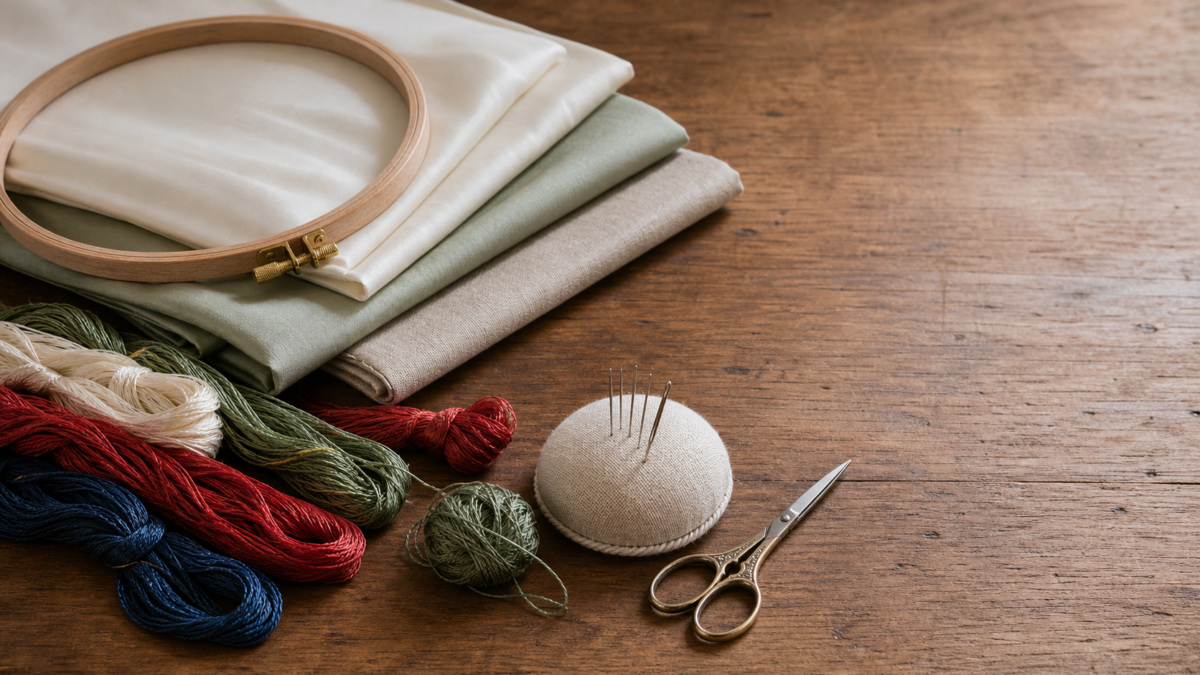
A beginner in Chinese embroidery needs a stable way to support the fabric, a suitable needle, small sharp scissors, thread and a compatible ground fabric. The best choice is not a fixed shopping list: it depends on what the piece will become, how dense or delicate the ground is, and how the selected thread behaves. Start with one coherent combination, then add specialized materials only when a project requires them.
Why a smaller, coherent setup is better
Chinese embroidery has used many tools, threads and grounds across different regions, periods and purposes. That variety can make a beginner believe that a complete traditional kit is required before any study can begin. It is not. The more useful principle is to select equipment that is convenient, simple and appropriate to the intended work.
A display panel, a practice sample and an embroidered household object do not ask the same things of their materials. Neither do a fine silk thread and a firmer cotton thread. Buying several unrelated needles, fabrics and decorative threads may create more uncertainty than possibility. A small group of compatible materials makes it easier to observe what the hand, thread and fabric are doing.
Before choosing anything, ask four questions:
- What will the finished object be used for—study, display or daily use?
- Does the ground fabric need to be opaque, translucent, firm or soft?
- Is the thread fine, divisible, firm, lustrous or metallic?
- Can the needle and support hold that combination without visibly stressing it?
These questions define a relationship. No single tool is “best” outside that relationship.
The essential tools and what each one controls
A hoop or frame supports the ground
The first task of a hoop or frame is to support the fabric so that the working area can be observed and handled consistently. A portable hoop may suit a small study, while a larger frame may be more appropriate when the design, fabric or working area demands broader support. Traditional Chinese practice includes several forms of frames and stands, but a beginner does not need all of them at once.
Look for smooth surfaces, secure fittings and a size appropriate to the planned work. The support should not abrade the ground or encourage repeated crushing of finished areas. Exact mounting method and working tension matter greatly in practice, but they are best learned through demonstration because they change with the fabric and the form of embroidery.
The needle is the meeting point of thread and fabric
A needle must carry the selected thread while passing through the ground without creating unnecessary damage. A needle that is too large for a delicate fabric can leave obvious openings. One that is too fine for a thicker or less flexible thread can cause abrasion, fraying or uncomfortable resistance.
Needle choice therefore follows the fabric structure, thread thickness and intended stitch family. This is more reliable than choosing by a universal number alone. Beginners can first compare whether the eye accepts the thread comfortably and whether the needle passes through a test area cleanly. Precise sizes and technique-specific combinations belong to supervised practice, where the result can be checked rather than guessed.
Small, sharp scissors protect the work
Embroidery scissors are used for controlled thread cutting, not for forcing or pulling material. A small, sharp pair gives better access and reduces ragged ends. Straight and curved tips serve different studio needs; neither is automatically superior. What matters at the beginner stage is that the blades meet cleanly, the tool is comfortable to control and it is reserved for thread work.
Choosing threads by behavior, not appearance alone
Silk thread
Silk is central to many Chinese embroidery traditions because its surface can reflect light with remarkable subtlety. Some silk threads can also be divided into finer elements, extending the range of visual effects. These qualities do not make silk ideal for every object: it is sensitive to abrasion, strong light and unsuitable washing. A practice or display context may therefore call for different decisions from a frequently handled textile.
Gold and silver threads
Metallic threads create brilliance and relief, but their structure and surface are less forgiving than ordinary soft embroidery thread. They are often secured on the surface rather than repeatedly drawn through the ground. For an introduction to their visual role, see Gold and Silver Thread Couching in Chinese Embroidery. Exact couching intervals, turns and edge control are reserved for guided study.
Cotton and modern sewing threads
Cotton is generally firmer and more washable than silk and can make sense with cotton or linen grounds, especially where durability matters. Modern sewing threads provide strength and a broad color range, and may also serve supporting roles in certain embroidery structures. These materials are not merely substitutes: each produces a different surface, line and relationship with the ground.
The ground fabric is part of the image
The fabric beneath embroidery is not an invisible background. Its weave, weight, sheen, color and transparency affect both the making process and the final image. Satin, damask, plain-woven silk, silk gauze, cotton and linen-based grounds have all been used for different purposes. A translucent ground can be important for work intended to be seen from both sides; a firmer opaque ground may support a different scale or function.
Three compatibility checks are useful before committing to a project:
- Structure: Is the weave stable enough for the intended density and thread?
- Surface: Does the ground compete with, soften or support the thread’s sheen?
- Purpose: Can the material tolerate the expected handling, display and care conditions?
Testing a small, separate sample can reveal puckering, visible needle openings, thread abrasion or an unexpected color relationship before valuable material is committed. The sample is for diagnosis, not a full substitute for learning how to mount and control the ground.
Common starter mistakes
The first mistake is buying by prestige: the most expensive silk, the finest needle or the largest frame is not automatically the most suitable. The second is mixing materials before understanding their behavior. A delicate ground, a coarse needle and a resistant thread can each be good materials separately yet form a poor system together.
Another mistake is treating color as the only selection criterion. Two threads of similar color can differ in sheen, twist, flexibility and response to light. Finally, beginners sometimes practice on fabric they would be afraid to waste. A modest but representative sample ground encourages observation and correction without turning every decision into a source of anxiety.
A practical learning sequence
Begin with one planned use, one ground and one main thread type. Learn to recognize how those materials respond before expanding the kit. Next, compare one variable at a time—for example, the same thread on a different ground, or a different thread on the same ground. This creates useful material knowledge without requiring a large collection.
The public principles in this guide help you make a sensible first selection. The hand skills that turn the selection into stable embroidery—mounting, tension, starting and finishing, stitch order and the control of divided silk—depend on demonstration and individual correction.
Continue with structured practice
For an overview of major stitch families, read Chinese Embroidery Stitches: A Beginner’s Guide. If you want to learn how tools and materials are prepared and controlled in actual practice, visit Classes & Courses. Course instruction can show the choices that text alone cannot safely standardize: exact setup, hand position, material preparation, tension and project-specific troubleshooting.
Leave your comment
Related posts